
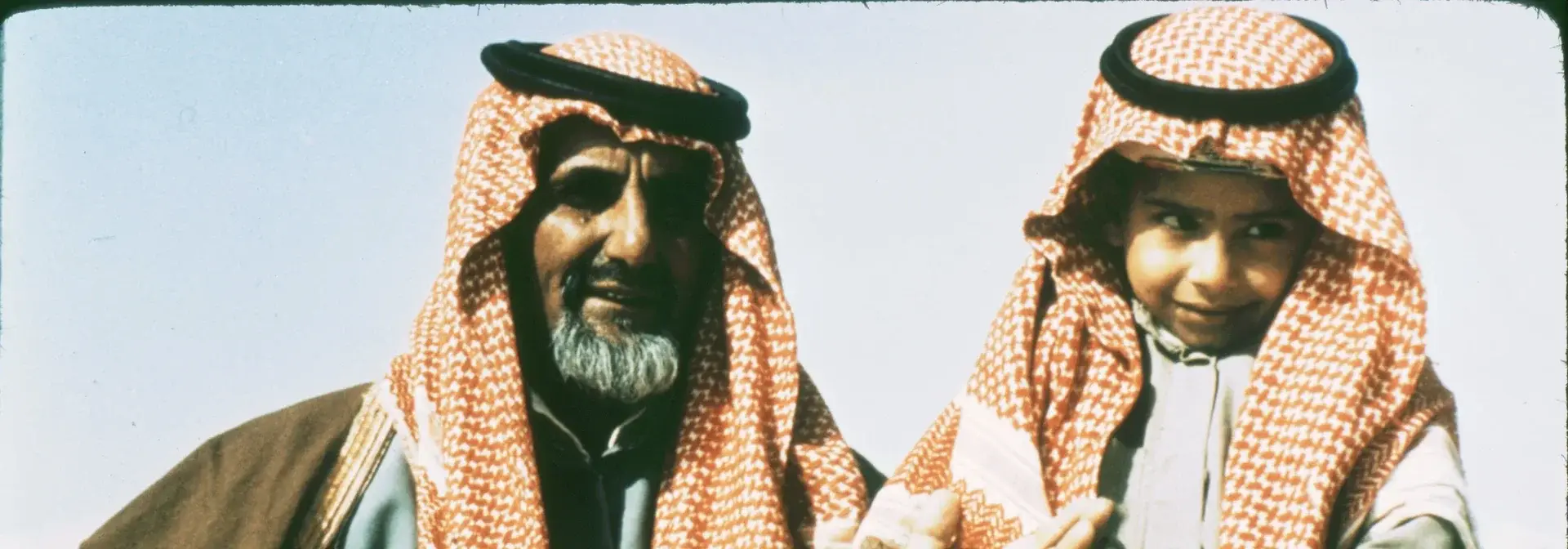
Overview
Saudi traditional dress is a clothing heritage that expresses the identity of the Kingdom of Saudi Arabia and the diversity of its environments, and the competent bodies are keen to document it and to highlight its features, history, and arts within a comprehensive project for the documentation of traditional national dress.[1]
Men's Saudi dress rests on the thobe, the agal, and the ghutra, and it is adorned with the bisht and the daqlah on major occasions, while women's dress varies from one region to another, among it the munaykhal thobe, the mushallal thobe, the darra'a, and the kartah.[2][9]
Official Documentation of Dress
The King Abdulaziz Foundation for Research and Archives launched its specialised publication "Saudi Traditional Dress.. Central Region" on 24 October 2023, corresponding to 9 Rabi' al-Thani 1445 AH; it is the first edition in a series covering all regions of the Kingdom, and the other editions take in the dress of the east, the south, the north, and the west of the Kingdom, alongside a special edition on the most prominent models of arts and designs in Saudi traditional dress in general.[1]
The Fashion Commission organised on 24 March 2024 an open meeting on "traditional and heritage dress", which discussed the importance of Saudi heritage, how it is reflected in traditional dress, and the importance of preserving it; and the Ministry of Culture launched on 20 February 2025 the "Hulat al-Tasees" competition to document the dress of Founding Day by sharing photographs of members of society wearing the dress of that defining day in the history of the Kingdom, in accordance with the Founding Day dress guide, with total prizes of 100,000 Saudi riyals distributed among 50 winners.[3][4]
The Agal in Saudi Dress
The agal is one of the most prominent components of men's Saudi dress: it sits on the head above the shemagh or the ghutra, comes in different types that begin with the threads of its making and extend to its different sizes, and forms a cultural identity for Saudis.[5]
Among its types is the muqassab agal, a symbol of Saudi identity that takes a hexagonal shape whose parts are joined by gilded separators of wire thread, and it is prominent on national occasions; the black circular agal is the most widely used at present, its common sizes range between 45 and 56 in line with the size of the head, its thickness is between 4.5 and 5.6, and its circumference reaches 110 cm.[5][6]
Agal Faisal and the Craft of Taif
Taif governorate was known for making the "muqassab" agal, known at present as "Agal Faisal", which King Faisal bin Abdulaziz was known to wear, and heritage dress and clothing in Taif have been historically connected for three centuries in their details, colours, method of sewing, and manner of wearing, until at present they form the culture of its people; Taif has been known for its inhabitants practising the craft of making or sewing agals.[6]
Making the Agal and Its Materials
The agal is made from natural materials and others that are synthetic, and natural wool thread is among the most widespread types for the stability it gives on the head, its lustre, and its quality of form, alongside other materials that include velvet and silk, while nylon is used in making the synthetic agal.[8]
Making an agal takes more than half an hour and passes through successive stages that begin with the cotton padding and its covering with a black layer and then the wrapping of the outer thread; the roots of this craft extend for thousands of years, as documents record ancient statues in which the features of the agal appear clearly, dating to between 2000 and 4000 BC.[7][8]
Regional Dress for Men and Women
Traditional dress differs from one region to another: in the Central Region men wear the thobe, the agal, and the ghutra, and they wear the daqlah and the bisht on major occasions, while women wear the "mihnaq" garment and place the "hamah" on the head on occasions, in addition to the shaylah and the belt.[9]
In the Southern Region men wear the samadah, the jubbah, the mihzam, and the dagger, while women wear the shaylah and the sidrah.[9]
Women's Dress in the Regions of the Kingdom
The Central Region was known for the multiplicity of its women's dress, among it the "munaykhal" thobe, which is distinguished by its width and the ample cut of its sleeves, and the "mushallal" thobe, marked by width, lightness, and ornament, which was usually worn over the ordinary thobe.[2]
The darra'a was also known among the women of the Central and Northern regions and took many types, among them the Indian darra'a, the um wardah darra'a, so named for its embroidery with forms of the rose, alongside the zari darra'a, the kit darra'a, the kinawi darra'a, the qirmiz darra'a, and the um tafat darra'a; and in Madinah traditional dress was known, most prominently the "kartah", a thobe that extends from the neck to the feet with long sleeves and varies in its colours and fabrics, and the choice of its colours in some styles of dress was linked to the age of the woman wearing it, so light colours were known among older women while young girls wore the silk kartah of bright colours, and among the bride's dress is the "shar'ah madini", a dark pink thobe of many designs, adorned with gold threads of qasab and kantir.[2]
Frequently Asked Questions
Q: What are the most prominent components of men's Saudi dress? A: The thobe, the agal, and the ghutra, to which the bisht and the daqlah are added on major occasions.[5][9]
Q: What is the muqassab agal? A: A type of agal that represents a symbol of Saudi identity, taking a hexagonal shape whose parts are joined by gilded separators of wire thread, and it is prominent on national occasions.[5]
Q: What are the most prominent women's dress in the Central Region? A: The "munaykhal" thobe and the "mushallal" thobe, alongside the darra'a in its types.[2]
Q: What is the "shar'ah madini"? A: A dark pink thobe among the bride's dress in Madinah, of many designs and adorned with gold threads of qasab and kantir.[2]
Q: How is Saudi traditional dress documented? A: Through the project of the King Abdulaziz Foundation for publications on the dress of the regions of the Kingdom, and the "Hulat al-Tasees" competition launched by the Ministry of Culture.[1][4]
Conclusion
The competent bodies in the Kingdom document Saudi traditional dress as part of the national heritage that is preserved.[1] Related topics on the platform include Al-Sadu, Al-Qatt Al-Asiri, Saudi Ardah, and Janadriyah Festival, and the agal craft is linked to cities such as Taif and Riyadh.
Related topics
- HistoricAl-Sadu WeavingAl-Sadu is a handweaving craft based on weaving threads of camel hair, goat hair and sheep wool. It is known among the people of the Kingdom of Saudi Arabia, who used it to make hair houses, carpets, daily necessities and tribal clothing, and its weaving was registered on the Representative List of the Intangible Cultural Heritage at UNESCO.
- TopicAl-Qatt Al-AsiriA traditional art of painted wall decoration in Asir homes, practised by women, added to UNESCO's Representative List of the Intangible Cultural Heritage in 2017.
- Performing arts and intangible heritageSaudi ArdahA collective performing tradition, also known as Najdi ardah, combining chanted poetry, drumming and movement at social and national occasions.
- HistoricAl-Janadriyah FestivalAl-Janadriyah Festival is the National Festival for Heritage and Culture in the Kingdom of Saudi Arabia. Its beginnings go back to 1405 AH, corresponding to 1985, and it is held at the Heritage Village in Al-Janadriyah to showcase heritage, culture and the arts with international participation. The Ministry of the National Guard organised it over the past decades, and the task of holding and organising it later passed to the Ministry of Culture.
- RegionTaif CityTaif City is a Saudi city in the west of the Kingdom, known as the “City of Roses and Bride of Saudi Summer Resorts” for its moderate summer climate and its natural views in Al-Shafa and Al-Hada. It contains more than 700 rose farms, farms of seasonal fruits, and cultural and historical landmarks including Souq Okaz and Shubra Palace.
- CityRiyadh (city)Capital of Saudi Arabia and seat of the Riyadh Region emirate, beside Diriyah, home to Qasr Al-Hukm and Masmak Palace.
Sources & references
- Saudi Press Agency (SPA) - Launch of the "Saudi Traditional Dress.. Central Region" edition and the project to document traditional national dress
- Saudi Press Agency (SPA) - Traditional women's dress in the regions of the Kingdom
- Saudi Press Agency (SPA) - The Fashion Commission's meeting on traditional and heritage dress
- Saudi Press Agency (SPA) - The "Hulat al-Tasees" competition
- Saudi Press Agency (SPA) - The agal and its importance in Saudi dress
- Saudi Press Agency (SPA) - The agal craft in Taif and Agal Faisal
- Saudi Press Agency (SPA) - The roots of the agal craft
- Saudi Press Agency (SPA) - The materials and stages of making the agal
- Saudi Press Agency (SPA) - The dress of the Central and Southern regions