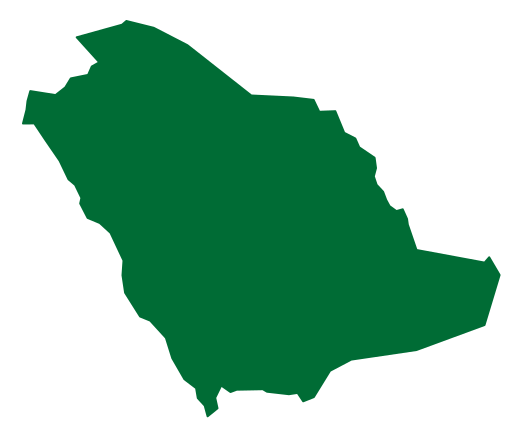

Restoring Saudi rule in 1824
The Second Saudi State was the polity re-established by Imam Turki bin Abdullah after the first state's end in Diriyah in 1818. He recovered Riyadh and expelled Ottoman-Egyptian forces and their local allies in 1824. Saudipedia and English Wikipedia agree on this year as the second state's beginning; the latter also calls it the Emirate of Najd. This was not a return to Diriyah as capital, but a new phase centred on Riyadh.
Riyadh replaces Diriyah as capital
Turki bin Abdullah chose Riyadh as his seat of government, while Diriyah had suffered destruction and population loss after the events of 1818. The capital's centre was associated with Qasr al-Hukm and the nearby congregational mosque. The Royal Commission for Riyadh City states that the palace served as the ruler's headquarters and a meeting place with residents from Imam Turki's reign. The second state thus marks a stage in Riyadh's history as a political capital, not simply Diriyah's urban continuation under another name.
Turki and Faisal: succession, interruption and return
Turki bin Abdullah ruled until his death in 1834. His son Faisal bin Turki then recovered power after Mishari bin Abdulrahman's brief control. Faisal faced renewed military intervention from Egypt, and his rule was interrupted in 1838 when he was taken to Egypt. During his absence, Khalid bin Saud and then Abdullah bin Thunayan held power in Riyadh. Faisal returned in 1843, beginning a second reign that lasted until his death in 1865. The years 1834–1865 should therefore not be presented as an uninterrupted reign.
The state's reach and foundations of government
The state was centred on Najd, with rule extending into parts of eastern Arabia, including Al-Ahsa and Qatif. Relationships between the ruler, towns and tribes helped sustain authority, while religious scholars remained important in justice and education and rulers retained the title imam. Government institutions and resources were reorganised during Faisal's second reign. Nevertheless, influence changed over time and was affected by Ottoman intervention and regional competition; the place names do not describe fixed sovereign borders or a map identical to today's Kingdom.
After 1865: rival heirs and Ha'il's rise
Faisal bin Turki's death was followed by succession disputes, particularly between his sons Abdullah and Saud, who exchanged control of Riyadh during the conflict. These divisions allowed Muhammad bin Abdullah bin Rashid, ruler of Ha'il, to expand his influence and intervene in Riyadh. Abdulrahman bin Faisal was the state's last ruler, and its rule ended in 1891 with Al Rashid's ascendancy. Wikipedia associates the endpoint with the Battle of Mulayda, while Saudipedia also describes Abdulrahman's attempted return and setback at Huraymila. The end was the outcome of a sequence of events, not one episode that replaces the rest.
From the state's end to Riyadh's recovery
Abdulrahman bin Faisal and his family left Riyadh and moved through eastern Arabia before settling in Kuwait. Their relocation did not establish a Saudi state in Kuwait; residence there instead formed part of the period preceding his son Abdulaziz's return to Riyadh. Abdulaziz recovered the city in 1902, beginning the third Saudi phase. The transition between 1891 and 1902 shows a break in control of the capital alongside continuity in the family and its political connections.
Image question: is this mosque from the second state's era?
The mosque has a historical connection to the second state's founder, but the photographed building is not its original structure. Saudipedia dates Imam Turki bin Abdullah Mosque's establishment to his reign between 1824 and 1834, rather than to one exact year adopted here. It was rebuilt on its site within the Qasr al-Hukm redevelopment programme, and the modern building opened in 1993. The 2024 photograph illustrates the continuity of the mosque's name and location in the capital. It is a contextual view of a landmark associated with the period, not photographic documentation of nineteenth-century Riyadh.
Sources & references
- Saudipedia: The Second Saudi State (Arabic)
- English Wikipedia: Second Saudi state
- Saudipedia: Unification of the Kingdom of Saudi Arabia (Arabic)
- Saudipedia: Imam Turki bin Abdullah Mosque (Arabic)
- Royal Commission for Riyadh City: Mosques Built by the Commission (Arabic)
- Royal Commission for Riyadh City: Qasr al-Hukm District Development Programme (Arabic)


.jpg)


