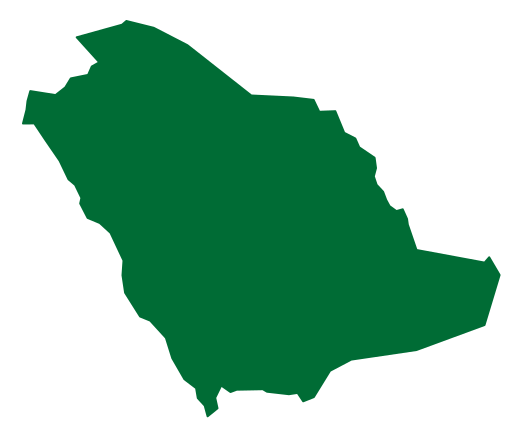

Upbringing and the National Guard
Abdullah bin Abdulaziz was born in Riyadh in 1924 to Fahda bint Asi Al Shuraim. He studied the Quran, religious subjects and Arabic and developed interests in reading and horsemanship. He took command of the National Guard in the 1960s, with his tenure associated with its military and administrative development and educational and medical services. This was a major field of his work before becoming crown prince and king. [1][2]
Crown princeship and accession
Abdullah became crown prince when King Fahd acceded in 1982 and remained in that position until 2005. Following Fahd’s illness in the 1990s, he took on a substantial share of the day-to-day administration of the state. He succeeded Fahd after his death in August 2005. During Abdullah’s reign, Sultan, Nayef and Salman successively served as crown prince, a sequence that explains Salman’s eventual succession. [1][2]
Universities, scholarships and research
The King Abdullah Scholarship Programme began in 2005, while universities and fields of study expanded within the Kingdom. King Abdullah University of Science and Technology opened in 2009 as a graduate and research institution. These projects connected the training of specialists with the establishment of new scientific institutions. Evaluating their results requires evidence about education, research and employment rather than relying solely on stated programme objectives. [1][2]
Dialogue and institutional participation
Abdullah supported national dialogue and initiatives bringing together different religions and cultures. In 2013, thirty women were appointed to the Shura Council, and its rules were amended to reserve at least one-fifth of its seats for women. In Arab diplomacy, he had proposed a peace initiative while crown prince that was adopted at the 2002 Beirut Arab summit. These measures belonged to different domestic and diplomatic contexts and should not be assumed to share identical aims or outcomes. [1][2]
Services, death and succession
The reign included expansions of the Two Holy Mosques and transport and pilgrim-service projects, including the Al Mashaaer railway, which began operating in 2010. Abdullah died in Riyadh on 23 January 2015 and was buried in Al Oud Cemetery. King Salman succeeded him. Studying the reign connects education, public services and institutional changes with the regional circumstances facing Saudi Arabia. [1][2]


