
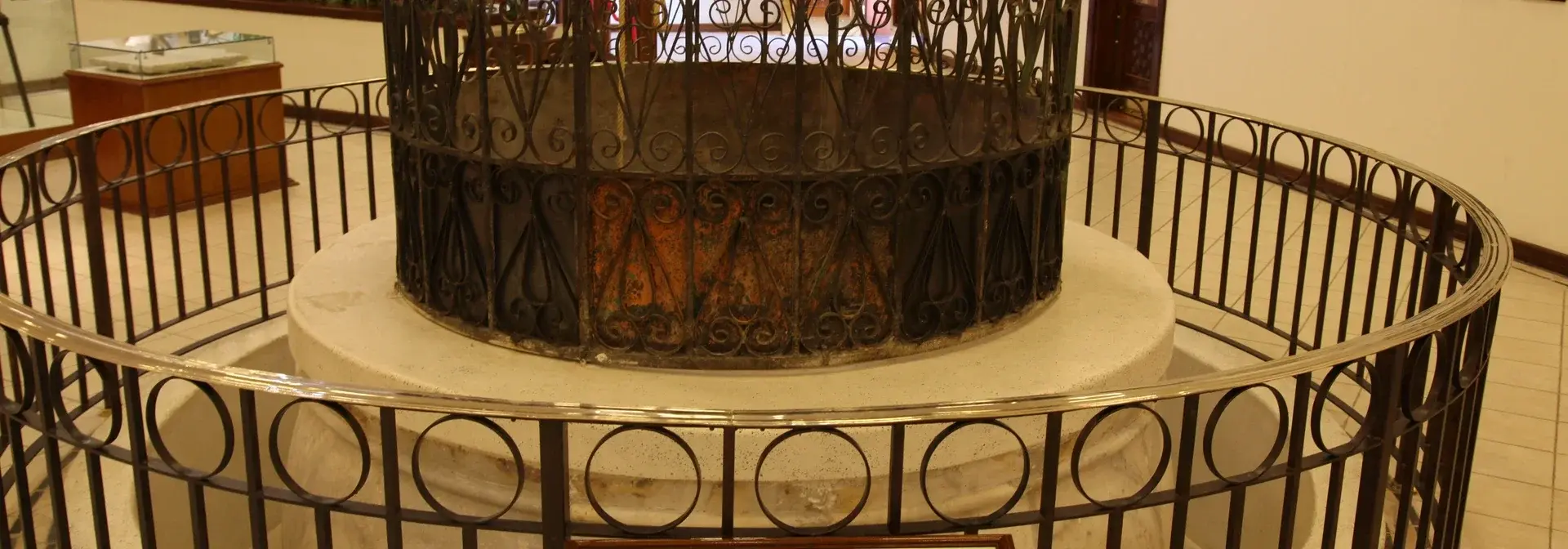
Overview
Zamzam Well lies east of the Kaaba, 21 metres away in the Mataf courtyard of the Grand Mosque, aligned with the Multazam.[1] It reaches a depth of about 30.5 metres, and its internal diameter ranges between 1.08 and 2.66 metres.[2]
The well is the source of Zamzam water, which is pumped, transported, stored and sterilised before it is distributed to those who come to the Grand Mosque, within a system overseen by specialised government bodies in the Kingdom of Saudi Arabia.[1][4]
Location within the Grand Mosque
The well lies in the Mataf courtyard of the Grand Mosque, east of the Kaaba and 21 metres away from it, aligned with the Multazam.[1]
Hydrologically, the well lies in Wadi Ibrahim, which runs through the city of Makkah, the valley to which its water resources are connected.[2] The site of the well was placed beneath the Mataf during expansion works, removing what had constrained those circumambulating.[3]
Dimensions and Geological Composition
The well reaches a depth of about 30.5 metres, with an internal diameter ranging between 1.08 and 2.66 metres.[2] Its body is distributed across two different geological layers.[2]
The upper section, 13.5 metres deep, is cut through the sandy silt of Wadi Ibrahim, while the lower section, 17.0 metres deep, is cut through the basal bedrock known as diorite.[2]
Care of the Well under the Saudi State
Official care for the well began in the reign of King Abdulaziz ibn Abdulrahman Al Saud, who in 1345 AH ordered the construction of a drinking fountain for Zamzam water named the King Abdulaziz Sabeel, and in the following year ordered a second sabeel together with the repair and cleaning of the well and the placing of a cover over it.[3]
In the reign of King Saud ibn Abdulaziz, a pump was ordered to raise Zamzam water and a building for dispensing Zamzam water was established in front of the well, and in 1377 AH the first expansion of the Mataf was carried out, with a unique design in which Zamzam Well was placed beneath the Mataf, removing what had constrained those circumambulating.[3]
King Faisal ibn Abdulaziz then ordered in 1393 AH the construction of a second basement for the well, in the interest of the comfort of the guests of the Most Merciful as they performed their rites, and King Khalid ibn Abdulaziz ordered a full cleaning of the well in which a number of divers took part.[3]
The project of the second Saudi expansion of the Grand Mosque in the reign of King Fahd ibn Abdulaziz included a water system for drinking and drainage, made up of two large pumping units for Zamzam water and several drinking taps, with a pump installed on the level of the second expansion.[3]
In the reign of King Abdullah ibn Abdulaziz, a plant for purifying the well water was established together with a filling and transport plant operating under an automatic control, monitoring and storage system, and the project was named the King Abdullah ibn Abdulaziz Project for Zamzam Water Supply.[3]
In 1439 AH, approval was granted by the Custodian of the Two Holy Mosques King Salman ibn Abdulaziz to complete the works on Zamzam Well and the rehabilitation of its culverts, and five culverts for Zamzam's services were constructed.[3]
Related people
- Kings of Saudi ArabiaKing Abdulaziz bin Abdulrahman Al SaudFounder and first king of Saudi Arabia, Abdulaziz recovered Riyadh in 1902 and led the unification proclaimed in 1932. His reign saw the development of state institutions and the beginnings of the oil industry.
- Kings of Saudi ArabiaKing Saud bin Abdulaziz Al SaudThe Kingdom’s second king and first crown prince after unification, Saud reigned from 1953 to 1964. His reign saw the Ministry of Education, King Saud University and expanding government services.
- Kings of Saudi ArabiaKing Faisal bin Abdulaziz Al SaudThe third Saudi king, Faisal brought extensive experience in foreign affairs and government. His reign included educational expansion, development planning and Saudi participation in the 1973 oil crisis.
- Kings of Saudi ArabiaKing Khalid bin Abdulaziz Al SaudThe fourth Saudi king, Khalid reigned during expanding infrastructure, education and healthcare funded by rising oil revenues. The Gulf Cooperation Council was founded during his reign in 1981.
- Kings of Saudi ArabiaKing Fahd bin Abdulaziz Al SaudThe fifth Saudi king, Fahd acceded in 1982. His reign included the Basic Law of Governance, the Shura Council and provincial laws, expansions of the Two Holy Mosques and the Gulf War.
- Kings of Saudi ArabiaKing Abdullah bin Abdulaziz Al SaudThe sixth Saudi king, Abdullah reigned from 2005 to 2015. His reign saw expanding higher education and scholarships, dialogue initiatives and women’s participation in the Shura Council.
- Kings of Saudi ArabiaKing Salman bin Abdulaziz Al SaudThe seventh Saudi king, Salman acceded in 2015 after serving in Riyadh, defence and the crown princeship. His reign has included Vision 2030 and administrative, economic and social changes.
Pumping, Transport and Storage
Raw water is pumped from Zamzam Well by two large pumps with a capacity of 360 cubic metres per hour, carrying the water from the well to the King Abdullah Project for the Development of Zamzam Water, which handles storage and sterilisation and then sends the water to the Zamzam reservoir station and to the King Abdulaziz Sabeel station.[3]
The pumping process runs through raw-water transport lines about 4 kilometres long, made of a non-corrosive material.[3]
The well water is stored in tanks with a capacity of 5000 cubic metres, divided into two parts and built of reinforced concrete, and is then transferred to the purification station for filtration and the production of highly pure and sterilised water through an integrated filter system, after which the treated water passes to the Kadi tanks with a capacity of 10000 cubic metres.[1]
Zamzam Water Supply within the Grand Mosque
The Grand Mosque receives daily about one and a quarter million litres from the King Abdullah ibn Abdulaziz Project for Zamzam Water Supply, and the containers distributed throughout the mosque, its courtyards and its external facilities are filled five times a day.[1]
The number of containers in the Grand Mosque reaches more than 20000, increasing during the blessed month of Ramadan and the Hajj season, alongside the drinking fountains spread through the mosque and the courtyards around it, and the number of Zamzam water taps reaches 1073 in addition to 223 barrels.[5]
Quality and Sterilisation
The Saudi Geological Survey established the Zamzam Studies and Research Centre, which supervises in full the extraction and sterilisation of Zamzam water and monitors everything relating to its quality and quantity, with the aim of preserving the sustainability of the water and the resources that feed it.[4]
Zamzam water is sterilised with ultraviolet light without the addition of any chemical substances, to ensure that the colour, taste and smell of the water do not change, and the level of sterilisation of bacteria and viruses reaches 99.77%, with one kilowatt of electricity sterilising 12000 gallons of water.[5]
Frequently Asked Questions
Q: Where is Zamzam Well located? A: East of the Kaaba, 21 metres away in the Mataf courtyard of the Grand Mosque, aligned with the Multazam.[1]
Q: How deep is Zamzam Well and what is its internal diameter? A: It reaches a depth of about 30.5 metres, and its internal diameter ranges between 1.08 and 2.66 metres.[2]
Q: What is Zamzam Well composed of geologically? A: Its upper section, 13.5 metres deep, lies in the sandy silt of Wadi Ibrahim, and its lower section, 17.0 metres deep, lies in the basal bedrock known as diorite.[2]
Q: How is Zamzam water sterilised? A: It is sterilised with ultraviolet light without chemical substances, and the level of sterilisation of bacteria and viruses reaches 99.77%.[5]
Q: What are the most prominent works of care for the well in the Saudi era? A: The King Abdulaziz Sabeel in 1345 AH, placing the well beneath the Mataf in the first expansion of the Mataf in 1377 AH, a second basement in 1393 AH, the drinking-water system in the second expansion, the King Abdullah Project for Zamzam Water Supply, and the completion of the well's works and the rehabilitation of five culverts in 1439 AH.[3]
Related topics
- HistoricThe Grand Mosque (Al-Masjid Al-Haram)The Grand Mosque (Al-Masjid Al-Haram) is the mosque at the centre of which stands the Kaaba in Makkah, and successive states and restorations followed upon its construction across the ages. In the Saudi era it witnessed major expansions and construction works, most notably the Third Saudi Expansion and the raising of the capacity of the Mataf and the courtyards.
- RegionMakkah CityMakkah City is a Saudi city in the west of the Kingdom of Saudi Arabia, home to the Grand Mosque and the qibla of Muslims, with a history of more than four thousand years. The city and the Holy Sites are seeing continuous development to raise the standard of services provided to pilgrims and Umrah performers under Saudi Vision 2030.
Sources & references
- Saudi Press Agency (SPA) — Zamzam water supply system in the Grand Mosque
- Saudi Press Agency (SPA) — Zamzam Well: depth, diameter and geological composition
- Saudi Press Agency (SPA) — the care of the kings for Zamzam Well and its water pumping system
- Saudi Press Agency (SPA) — the Zamzam Studies and Research Centre at the Saudi Geological Survey
- Saudi Press Agency (SPA) — sterilisation of Zamzam water and the supply system in the Grand Mosque