

Overview
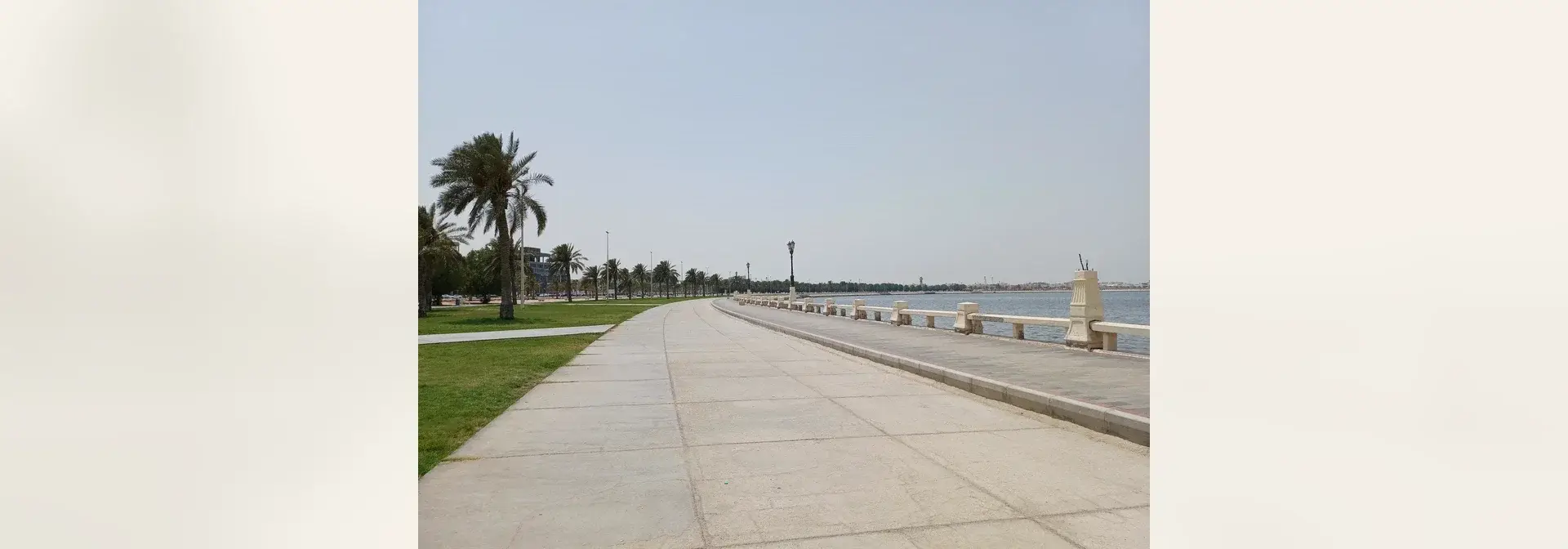
Dammam Corniche is a waterfront on the Arabian Gulf coast in Dammam. It is the longest waterfront in the Kingdom at about 4.5 km, and its construction cost more than SAR 90 million.[1]
The waterfront extends for about 4.5 km, with an 8 km promenade and an area of about 500,000 square metres, making it a broad destination for recreation and walking for the residents of the Eastern Province and its visitors.[2]
Location and Area
The waterfront lies in the city of Dammam on the Arabian Gulf coast. It covers about 500,000 square metres and is accompanied by a promenade running 8 km along the coast.[2]
At the centre of the waterfront is a main open plaza, circular in shape, standing 6 metres above sea level and covering 17,000 square metres, and two towers rise there to a height of 23 metres, designed in a style inspired by Gulf heritage.[2]
The Longest Waterfront in the Kingdom
The Dammam waterfront is classified as the longest waterfront in the Kingdom. It is about 4.5 km long, and the Eastern Province Municipality manages its facilities and their development.[1]
The waterfront is among the largest waterfronts in the Kingdom, extending over a broad area that allows visitors to walk, take recreation and look out over the sea through open spaces and public facilities along the coast.[2][7]
Opening and Development
The Eastern Province Municipality announced on 26 June 2007 that its preparations were complete for the opening of the waterfront in Rajab 1428 AH.[1] By 2014 the waterfront had reached 4.5 km in length, with an 8 km promenade and an area of about 500,000 square metres, along with a main plaza and two towers.[2]
In 2015 a service office for waterfront visitors was opened, a beautification murals project was carried out in King Abdullah Park, and the East Dammam Municipality removed 47 damaged boats from the waterfront with the support of government agencies.[7][8][9]
In 2018 the Municipality organised a workshop on "Rehabilitating Residential Neighbourhoods" within the Humanising Cities Initiative and the improvement of the urban landscape, linking the city centre to the Corniche.[10]
Al-Murjan Island
The waterfront includes Al-Murjan Island, an artificial tourist island built in 1991.[3] At the centre of the island stands a tower 30 metres high, designed in the manner of Islamic towers, and an iron wall with an aesthetic character, connected to concrete columns, runs for 2,500 metres around it.[4]
The Municipality is studying offering the island for investment at no more than 5% of its total area, while developing 95% of it with services for its visitors, and the investment opportunity set a building ratio of 5% to make the largest possible area available to visitors and recreation-goers free of charge.[3][4]
In 2022 the Municipality offered varied investment opportunities on the island, and in 2023 it announced the opening of the technical bid envelopes for its operation and development project.[5][6]
Facilities and Services
The Corniche includes a service office for waterfront visitors, alongside King Abdullah Park, which saw a beautification murals project, and open spaces for recreation along the coast.[7][8]
The circular plaza, the two towers and the walking paths allow recreation and walking along the coast for the residents of Dammam and visitors to the region.[2]
Frequently Asked Questions
Q: What is Dammam Corniche? A: A waterfront on the Arabian Gulf coast in the city of Dammam, regarded as the longest waterfront in the Kingdom at about 4.5 km.[1]
Q: How large is the Corniche and how long is its promenade? A: About 500,000 square metres, and it includes an 8 km promenade.[2]
Q: What are the most prominent landmarks of the Corniche? A: A circular plaza rising 6 metres above sea level and covering 17,000 square metres, two towers 23 metres high, and Al-Murjan Island.[2][3]
Q: When was Al-Murjan Island built? A: In 1991; it is an artificial tourist island.[3]
Q: What is the tower at the centre of Al-Murjan Island? A: A tower 30 metres high in the manner of Islamic towers, and an iron wall 2,500 metres long surrounds the island.[4]
Related topics
- RegionDammam CityDammam City is a Saudi city in the Eastern Province on the coast of the Arabian Gulf. Its metropolitan area takes in Dammam City together with the governorates of Al-Khobar and Al-Bayda and the Dhahran centre; within it stand King Abdulaziz Port and King Fahd International Airport, and the King Fahd Causeway links the Kingdom of Saudi Arabia with the Kingdom of Bahrain. In 2026 the Dammam metropolitan area joined the Global Quality of Life Initiative.
- RegionEastern ProvinceA large eastern Saudi region administered from Dammam, combining Gulf cities, the oases of Al Ahsa and Qatif, desert areas, energy industries and maritime commerce.
- RegionAl KhobarAl Khobar is a coastal city in the Eastern Province of Saudi Arabia, on the shore of the Arabian Gulf, distinguished by its coastal position and a corniche chain that runs along the shore. Its waterfront has seen a succession of development projects, most notably the North Al Khobar Corniche, the Al Khobar Walk, Al Khobar Terrace and the extension of the Al Sadfa Corniche.
- RegionDhahran CityDhahran City is a city in the Eastern Province of the Kingdom of Saudi Arabia. Its name is bound up with the story of oil discovery in the Kingdom and with its hosting of the world's largest oil company, and it is home to the headquarters of Saudi Aramco, King Fahd University of Petroleum and Minerals and the King Abdulaziz Center for World Culture (Ithra).
- HistoricAl Khobar CornicheAl Khobar Corniche is a waterfront on the coast of the Arabian Gulf in Khobar Governorate in the Eastern Province, redeveloped in successive phases that covered the southern and northern corniches, and bringing together destinations, facilities, green areas, pedestrian paths and public events.
Sources & references
- Saudi Press Agency (SPA) — Eastern Province Municipality: the Dammam waterfront is the longest waterfront in the Kingdom
- Saudi Press Agency (SPA) — the Dammam waterfront: 4.5 km and an 8 km promenade
- Saudi Press Agency (SPA) — Al-Murjan Island on Dammam Corniche
- Saudi Press Agency (SPA) — an investment opportunity on Al-Murjan Island
- Saudi Press Agency (SPA) — varied investment opportunities on Al-Murjan Island
- Saudi Press Agency (SPA) — opening of the technical bid envelopes for the Al-Murjan Island project
- Saudi Press Agency (SPA) — a service office for Dammam waterfront visitors
- Saudi Press Agency (SPA) — the beautification murals project in King Abdullah Park
- Saudi Press Agency (SPA) — removal of damaged boats from Dammam Corniche
- Saudi Press Agency (SPA) — workshop on rehabilitating residential neighbourhoods within the Humanising Cities Initiative