
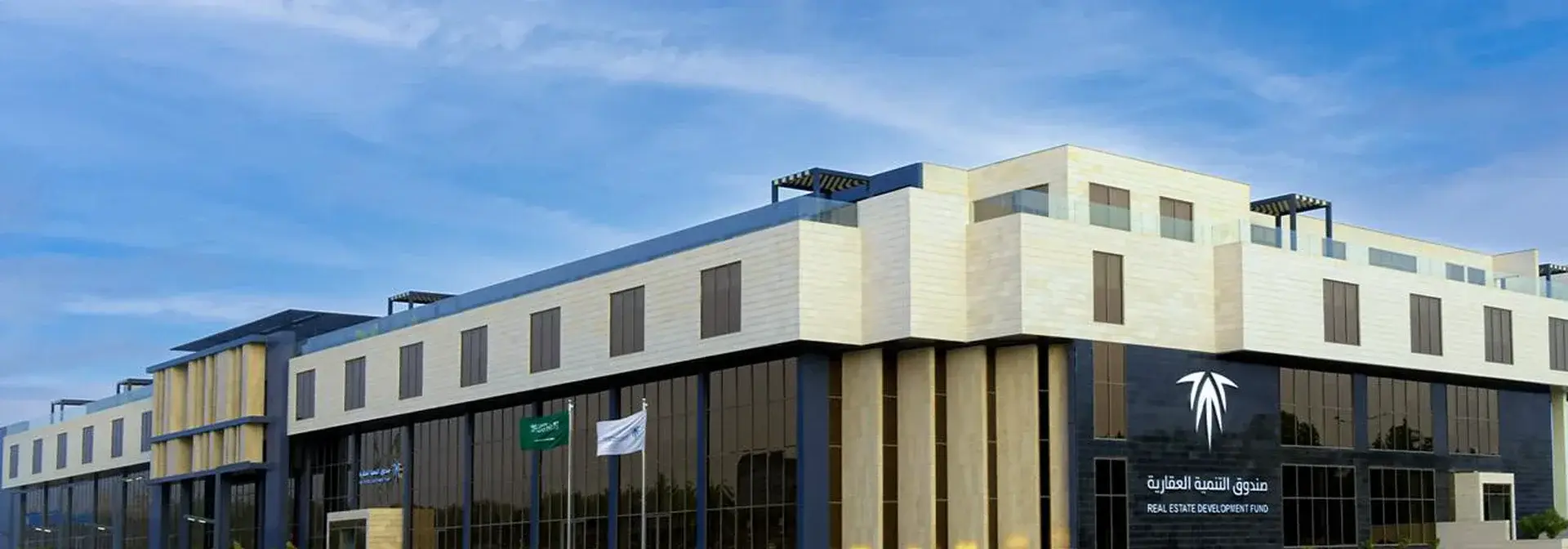
Overview
The Real Estate Development Fund is a Saudi government fund established in 1394 AH, corresponding to 1974, that works to enable citizens to own their homes.[1][4]
The Fund was mandated to lend to individuals and institutions for the establishment of real-estate projects for private or commercial use, through long- and medium-term interest-free loans, and after June 2017 it moved to a model of subsidised real-estate financing in partnership with the housing ecosystem and the private sector.[2][4]
Establishment and Founding
The Lending Mandate and Development Role
The Fund's mandate rested on lending to individuals and institutions for the establishment of real-estate projects for private or commercial use, and it contributed to shaping the features of housing development in the Kingdom through long- and medium-term interest-free loans.[2]
It disbursed 255 billion riyals from its establishment up to fiscal year 1436 AH, out of 587 billion riyals disbursed by government funds and government lending programmes, equivalent to 43% of the total expenditure of the specialised government development funds.[2]
In 2017 its services extended to 4,300 cities, governorates and centres in the Kingdom.[2]
The New Statute and Independence
The Council of Ministers approved a new statute for the Fund comprising 18 articles, announced on 21 Jumada al-Ula 1442 AH, corresponding to 5 January 2021, replacing the statute issued by Royal Decree No. (M/23).[1]
The new statute grants the Fund independence and flexibility in partnership and in providing financing and housing solutions, which strengthens its role in the housing finance system.[1]
Transition to Housing Support
The transition began in June 2017 in partnership with the housing ecosystem and the private sector, in a phase marked by ease of procedures, during which the Fund launched the subsidised real-estate loan programme at a rate of up to 100%.[4]
After the programme was launched, the Fund announced list (zero) of the waiting lists in early 2020, after those lists had exceeded 480,000 beneficiaries with a waiting period ranging between 12 and 15 years.[4]
Impact on Home Ownership
The real-estate financing market in the Kingdom grew by 133% in the first quarter of 2019 compared with the corresponding period of the previous year, and the Fund's share of subsidised real-estate financing reached 84% of the total market in the same quarter.[3]
The Fund enabled about 500,000 Saudi families across the regions of the Kingdom from June 2017 until the end of the first quarter of 2021, compared with about 860,000 beneficiaries over 40 years since its establishment, so that the total number of families enabled since its establishment exceeded 1.3 million families.[4]
This contributed to raising citizens' home ownership from 47% in 2016 to 60% at the end of 2020, exceeding the target by eight points, within the target of the Housing Programme under Saudi Vision 2030 to raise the rate to 70%.[4]
Services and Financing Partnerships
On 9 Rabi' al-Thani 1440 AH, corresponding to 16 December 2018, the Fund launched the “Real Estate Advisor” service, which carries out a comprehensive analysis of the beneficiary's credit standing and introduces him to the real-estate financing options available with financing institutions before he approaches them.[5]
On 1 Dhu al-Qi'dah 1444 AH, corresponding to 21 May 2023, the Fund signed two framework agreements with Bank Albilad and the Saudi British Bank “Al-Awwal” to finance the updated housing support packages.[6]
The programme provides immediate non-refundable support of up to 150,000 riyals on off-plan sale products, ready housing units and self-build, with in-kind support for housing units under construction, and the State bears the real-estate transaction tax on the citizen's first home for an amount not exceeding one million riyals of the purchase value of the home.[6]
Frequently Asked Questions
Q: When was the Real Estate Development Fund established and under which statute? A: It was established in 1394 AH, corresponding to 1974, and its first statute was issued by Royal Decree No. (M/23) dated 11/6/1394 AH.[1]
Q: What is the Fund's new statute? A: A statute of 18 articles announced on 5 January 2021, granting the Fund independence and flexibility in partnership and in providing financing and housing solutions.[1]
Q: How much support is provided in the updated housing support packages? A: Immediate non-refundable support of up to 150,000 riyals, with the State bearing the real-estate transaction tax on the citizen's first home for an amount not exceeding one million riyals of the purchase value.[6]
Q: What impact has the Fund had on citizens' home ownership? A: The rate rose from 47% in 2016 to 60% at the end of 2020.[4]
Q: How did the Fund's work change after June 2017? A: It moved to a model of subsidised real-estate financing in partnership with the private sector, and announced list (zero) in early 2020.[4]
Conclusion
The Fund's capital reached 191 billion riyals, it disbursed 255 billion riyals up to fiscal year 1436 AH, and it enabled more than 1.3 million families to own their homes.[2][4]
Its activity is integrated with other national funds and programmes, including Saudi Industrial Development Fund, National Development Fund, Agricultural Development Fund and Public Investment Fund.
Related topics
- TopicSakani ProgramThe Sakani Program is one of the housing system programs in the Kingdom of Saudi Arabia and one of the realization programs of Saudi Vision 2030. It was launched by the Ministry of Housing in early 2017 to enable Saudi families to own their first home through a range of housing and financing solutions, and it continues to expand the housing supply and raise the Kingdom's home ownership rate.
- TopicNational Development FundThe National Development Fund is a national development institution established by Royal Order No. (A/13) dated 13/01/1439 AH to provide general supervision over the development funds and banks in the Kingdom. It is organisationally linked to the Prime Minister, and through its strategy it aims to inject more than 570 billion riyals into real GDP by 2030.
- TopicSaudi Industrial Development FundThe Saudi Industrial Development Fund is a government fund established in 1394 AH (1974) with capital of SAR 500 million to develop the local industrial sector. Its capital increased in stages until it reached SAR 105 billion in January 2019, and today it covers the industry, mining, energy and logistics services sectors.
- TopicThe Public Investment FundThe Public Investment Fund is a Saudi fund established in 1971 CE/1391 AH under Royal Decree No. (M/24), and linked in 1436 AH/2015 CE to the Council of Economic and Development Affairs. The assets it manages exceed SAR 3.4 trillion, and its activity spans three investment portfolios and giga-projects including NEOM, Qiddiya, the Red Sea, Roshn, and Diriyah.
- National visions and programmesSaudi Vision 2030: A Framework for TransformationAn introduction to Saudi Vision 2030, its social, economic and institutional themes, and the relationship between implementation programmes, long-term targets and measured results.
- TopicNational Transformation ProgramThe National Transformation Program is the first executive programme of Saudi Vision 2030, launched in June 2016 to be the largest of the Vision's realisation programmes in terms of the strategic objectives assigned to it. The Program works to achieve 34 of the Vision's 96 objectives through more than 313 initiatives led by seven ministries and more than 50 participating entities.
- TopicAgricultural Development FundThe Agricultural Development Fund is a Saudi government institution with an independent legal personality and financial and administrative autonomy. It is organizationally affiliated with the National Development Fund and headquartered in Riyadh. The Fund supports sustainable agricultural development and food security through concessional loans and credit facilities, and it originated from the Saudi Arabian Agricultural Bank, established in 1382 AH (1963).