
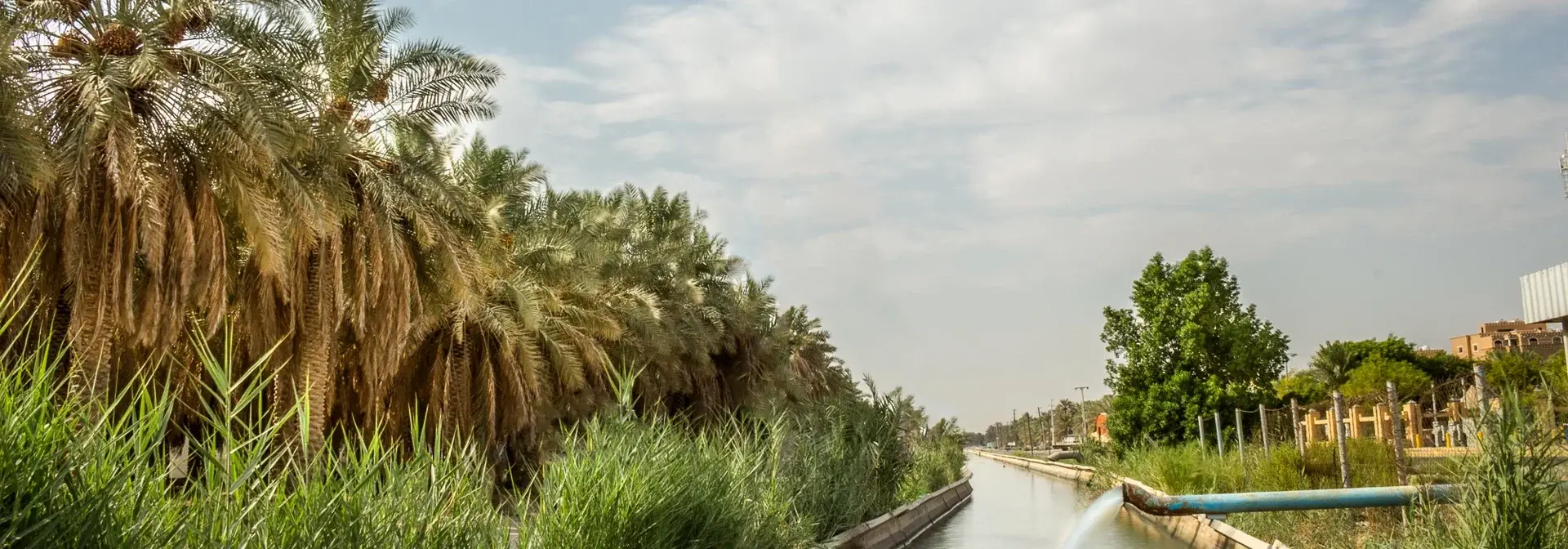
Overview
Aflaj is a traditional irrigation system in the Kingdom of Saudi Arabia that conveys water from springs, wellsprings and channels to agricultural land, and the buried-channel system known locally as Al-Kharaz in Aflaj Governorate in the Riyadh region is among its most prominent forms.[3]
The Al-Ahsa Oasis in the Eastern Province is one of the broadest models in the Arabian Peninsula based on springs, channels and streams, and its irrigation systems developed in stages until the projects converting open channels into closed pipes reached a wide scope serving thousands of farms.[1][5][7]
The Buried-Channel System (Al-Kharaz)
Aflaj Governorate in the Riyadh region is distinguished by an irrigation system of buried channels known locally as Al-Kharaz, which is a unique model of a water, agriculture and irrigation management network in the Arabian Peninsula.[3]
The system is based on a main natural spring from which small channels extend, used for ventilation, lighting and maintenance; all these channels are connected to one another at almost equal intervals, and some of them remain in their original condition.[3]
Qusayrat Ad in Aflaj Governorate
The Qusayrat Ad site in Aflaj Governorate contains the remains of buildings, tombs, springs, channels and historic irrigation systems, reflecting the continuity of agricultural activity and the ancient irrigation systems at the site.[3]
A team from the Heritage Commission inspected the site as part of the Commission's tours to survey archaeological sites across the regions of the Kingdom and to assess their needs for research, archaeological survey, rehabilitation and protection, in Jumada al-Akhirah 1442 AH.[3]
Aflaj and Springs in the Al-Ahsa Oasis
The Al-Ahsa Oasis took its name from the nature of its geographical land, the abundance of its water and its freshness; it once contained more than thirty naturally flowing springs that supplied the agricultural oasis with water through a group of springs and streams that formed the traditional irrigation network in Al-Ahsa before the implementation of the irrigation and drainage project.[1]
The earliest date of human settlement in Al-Ahsa goes back to the fifth millennium BC; the region knew diverse agricultural methods and advanced irrigation systems, and irrigation channels were discovered extending along the eastern parts of the oasis, carrying water from springs and wellsprings to agricultural land.[9]
The springs of Al-Ahsa reached the peak of their production in 1967, producing 220 million cubic metres of water in a single year, or about 600,000 cubic metres per day.[2]
Water Springs in the Kingdom
Water springs in the Kingdom are classified geologically into six types: three in the Arabian Shield and three in the sedimentary shelf, and their total number is estimated at more than seven hundred springs, most of which have been exposed to drought.[4]
Projects to Convert Irrigation Channels
The Al-Ahsa Irrigation and Drainage Authority carried out projects to convert irrigation channels in eight phases at a total cost of up to 800 million riyals, serving 19,200 farms over an area of 5,300 hectares of the oasis's total area.[5]
The pipes of the project converting open channels into closed pipes reached 1,000 kilometres in length, benefiting about 25,000 farms, and it comprises seven pumping stations and an automatic control and metering system that allows the opening and closing of farmers' valves and the measurement of the amount of water flowing to each farm.[6]
The first phase of the project was inaugurated on 17 Rabi' al-Thani 1439 AH, corresponding to 4 January 2018, at a cost of 615 million riyals, comprising four pumping stations and a transmission and distribution network, with lengths exceeding 400 kilometres serving 4,900 farms.[7]
Added to this is the project transferring treated water from Al-Khobar to the Al-Ahsa Oasis, which aims to reuse tertiary-treated water for irrigation purposes by conveying 200,000 cubic metres per day, representing 45% of the water needs for irrigating the oasis's farms, through a transmission line 184 kilometres long and 1,500 millimetres in diameter.[7]
Examples in Al-Qassim and Al-Kharj
The heritage town of Uyun Al-Jiwa in the Al-Qassim region contains Al-Mashaqiq, which are ancient wells and deep water channels carved into the rock, some of them reaching more than 100 metres in length and half a metre in width; each group of wells is linked by underground channels to make use of the surplus water in some in order to support the shortage in others.[10]
In Al-Kharj Governorate there are natural springs and wellsprings that once supplied farms and agricultural projects with water through a group of channels and watercourses, and the springs of Al-Sayh were the main source of water supply for all uses in the oasis.[11]
Aflaj and Registration on Global Lists
The Al-Ahsa Oasis was inscribed on the UNESCO World Heritage List on 15 Shawwal 1439 AH, corresponding to 29 June 2018, as the fifth Saudi site added to the list after Mada'in Salih, the At-Turaif district in Historic Diriyah, Historic Jeddah, and the rock art sites in Jubbah and Shuwaymis in Hail.[9]
The oasis entered the Guinness World Records as the largest self-contained oasis in the world in Safar 1442 AH, corresponding to October 2020, as it contains 2.5 million palm trees fed from a vast groundwater aquifer through 280 artesian wells, over an area exceeding 85.4 square kilometres.[8]
Palm cultivation and the irrigation of orchards represent the essence of the agricultural landscape associated with aflaj, and related topics on the platform include date palm cultivation in Saudi Arabia.[8]
Governance and Sustainability
The General Irrigation Corporation maintains and sustains springs and aflaj, alongside working to integrate traditional irrigation systems with modern irrigation technologies to increase the efficiency of water use and conserve it.[4]
The Ministry of Environment, Water and Agriculture organised in Riyadh a workshop entitled 'Water Springs in the Kingdom: Their Status, Legislation and Sustainability' in Rabi' al-Awwal 1446 AH, corresponding to September 2024, to discuss the mechanisms for rehabilitating, organising and governing springs and aflaj.[4]
Frequently Asked Questions
Q: What are aflaj? A: A traditional irrigation system in the Kingdom of Saudi Arabia that conveys water from springs, wellsprings and channels to agricultural land, and one of its most prominent models is known locally as the buried channels (Al-Kharaz) in Aflaj Governorate in the Riyadh region.[3]
Q: How does the Al-Kharaz system work? A: It is based on a main natural spring from which small channels extend, used for ventilation, lighting and maintenance; they are connected to one another at almost equal intervals, and some of them remain in their original condition.[3]
Q: What is the earliest evidence of irrigation in the Al-Ahsa Oasis? A: The earliest human settlement there goes back to the fifth millennium BC, and irrigation channels were discovered extending along its eastern parts, carrying water from springs and wellsprings to agricultural land.[9]
Q: How have irrigation systems in Al-Ahsa developed in modern times? A: Projects to convert open irrigation channels into closed pipes were carried out in eight phases, the first of which was inaugurated on 4 January 2018, alongside the project transferring treated water from Al-Khobar to the oasis.[5][7]
Q: When was the Al-Ahsa Oasis registered on global lists? A: On the UNESCO World Heritage List on 29 June 2018, and it entered the Guinness World Records as the largest self-contained oasis in the world in October 2020.[8][9]
Conclusion
The subject of aflaj in the Kingdom of Saudi Arabia brings together a deeply rooted irrigation heritage and contemporary care, from the buried-channel system in Aflaj Governorate and the Qusayrat Ad site to the networks of springs and channels in the Al-Ahsa Oasis, Al-Kharj and Uyun Al-Jiwa, and the modernisation and governance projects that followed them.[1][3][5][10][11]
Related topics
- HistoricAl-Ahsa OasisThe world's largest self-contained oasis according to Guinness World Records, inscribed on the UNESCO World Heritage List in 2018 as a cultural landscape of human interaction with the environment.
- GovernorateAl-Kharj GovernorateA governorate about 80 km south-east of Riyadh, described by Yaqut al-Hamawi as a valley of Al-Yamamah, with King Abdulaziz's palace at Al-Sih, springs and ancient archaeological sites.
- RegionQassim RegionAn inland Najdi region administered from Buraydah, associated with trading towns, date cultivation and markets, and the geographical corridor of Wadi Al Rummah.
- RegionRiyadh RegionA central Saudi administrative region encompassing the national capital and varied Najdi governorates, with connections to Diriyah, oasis settlement, government and modern economic activity.
- Agricultural heritage and traditional knowledgeDate Palm Cultivation in Saudi ArabiaDate palm cultivation in Saudi Arabia combines food production with knowledge of irrigation, pollination and fruit care. Al-Ahsa illustrates its links to farming heritage.
Sources & references
- Saudi Press Agency (SPA) — 'General / Springs of the Al-Ahsa Oasis / report'
- Saudi Press Agency (SPA) — 'General / Springs of the Al-Ahsa Oasis / report / first and final addition'
- Saudi Press Agency (SPA) — 'Cultural / A team from the Heritage Commission inspects Qusayrat Ad in Aflaj'
- Saudi Press Agency (SPA) — 'Environmental / Minister Al-Fadley stresses the importance of governing and regulating water springs in sustaining water sources and enhancing rural and agricultural development'
- Saudi Press Agency (SPA) — 'General / Engineer Al-Naim: the Irrigation Authority in Al-Ahsa carries out projects to convert irrigation channels at a value of 800 million'
- Saudi Press Agency (SPA) — 'General / The Governor of the Eastern Province inaugurates the project to convert open irrigation channels into closed pipes in Al-Ahsa'
- Saudi Press Agency (SPA) — 'General / The Minister of Environment inaugurates the first phase of the project to convert open irrigation channels into closed pipes in Al-Ahsa'
- Saudi Press Agency (SPA) — 'Cultural / “Guinness” registers the Al-Ahsa Oasis as the largest oasis in the world'
- Saudi Press Agency (SPA) — 'Cultural / Prince Sultan bin Salman announces: the Al-Ahsa Oasis is a world heritage site'
- Saudi Press Agency (SPA) — 'Cultural / The heritage “Mashaqiq” of Uyun Al-Jiwa ... optimal use of water resources'
- Saudi Press Agency (SPA) — 'General / The springs of Al-Sayh are among the most important tourist sites attracting visitors to Al-Kharj'