
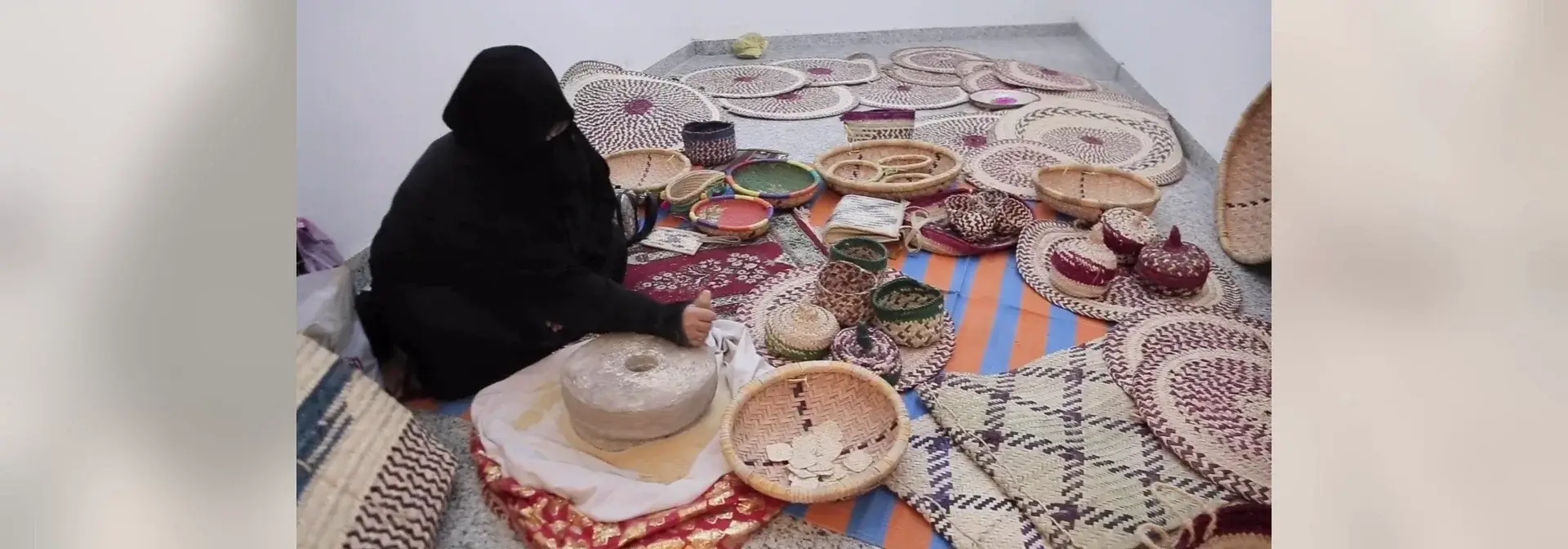
Overview
Saudi traditional handicrafts are a productive activity based primarily on manual work that draws its designs, form and artistic and decorative elements from the cultural heritage inherited across the regions of the Kingdom. This activity is divided into productive artistic and heritage industries, and service industries. [3]
The Law of Crafts and Handicrafts was issued by Royal Decree No. (M/49) dated 1447/03/02 AH, and under it the Heritage Commission regulates the activity. [1][2]
Regulatory Framework and Objectives
Its objectives are to regulate the activity of crafts and handicrafts, develop it and advance it, reinforcing this activity tied to the inherited national cultural heritage, preserving it and protecting it from extinction, and raising the competitiveness of craft products locally and abroad. [3]
The Heritage Commission regulates the activity and maintains the National Register of Craftspeople and quality standards, under Council of Ministers Resolution No. (157) dated 1447/02/25 AH. [2]
Ministerial Decision No. (2347/Q) dated 1447/08/10 AH issued the implementing regulations of the Law. The Royal Decree also granted existing craft practitioners a period of one year from the date the Law took effect to adjust their status in line with its provisions. [4][1]
Licensing and the National Register of Craftspeople
No craft or handicraft may be practised for commercial purposes, nor may handmade craft products be traded as a principal activity, without first obtaining the craft licence from the Commission. [3]
The Law also established the National Register of Craftspeople as a database recording the data of craftspeople, their classifications, crafts, handicrafts and activities. [3]
The Law encourages the establishment of associations specialised in crafts and handicrafts. Violators are subject to a fine not exceeding twenty thousand riyals, with the possibility of removal from the National Register of Craftspeople or suspension or cancellation of the licence. [3]
The Year of Handicrafts and the Royal Institute of Traditional Arts
2025 CE was designated the Year of Handicrafts by the Council of Ministers, under Resolution No. (236) dated 1446/03/14 AH. [5]
The organisation of the Royal Institute of Traditional Arts was issued on 1445/01/03 AH, corresponding to 21 July 2023 CE, and it defined traditional arts as inherited arts tied to national identity that are passed down through generations, produced or developed by local communities, and that include handicraft products and traditional artworks. [7]
The Institute enjoys legal personality and financial and administrative independence, is organisationally linked to the Minister of Culture, and has its principal headquarters in the city of Riyadh. [7]
Crafts and Intangible Cultural Heritage
Metal engraving (gold, silver and copper), with its associated arts, skills and practices, was inscribed on the Representative List of the Intangible Cultural Heritage of Humanity, announced on 6 December 2023 CE during the eighteenth session held in Kasane, Republic of Botswana. [6]
Registered intangible cultural elements for the Kingdom thus reached 13, after having been 11, following the inscription of hareess and metal engraving. [6]
Related craft and heritage topics within the encyclopedia include Al-Sadu, Taif Rose and Arabic Calligraphy.
Crafts and Cultural Tourism
Asir led the regions of the Kingdom in the number of domestic trips that include visits to museums and art exhibitions, and among the reasons for this was the rise in the number of private museums in the region, alongside centres specialised in displaying Al-Qatt Al-Asiri arts and traditional industries. [8]
Frequently Asked Questions
Q: Which body regulates the activity of crafts and handicrafts in the Kingdom? A: The Heritage Commission, under Council of Ministers Resolution No. (157) dated 1447/02/25 AH.
Q: Is a licence required to practise a handicraft for commercial purposes? A: Yes; commercial practice or trading in handmade craft products as a principal activity is not permitted without first obtaining the craft licence from the Heritage Commission.
Q: What is the National Register of Craftspeople? A: A database recording the data of craftspeople, their classifications, crafts, handicrafts and activities.
Q: When were the Law of Crafts and Handicrafts and its implementing regulations issued? A: The Law was issued by Royal Decree No. (M/49) dated 1447/03/02 AH, and its implementing regulations were issued by Ministerial Decision No. (2347/Q) dated 1447/08/10 AH.
Q: What is the period for adjusting the status of existing craft practitioners? A: One year from the date the Law took effect.
Related topics
- HistoricAl-Sadu WeavingAl-Sadu is a handweaving craft based on weaving threads of camel hair, goat hair and sheep wool. It is known among the people of the Kingdom of Saudi Arabia, who used it to make hair houses, carpets, daily necessities and tribal clothing, and its weaving was registered on the Representative List of the Intangible Cultural Heritage at UNESCO.
- TopicAl-Qatt Al-AsiriA traditional art of painted wall decoration in Asir homes, practised by women, added to UNESCO's Representative List of the Intangible Cultural Heritage in 2017.
- HistoricTaif RoseThe Taif rose is a rose cultivated in the mountainous areas of Taif Governorate in western Saudi Arabia, where more than 2,200 farms produce over 550 million roses a year. Rose water and rose oil are extracted from it by traditional distillation, and the harvest is accompanied by an annual festival, research activity and training.
- HistoricArabic CalligraphyArabic Calligraphy is the art of writing the Arabic letters, and in the Kingdom of Saudi Arabia it receives care that extends to serving the Qur'anic text and developing its digital tools. Foremost among the manifestations of that is the collection of computerised fonts produced by the King Fahd Complex for the Printing of the Holy Qur'an, alongside the International Competition for Writing the Holy Qur'an.
- HistoricSaudi Traditional DressSaudi traditional dress is a clothing heritage that expresses the identity of the Kingdom of Saudi Arabia and the diversity of its regions. Men's dress rests on the thobe, the agal, and the ghutra, women's dress ranges from the munaykhal and mushallal thobes to the darra'a and the kartah, and the King Abdulaziz Foundation for Research and Archives documents the dress of the Kingdom's regions in a specialised series of publications.
- TopicNational Culture StrategyThe National Culture Strategy is a national strategy approved by the Council of Ministers on 27 March 2019 to organise and develop the cultural sector in the Kingdom of Saudi Arabia. It rests on three pillars — culture as a way of life, culture for economic growth, and culture for enhancing the Kingdom's international standing — and covers the sixteen cultural sectors within the framework of Saudi Vision 2030.
- RegionAsir RegionA southwestern Saudi region administered from Abha, combining Sarawat highlands, Tihamah and the coast, with agricultural terraces, historic villages and distinctive local cultural traditions.
Sources & references
- Umm Al-Qura Gazette — the Official Gazette: the Royal Decree issuing the Law of Crafts and Handicrafts and the grace period for adjusting status
- Umm Al-Qura Gazette — the Official Gazette: the Council of Ministers resolution assigning the Heritage Commission to regulate the activity of crafts and handicrafts
- Umm Al-Qura Gazette — the Official Gazette: the text of the Law of Crafts and Handicrafts (definition, objectives, licensing, register and penalties)
- Umm Al-Qura Gazette — the Official Gazette: the implementing regulations of the Law of Crafts and Handicrafts
- Umm Al-Qura Gazette — the Official Gazette: the Council of Ministers resolution designating 2025 CE as the Year of Handicrafts
- Umm Al-Qura Gazette — the Official Gazette: the inscription of metal engraving on the UNESCO Representative List of the Intangible Cultural Heritage
- Umm Al-Qura Gazette — the Official Gazette: the organisation of the Royal Institute of Traditional Arts and the definition of traditional arts
- Umm Al-Qura Gazette — the Official Gazette: the Cultural Status Report 2023 and Asir leading the cultural tourism indicators