
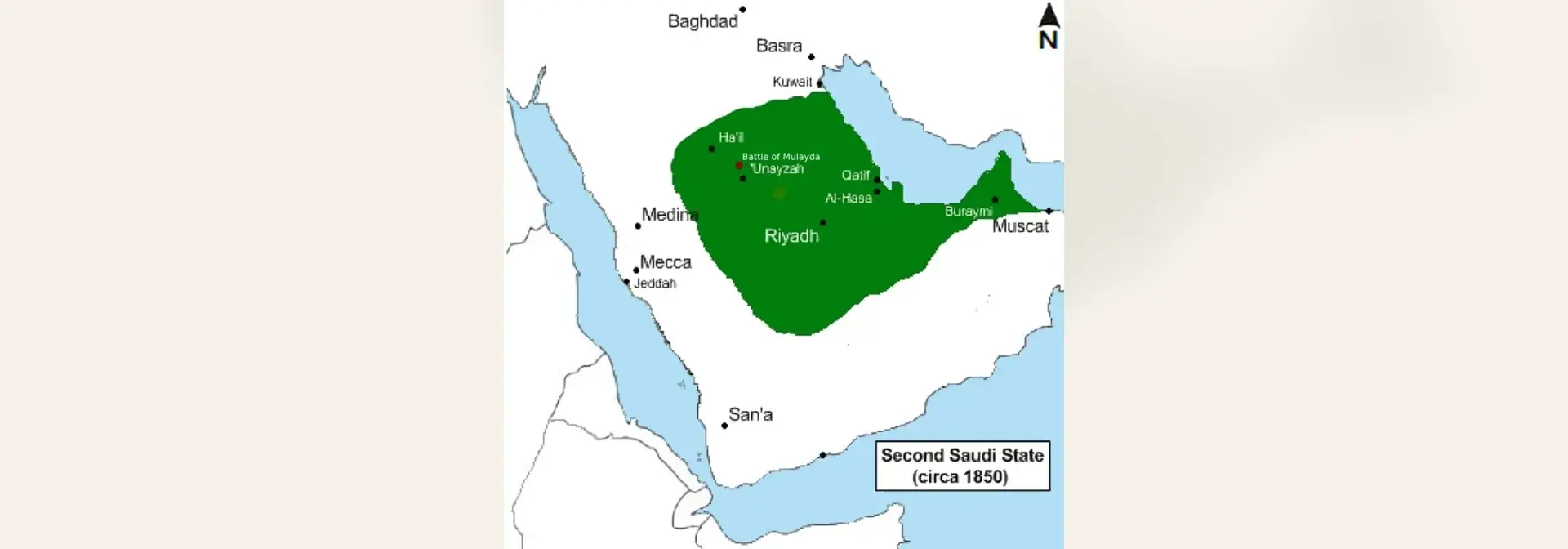
Overview
The Battle of Mulayda was fought in 1308 AH/1891, and it was one of the last major episodes in the history of the Second Saudi State, whose era ended the following year, 1309 AH/1891.[1][2][3]
The battle was followed by the departure of Imam Abdulrahman bin Faisal with his family from Riyadh and his subsequent settlement in Kuwait, before King Abdulaziz bin Abdulrahman bin Faisal Al Saud was able to recapture Riyadh and return with his family to it on the fifth of Shawwal 1319 AH/1902.[1][3][6]
Context of the Second Saudi State
The Saudi State was founded by Imam Mohammed bin Saud in 1139 AH/1727, setting out from its capital Diriyah on a course of state-building.[8] After the events of the fall of the First Saudi State, Riyadh became the capital of the Saudi State in the Second Saudi State, during the era of Imam Turki bin Abdullah.[5]
After seven years of sustained activity, Imam Turki bin Abdullah was able to expel the Ottoman garrisons from Najd and free it of them, and to enter Riyadh in 1240 AH/1824.[6]
The Second Saudi State lasted for nearly seventy-five years from the first attempts to establish it in 1234 AH, and it continued to rule the region until 1309 AH/1891.[3][6]
Political Developments in Najd
The final years of the era of the Second Saudi State saw political developments in Najd, against the backdrop of an adversarial position on the part of the Ottoman State, which took certain internal differences as a pretext for extending its effective control over the coastal area of the Arabian Gulf and the inland areas of the Arabian Peninsula.[4]
The Battle of Mulayda and Its Aftermath
The Battle of Mulayda was fought in 1308 AH/1891, coming at the close of the course of the Second Saudi State after nearly seventy-five years from the first attempts to establish it.[1][2][3]
The battle was followed by the departure of Imam Abdulrahman bin Faisal with his family from Riyadh, and his daughter Noura accompanied her brother Abdulaziz in that departure.[1]
After his departure, Imam Abdulrahman bin Faisal settled in Kuwait, and his daughter Noura was a factor in encouraging her brother Abdulaziz to strive to recover the realm of his forefathers and to leave Kuwait in pursuit of that goal.[1][2]
In 1309 AH, Imam Abdulrahman bin Faisal, the last ruler of the Second Saudi State, departed for the Empty Quarter desert and from there to Kuwait.[3]
Noura bint Abdulrahman bin Faisal
Noura bint Abdulrahman bin Faisal is the eldest of the sisters of King Abdulaziz; she was born in the city of Riyadh in 1292 AH, and she witnessed the departure of the family from Riyadh after the Battle of Mulayda.[1]
Her biography likewise records that she accompanied her brother Abdulaziz when Imam Abdulrahman left Riyadh with his family after the battle, and her role in encouraging her brother to leave Kuwait in pursuit of recovering the realm of his forefathers.[1][2]
Related people
Scholarly Life in Riyadh
Documents and manuscripts that had not previously been published record aspects of the state of education in the city of Riyadh in the era of the Second Saudi State up to 1309 AH, a period falling within the span 1240-1309 AH/1824-1891.[7]
Frequently Asked Questions
Q: When was the Battle of Mulayda fought? A: It was fought in 1308 AH/1891.[1][2]
Q: What is the connection between the Battle of Mulayda and the end of the Second Saudi State? A: It was one of its last episodes, as the era of the Second Saudi State ended the following year, 1309 AH/1891, with the departure of Imam Abdulrahman bin Faisal for Kuwait.[3][6]
Q: Which Imam left Riyadh after Mulayda? A: Imam Abdulrahman bin Faisal, the last ruler of the Second Saudi State, who left Riyadh with his family after the battle.[1][3]
Q: How many years did the Second Saudi State last? A: Nearly seventy-five years from the first attempts to establish it in 1234 AH.[3]
Q: When was Riyadh recaptured? A: On the fifth of Shawwal 1319 AH/1902, when King Abdulaziz bin Abdulrahman bin Faisal Al Saud was able to recapture Riyadh and return with his family to it after a political vacuum that lasted nearly ten years.[6]
Conclusion
The era of the Second Saudi State ended in the year following the Battle of Mulayda, in 1309 AH/1891, and Riyadh then returned to the House of Al Saud on the fifth of Shawwal 1319 AH/1902.[3][6]
The topics connected to the battle on the platform include the Qassim region, the Battle of Al-Bukayriyah, the Battle of As-Sarif, the Capture of Riyadh, the unification of the Kingdom of Saudi Arabia and Imam Turki bin Abdullah.
Related topics
- RegionQassim RegionAn inland Najdi region administered from Buraydah, associated with trading towns, date cultivation and markets, and the geographical corridor of Wadi Al Rummah.
- EventBattle of Al-BukayriyahThe Battle of Al-Bukayriyah was fought in 1904 between the forces of King Abdulaziz bin Abdulrahman Al Saud on one side and the Ottoman Empire (the Turks) and Al Rashid on the other, within the course of the unification of the Kingdom of Saudi Arabia. The records of the Saudi state are preserved in the India Office in London, covering the events of the period from 1902 to 1931.
- EventBattle of SarifThe Battle of Sarif was the first attempt by King Abdulaziz bin Abdulrahman Al Saud to recover Riyadh in 1318 AH / 1901 CE, and men of Al Saud and the people of Riyadh took part in it. It followed the departure of the Al Saud family from Riyadh with Imam Abdulrahman bin Faisal in 1308 AH / 1890 CE and the taking of Kuwait as a base of departure, and it was followed by the successful attempt in 1319 AH / 1901–1902 CE that led to the recovery of Riyadh.
- EventThe Capture of RiyadhThe Capture of Riyadh was King Abdulaziz bin Abdulrahman Al Saud's recovery of the city of Riyadh and his entry into it with his men on 5 Shawwal 1319 AH, corresponding to 16 January 1902, together with his pledge of allegiance as Emir there. It was followed by the unification of Najd, the capture of Al-Ahsa, and his official recognition as ruler of Najd, Qassim, and Al-Ahsa.
- EventUnification of Saudi ArabiaKing Abdulaziz's path from the recovery of Riyadh in 1902 to the proclamation of the Kingdom of Saudi Arabia on 23 September 1932, now National Day.
Sources & references
- Al-Darah Magazine - King Abdulaziz Foundation - Noura bint Abdulrahman bin Faisal Al Saud, Dr. Dalal bint Makhlad Al-Harbi
- Al-Darah Magazine - King Abdulaziz Foundation - The movements of Imam Abdulrahman bin Faisal Al Saud in 1308 AH/1891, Dr. Nasser bin Mohammed Al-Juhaimi
- Al-Darah Magazine - King Abdulaziz Foundation - Book review: The History of the Second Saudi State
- Al-Darah Magazine - King Abdulaziz Foundation - Internal political developments in Najd
- Al-Darah Magazine - King Abdulaziz Foundation - Riyadh, capital of the Saudi State
- Saudi Press Agency (SPA) - Report: Diriyah, the nucleus of the Saudi State
- Saudi Press Agency (SPA) - Reading a book: Scholarly life in the city of Riyadh in the era of the Second Saudi State
- Saudi Press Agency (SPA) - Founding Day: Imam Mohammed bin Saud establishes the entity of the State