
Overview
The Kingdom of Dadan is an ancient Arabian kingdom in the northwest of the Arabian Peninsula; the city of Dadan was its historic capital, and later the capital of the Kingdom of Lihyan, and its period extends from the late ninth century BCE.[1]
The city of Dadan is located in AlUla Governorate and is among the most important archaeological discoveries in the region, as it was built in the ninth century BCE from stones available in Wadi al-Wahah.[7] Human presence in AlUla dates back more than 7 thousand years.[1]
Location and the Incense Route
Dadan formed a vital centre of agricultural and commercial activity across the ages, owing to its position on the Incense Route, one of the most important ancient trade routes in the region, which contributed to its cultural and economic prosperity and made it a principal station for the exchange of goods and ideas among multiple civilisations.[1]
The discovery of the first two inscriptions in the Dadanitic script in Al-Qassim region highlights the importance of central Arabia as a corridor for trade caravans, and points to the route linking the kingdoms of Dadan and Lihyan in the northwest of the Arabian Peninsula with the Kingdom of Kindah in Qaryat al-Faw, passing through central Arabia.[5]
Economic and Agricultural Life
Dadan was a commercial and agricultural centre in the northwest of the Arabian Peninsula; the Minaeans, traders from the Kingdom of Ma'in in the south of the Arabian Peninsula, established a trading post there as part of an extended trade network, leaving behind inscriptions that document their cultural practices.[2]
Agricultural activity in Dadan began around the third millennium BCE, and archaeologists have found evidence of handicrafts dating to the second millennium BCE.[2]
Rock-Cut Tombs and City Landmarks
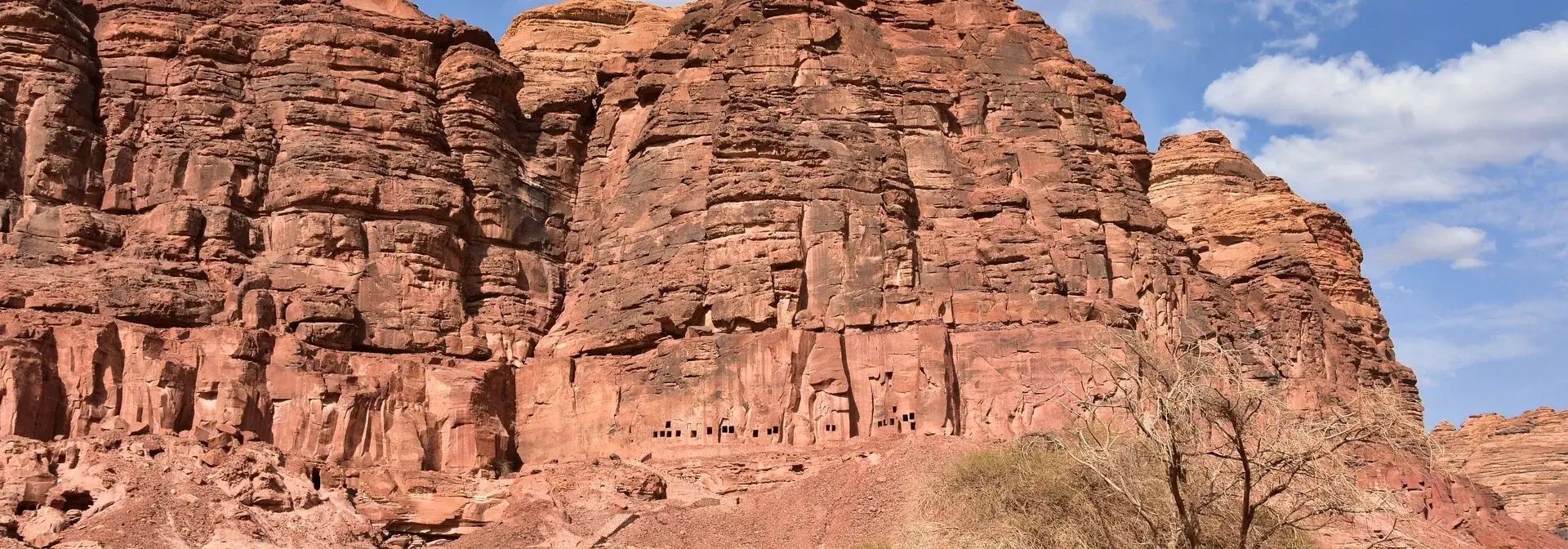
The city of Dadan contains striking archaeological landmarks, most notably tombs carved into the faces of the red rock slopes, some of them distinguished by rectangular geometric facades crowned with carved lions, reflecting an advanced level of artistic and architectural creativity among the ancient civilisations of the region.[1]
The number of tombs carved into the red rock slopes exceeds twelve, and the historic city was built from stones available in Wadi al-Wahah.[7]
Dadanitic Inscriptions and Jabal Ikmah
Jabal Ikmah contains more than 300 Dadanitic inscriptions of exceptional importance, forming the largest collection of preserved Dadanitic inscriptions in the northwest of the Arabian Peninsula.[3]
Jabal Ikmah was inscribed on UNESCO's Memory of the World register, through the efforts of the Royal Commission for AlUla in coordination with the Saudi National Commission for Education, Culture and Science.[3]
Excavation, Documentation and Studies
Excavation in the first season took place in February–March 2020 across four areas of the Dadan site, covering an area of up to about 1,800 square metres; around 1,949 artefacts were found, and more than 16 pottery sherds were studied and classified.[4]
The team carried out a systematic survey of Jabal AlKhuraibah, adjoining the site on the east, covering about 22 hectares in which 340 archaeological features were recorded.[4] Among the pieces discovered at Dadan is a spearhead made of copper alloy dating to the period between 400 and 50 BCE.[2]
The Heritage Commission announced the discovery and documentation of the first two inscriptions in Al-Qassim region written in the Dadanitic script during archaeological survey work in the region.[5] The King Abdulaziz Foundation also published a scholarly book titled “Advancements in Religious Thought in the Kingdom of Lihyan: A Historical Study in Light of the Dadanitic Inscriptions”, in 166 pages.[6]
The exhibition “Illuminating Discoveries: Historical Phases in Dadan” included more than 100 artefacts retrieved from the Dadan archaeological site and the mountain refuge of Umm Daraj over the past five years.[2]
Frequently Asked Questions
Q: What is the Kingdom of Dadan? A: An ancient Arabian kingdom in the northwest of the Arabian Peninsula, with the city of Dadan as its historic capital and later the capital of the Kingdom of Lihyan.
Q: Where is the city of Dadan located? A: In AlUla Governorate in the northwest of the Kingdom of Saudi Arabia, and it is among the most important archaeological discoveries in the region.
Q: What are the most prominent landmarks of the city of Dadan? A: The tombs carved into the red rock slopes, some with rectangular geometric facades crowned with carved lions, along with the inscriptions of Jabal Ikmah.
Q: What is the significance of the Jabal Ikmah inscriptions? A: The mountain holds the largest collection of preserved Dadanitic inscriptions in the northwest of the Arabian Peninsula, and it was inscribed on UNESCO's Memory of the World register.
Q: What are the earliest activities in Dadan? A: Agricultural activity there dates to around the third millennium BCE, and evidence of handicrafts from the second millennium BCE has been found.
Conclusion
The Kingdom of Dadan combines a historic standing as the capital of the kingdoms of Dadan and Lihyan, a location on the Incense Route that contributed to its commercial and agricultural prosperity, and an archaeological heritage that includes the tombs carved into the red rock slopes and more than 300 Dadanitic inscriptions on Jabal Ikmah.[1][3] Scientific documentation of the site continues through archaeological surveys and scholarly publications.[5][6] Related topics on the platform include History of Hegra, AlUla Old Town, Rock Art of Hail and Darb Zubaydah.
Related topics
- Governorate and oasis geographyGeography of AlUlaAlUla is a governorate in Madinah Region in northwestern Saudi Arabia, where cultivated oases and settlements lie among wadis and desert escarpments.
- EventIncense Trade RouteThe Incense Trade Route is a trade artery established by the caravans from the south of the Arabian Peninsula between Makkah and Madinah, on to the Levant to the north and Al-Ahsa and Bahrain to the east. Stations along its course include Qaryat al-Faw, AlUla and the Hegra site, and the Kingdom of Saudi Arabia is reviving this legacy today through cultural and tourism projects.
- EventQaryat al-FawQaryat al-Faw is an archaeological site in Wadi ad-Dawasir Governorate, south of the Riyadh Region, also known as Dhat Kahil, and served as the capital of the Kingdom of Kindah from the fourth century BCE until the early fourth century CE. The Cultural Landscape of Al-Faw Archaeological Area was inscribed on the World Heritage List in 2024.
- Archaeological sitesHistory of HegraHegra, also called Mada'in Salih, is an archaeological site in AlUla Governorate whose tombs, wells and inscriptions illuminate Nabataean life and caravan routes.
- HistoricAlUla Old TownAlUla Old Town is a historic settlement in the centre of AlUla Governorate, preserving an earthen urban fabric of hundreds of houses, markets and historic passageways. It was selected among the Best Tourism Villages in the World for 2022.
- HistoricRock Art of HailThe Rock Art of Hail is a World Heritage property in the Hail Region of Saudi Arabia, inscribed on the UNESCO list in 2015, comprising the largest rock art complexes in the Arabian Peninsula with engravings spanning about 10,000 years.
- HistoricDarb ZubaydahThe Kufa pilgrimage road linking Iraq to Makkah through five Saudi regions, used since before Islam and named after the spring dug by Zubaydah bint Ja'far.
Sources & references
- Saudi Press Agency (SPA) — the Kingdom of Dadan in AlUla
- Saudi Press Agency (SPA) — Dadan discoveries and the “Illuminating Discoveries” exhibition
- Saudi Press Agency (SPA) — inscription of Jabal Ikmah on the Memory of the World register
- Saudi Press Agency (SPA) — results of the first excavation season at the Dadan site
- Saudi Press Agency (SPA) — discovery of the first two inscriptions in the Dadanitic script in Al-Qassim
- Saudi Press Agency (SPA) — the King Abdulaziz Foundation publishes a book in light of the Dadanitic inscriptions
- Royal Commission for AlUla — Experience AlUla: the city of Dadan