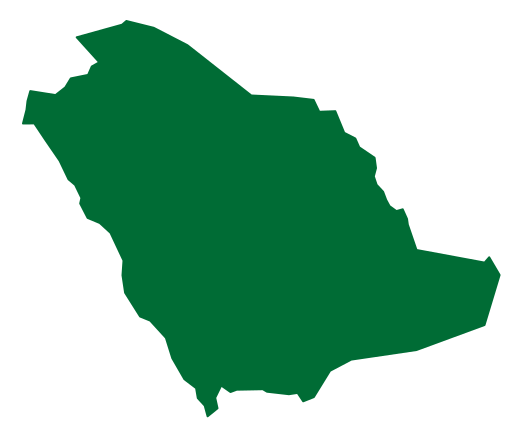

Overview
The Rock Art of Hail is a World Heritage property in the Hail Region of Saudi Arabia, and its official registered name is 'Rock Art in the Hail Region of Saudi Arabia'. [2] The property was inscribed on the UNESCO World Heritage List in 2015 during the 39th session of the World Heritage Committee held in Bonn. It is a serial property of two components: Jabal Umm Sinman at Jubbah, and Jabal al-Manjor and Jabal Raat at Shuwaymis. [1]
Location and components
The property consists of two components located in a desert landscape: Jabal Umm Sinman at Jubbah, and Jabal al-Manjor and Jabal Raat at Shuwaymis. [1]
Jabal Umm Sinman lies in the Hail Region and is about 90 km northwest of the city of Hail. Jabal al-Manjor and Jabal Raat lie on Wadi al-Mukhayet, about 40 km west of Shuwaymis and about 250 km south of Hail. [5]
Fourteen clusters of petroglyphs surround the lower slopes of Jabal Umm Sinman, and the Jabal al-Manjor and Raat component contains 18 rock art clusters. [5] The core area of the property covers about 2043.8 hectares and the buffer zone about 3609.5 hectares. [2] The Jabal Umm Sinman component covers 1783.9 hectares, surrounded by a buffer zone of 1951 hectares, while the Jabal al-Manjor and Raat component covers 259.9 hectares, surrounded by a buffer zone of 1658.5 hectares. [4]
The rock art and its chronological span
The rock art at the two components covers about 10,000 years of human history and shows numerous representations of human and animal figures. [1]
With its two components, the property contains the largest and richest rock art complexes in Saudi Arabia, the Arabian Peninsula and the Middle East generally. [4]
The oldest rock art tradition evident at both properties is among the largest surviving examples of Neolithic petroglyphs and includes animals such as the ibex. [5] After the domestication of cattle and horses, and then the desiccation that followed after about 3000 years, camels and Thamudic and later Arabic script appeared in the engravings. [5] This rock art has been termed the 'Jubbah style'. [4]
Inscription on the World Heritage List
The property was inscribed on the World Heritage List in 2015, with reference number 1472. [2]
It was inscribed on the basis of the two cultural criteria (i) and (iii), having initially been nominated on criteria (i), (ii), (iii) and (v). [3]
The inscription was preceded by the property's inclusion in the Saudi Tentative List on 17 September 2012 and the receipt of the nomination file at the World Heritage Centre on 24 January 2014. [4] The property is one of the Saudi properties inscribed on the World Heritage List, which number 8, the Kingdom having joined the World Heritage Convention on 7 August 1978, alongside other Saudi properties such as Al-Ahsa Oasis and At-Turaif District. [7]
Scientific research and rediscovery
Management and protection
The sites are government-owned and are treated as protected areas, safeguarded under Royal Decree No. M/26 dated 23/6/1392 AH (1972 CE) and Council of Ministers Resolution No. 78 dated 16/3/1429 AH (2008 CE). [4] The property is managed by the Heritage Commission, one of eleven sub-commissions of the Ministry of Culture, after heritage was separated from the Ministry of Tourism and the Ministry of Culture and the Heritage Commission were established. [6]
Frequently asked questions
Q: What is the Rock Art of Hail? A: A World Heritage property in the Hail Region of Saudi Arabia, whose official registered name is 'Rock Art in the Hail Region of Saudi Arabia'. [2]
Q: When was the property inscribed on the World Heritage List? A: It was inscribed in 2015 during the 39th session of the World Heritage Committee, with reference number 1472. [1][2]
Q: What are the components of the property? A: Two components: Jabal Umm Sinman at Jubbah, and Jabal al-Manjor and Jabal Raat at Shuwaymis. [1]
Q: How old is the rock art at the property? A: It covers about 10,000 years of human history. [1]
Q: Who manages and protects the property? A: It is managed by the Heritage Commission of the Ministry of Culture, and the sites are protected under Royal Decree M/26 of 1972 and Council of Ministers Resolution No. 78 of 2008. [4][6]
Related topics
- RegionHail RegionA north-central Saudi region administered from Hail, associated with the Aja and Salma mountains, the Nafud desert, historical caravan routes and varied regional activities.
- HistoricAl-Ahsa OasisThe world's largest self-contained oasis according to Guinness World Records, inscribed on the UNESCO World Heritage List in 2018 as a cultural landscape of human interaction with the environment.
- HistoricAt-Turaif DistrictA historic district at the heart of Diriyah, built in the mid-eighteenth century CE, seat of the First Saudi State and a UNESCO World Heritage site since 2010.
- HistoricHima Cultural AreaOne of the world's largest rock-art complexes, in Thar governorate north of Najran city, inscribed on the UNESCO World Heritage List in 2021.
Sources & references
- UNESCO — World Heritage Centre (inscription page)
- UNESCO — World Heritage Centre (Arabic inscription page)
- UNESCO — Committee Decision 39 COM 8B.11
- UNESCO — ICOMOS evaluation (nomination document 1472)
- UNESCO — Executive Summary of the nomination file
- UNESCO — State of Conservation report (SOC 2021)
- UNESCO — World Heritage Centre (State Party page: Saudi Arabia)