
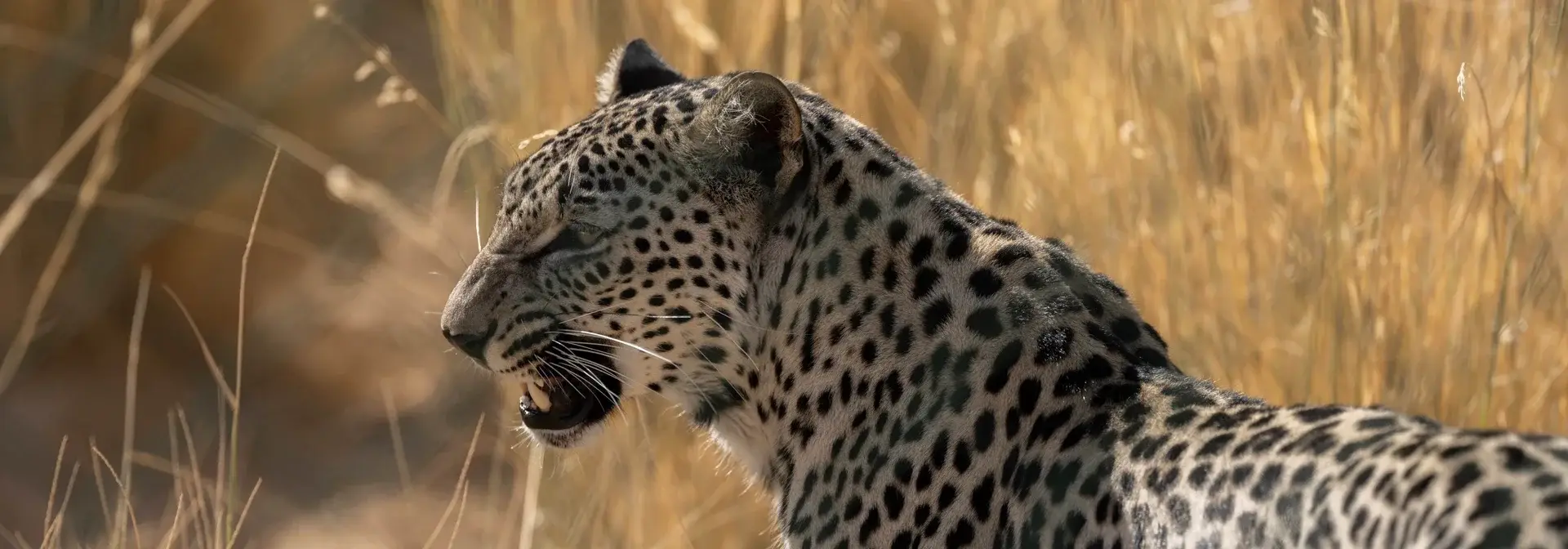
Overview
The Arabian Leopard is an animal of the Felidae family, known scientifically as Panthera pardus nimr. It is a subspecies of the endangered leopard and one of the smallest leopard subspecies. It weighs on average between 30 and 40 kg for males and between 25 and 35 kg for females, and it originated in Africa about 500,000 years ago.[1]
The International Union for Conservation of Nature has classified it as Critically Endangered since 1996, and only limited numbers remain in the wild of the Arabian Peninsula, which has made it the focus of national and international efforts to conserve it.[1][2]
Definition and Classification
The Arabian Leopard is among the rarest leopard subspecies in the world, and it is classified as Critically Endangered on the Red List of the International Union for Conservation of Nature, a classification in place since 1996.[1][2]
To raise awareness of this endangered wild species, the United Nations General Assembly declared 10 February a world day for the Arabian Leopard, following global recognition of it in June 2023.[1] In the Kingdom of Saudi Arabia, the Council of Ministers adopted the tenth of February each year as the Arabian Leopard Day.[8]
Relationship with AlUla
AlUla Governorate has a deep historical relationship with the Arabian Leopard extending over thousands of years, documented by the rock inscriptions spread across its mountains and valleys, which reflect its presence in the natural environment and the cultural identity of the region as one of the symbols of ecological balance in the Arabian Peninsula.[7]
National Conservation Efforts
In 1416 AH, a decision was issued to form a national committee for the conservation of the Arabian Leopard, working in coordination with the national committees in the Arab Gulf states where the leopard is found. A directive was also issued to begin a programme for breeding the Arabian Leopard at the National Centre for Wildlife Research in Taif.[12]
On 27 February 2007, An-Namas Governorate hosted the symposium "The Saudi Arabian Leopard and the Risk of Extinction", in cooperation with King Saud University and King Khalid University.[12]
Arabian Leopard Breeding and Conservation Centre
The Arabian Leopard Breeding and Conservation Centre in AlUla is the only site currently active in the world specialising in breeding the Arabian Leopard for its conservation.[7] Since its management passed to the Royal Commission for AlUla in 2020, the number of leopards there has risen from 14 to 31.[2]
The centre's record includes successive births, among them seven cubs in 2023 and five further births, including a set of triplets.[2] On 4 December 2024, the birth of triplet Arabian Leopard cubs, two males and a female, was announced, the first documented case of triplet births in captivity in the Kingdom and the third of its kind in thirty years.[6] The centre obtained accreditation from the European Association of Zoos and Aquaria (EAZA) on 9 January 2025, making it the first institution of its kind in the Kingdom to receive this membership.[2]
Sharaan Nature Reserve
His Royal Highness Prince Mohammed bin Salman bin Abdulaziz, Crown Prince and Prime Minister, launched the Sharaan Nature Reserve in AlUla Governorate on 10 February 2019, as part of a series of major strategic projects, and the initiative included the establishment of the largest global fund of its kind to protect the Arabian Leopard, named the Global Fund for the Protection of the Arabian Leopard.[4]
The reserve is among the most prominent protected areas in AlUla Governorate, and it has obtained the Green List accreditation of the International Union for Conservation of Nature.[5] On 8 November 2020, the reserve witnessed the largest release of endangered wildlife by number of species, in which 25 mountain ibex, 50 reem gazelles, 20 idmi gazelles and 10 Arabian oryx were released, restoring the wildlife that had spread through the region.[11]
The Fund and Scientific Projects
The Royal Commission for AlUla established the Arabian Leopard Fund by royal decree with initial funding of 25 million US dollars to support efforts to conserve the Arabian Leopard regionally and globally.[9] In partnership with the Commission, the Fund launched the Arabian Leopard Scholarship Programme on 14 February 2024, comprising 50 scholarships.[9] On 24 June 2026, a strategic cooperation agreement was signed to study the genome of the Arabian Leopard, after the building of its first high-quality genome to form a scientific basis for future research studies.[3]
In the field of partnerships, the Royal Commission for AlUla and the Arabian Leopard Fund signed two memoranda of understanding with Catmosphere on 10 February 2022.[8] On 14 May 2025, a strategic cooperation agreement was announced with the National Zoological Park and the Conservation Biology Institute of the Smithsonian Institution, providing for the loan of a pair of AlUla Arabian leopards to the American capital, Washington, in support of international efforts to protect the Arabian Leopard.[10]
Frequently Asked Questions
Q: What is the Arabian Leopard? A: A subspecies of the endangered leopard and one of the smallest leopard subspecies, known scientifically as Panthera pardus nimr.[1]
Q: What is its status on the Red List of the International Union for Conservation of Nature? A: It is classified as Critically Endangered since 1996.[1][2]
Q: When is the Arabian Leopard Day? A: 10 February, declared by the United Nations General Assembly a world day for the Arabian Leopard, and adopted by the Kingdom of Saudi Arabia as the Arabian Leopard Day each year.[1][8]
Q: What is the Arabian Leopard Breeding and Conservation Centre? A: The only site currently active in the world specialising in breeding the Arabian Leopard for its conservation, located in AlUla Governorate, and the number of leopards there has risen from 14 to 31 since 2020.[7][2]
Conclusion
The Arabian Leopard combines its presence as a symbol of ecological balance in the Arabian Peninsula with national conservation efforts extending from the national committee for the conservation of the Arabian Leopard and the breeding programme at the National Centre for Wildlife Research in Taif to the Arabian Leopard Breeding and Conservation Centre in AlUla Governorate and the Sharaan Nature Reserve.[7][12]
Its topics on the platform connect to the Arabian Oryx, the Ibex Reserve, the Prince Mohammed bin Salman Royal Reserve, the Saudi Green Initiative and AlUla Old Town.
Related topics
- HistoricArabian OryxThe Arabian Oryx, also known as the wadhi oryx, is a species of wild mammal and the largest wild mammal in the Arabian Peninsula. It was absent from its natural habitat in northern Saudi Arabia for about ninety years, then was resettled in protected reserves and released in Uruq Bani Ma'arid Reserve and King Salman bin Abdulaziz Royal Reserve.
- HistoricAl-Waol Ibex ReserveAl-Waol Ibex Reserve is a nature reserve in the Riyadh Region, supervised and managed by the National Center for Wildlife, located about 120 km south of Riyadh city within the Tuwaiq Mountains range. It was inscribed on 9 October 2024 in the Green List of the International Union for Conservation of Nature, becoming the first reserve in the Kingdom to meet its standards.
- HistoricPrince Mohammed bin Salman Royal ReservePrince Mohammed bin Salman Royal Reserve is a royal reserve in the northwest of the Kingdom of Saudi Arabia. It extends over an area of 24,500 square kilometers and encompasses 15 ecosystems, containing more than 50% of the Kingdom's wildlife species. Established by royal decree and overseen by the Council of Royal Reserves chaired by His Royal Highness the Crown Prince and Prime Minister, it combines wildlife reintroduction, ecological tourism and biodiversity conservation.
- TopicSaudi Green InitiativeThe Saudi Green Initiative is a national initiative announced by His Royal Highness the Crown Prince and Prime Minister on 27 March 2021, charting the Kingdom's direction in protecting land and nature along a clear and ambitious roadmap. It targets the planting of 10 billion trees, the raising of protected areas to more than 30 percent, and the supply of 50 percent of electricity generation from renewable energy by 2030.
- HistoricAlUla Old TownAlUla Old Town is a historic settlement in the centre of AlUla Governorate, preserving an earthen urban fabric of hundreds of houses, markets and historic passageways. It was selected among the Best Tourism Villages in the World for 2022.
Sources & references
- Saudi Press Agency (SPA) — Defining the Arabian Leopard, its classification, weights, origin and world day
- Saudi Press Agency (SPA) — Accreditation of the Arabian Leopard Breeding and Conservation Centre and the classification of the species
- Saudi Press Agency (SPA) — Agreement to study the genome of the Arabian Leopard
- Saudi Press Agency (SPA) — Launch of the Sharaan Nature Reserve and the Global Fund for the Protection of the Arabian Leopard
- Saudi Press Agency (SPA) — The Sharaan Reserve and Green List accreditation
- Saudi Press Agency (SPA) — Birth of triplet Arabian Leopard cubs
- Saudi Press Agency (SPA) — AlUla's relationship with the Arabian Leopard and the breeding centre
- Saudi Press Agency (SPA) — Two memoranda of understanding with Catmosphere and the Arabian Leopard Day
- Saudi Press Agency (SPA) — Establishment of the Arabian Leopard Fund and the scholarship programme
- Saudi Press Agency (SPA) — Cooperation agreement with the Smithsonian Institution
- Saudi Press Agency (SPA) — Release of wildlife in the Sharaan Nature Reserve
- Saudi Press Agency (SPA) — The national committee for the conservation of the Arabian Leopard and the breeding programme in Taif