
Overview
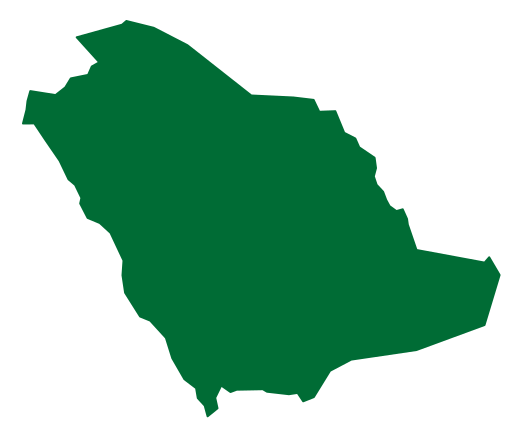
Prince Mohammed bin Salman Royal Reserve is a royal reserve in the northwest of the Kingdom of Saudi Arabia. It extends over an area of 24,500 square kilometers and encompasses 15 distinct ecosystems ranging from mountain hills to coral reefs. [1]
It is one of the royal reserves in the Kingdom established by royal decree and is overseen by the Council of Royal Reserves, chaired by His Royal Highness the Crown Prince and Prime Minister, Prince Mohammed bin Salman bin Abdulaziz. [1][2]
Location, Area and Ecological Diversity
The reserve extends over an area of 24,500 square kilometers in the northwest of the Kingdom. It encompasses 15 distinct ecosystems, from mountain hills to coral reefs, and links the major projects of NEOM, AMAALA, the Red Sea Project and AlUla. [1]
The reserve covers 1% of the Kingdom's terrestrial area and 1.8% of its marine area, while containing more than 50% of the Kingdom's wildlife species, making it one of the richest areas for biodiversity in the Middle East. It is home to the Wadi Al Disah project of the Public Investment Fund and the AMAALA project of Red Sea Global. [3]
The Marine Environment
The reserve's marine area extends over 3,856 square kilometers to the limits of the Kingdom's territorial waters, forming 1.8% of those waters. It is the longest coastline managed by a single environmental protection authority in the Kingdom, with a length of 170 kilometers. [4]
This area contains 64% of the Kingdom's coral reef species and 22% of its fish species, and shelters threatened species such as hawksbill turtles, green turtles, spinner dolphins, dugongs, whale sharks and mangrove forests. [4]
Wildlife Reintroduction
The reserve's wildlife reintroduction programme seeks to restore 23 species that historically occurred there, including 16 species extinct within the reserve's boundaries, 4 critically endangered species and 3 vulnerable species listed by the International Union for Conservation of Nature, among them the Arabian leopard, the Asiatic cheetah and the Arabian oryx. The programme supports a large-scale natural habitat restoration project that will rehabilitate more than 400 species of native plants. [1]
The reserve recorded the birth of its fifteenth Arabian oryx since the reintroduction programme began in late 2022 as part of the Integrated Development Management Plan, after the Arabian oryx was declared extinct in the wild across the Arabian Peninsula during the 1970s and was later classified as Vulnerable on the IUCN Red List. [5] In the spring 2025 season the reserve celebrated the birth of its first sand gazelle, bringing the total number of sand gazelles born there to 94 since the programme began in 2022. The reserve has succeeded in reintroducing 11 of the 23 species, and the sand gazelle is classified as an endangered species. [6]
The reserve reintroduced the Asian houbara bustard after an absence of more than 35 years, releasing 20 birds in cooperation with the National Center for Wildlife and the Prince Mohammed bin Salman Foundation for the Conservation of the Houbara, and fitted 10 birds with satellite tracking devices. It is the thirteenth species reintroduced in the reserve. UNESCO previously inscribed falconry in the Arabian Peninsula on the List of the Intangible Cultural Heritage in 2021. [7]
Scientific Discoveries and World Heritage Sites
The reserve announced the discovery of a bat species known as Vansonia rueppellii (Rüppell's bat), recorded by researchers for the first time in the Kingdom within the reserve in October 2023 in cooperation with Al Manara Development at King Abdullah University of Science and Technology (KAUST). The discovery was published in the journal Zoology in the Middle East in November 2024, raising the reserve's tally to 18 of the Kingdom's 32 bat species (56%). [3]
Four sites within the reserve are placed on UNESCO's tentative list of World Heritage sites, and the reserve seeks to become a global destination for the conservation of the desert environment and for heritage tourism. [1]
Planning and Strategic Targets
The Council of Royal Reserves was established by royal decree to set the strategic directions of the royal reserves system, preserve their environmental and natural components, reintroduce wildlife, enhance their development and activate ecological tourism, while ensuring that each reserve retains its unique identity. The royal reserves development authorities prepare strategies and plans and manage and implement operations. [2] On 8 August 2024 the board of directors of the Prince Mohammed bin Salman Royal Reserve Development Authority, chaired by His Royal Highness the Crown Prince and Prime Minister and Chairman of the Council of Royal Reserves, announced the launch of the Integrated Development Management Plan (IDMP), a comprehensive roadmap covering environmental, economic, social, tourism and cultural aspects. It sets guidelines for the restoration and conservation of wildlife following the best international standards, and a framework for developing ecological tourism. [1]
The Council of Royal Reserves, chaired by His Royal Highness the Crown Prince and Prime Minister, approved the 2030 strategic targets for the royal reserves, focused on protecting wildlife, tree-planting activities, enhancing ecological tourism and providing job opportunities. The royal reserves make up 13.5% of the Kingdom's total area and contribute to protecting 30% of terrestrial and marine areas by 2030, planting more than 80 million trees by the same year, attracting more than 2.3 million visitors annually, and protecting and reintroducing more than 30 species of threatened native animals. [2]
Environmental Oversight, Capacity Building and Community Education
The National Center for Environmental Compliance and the Prince Mohammed bin Salman Royal Reserve Development Authority signed a memorandum of understanding to enhance cooperation in environmental protection and oversight of environmental compliance within the reserve. It covered the application of best practices in line with the Environment Law and its implementing regulations, the exchange of data and electronic linkage, the development of environmental monitoring, the study of environmental challenges and national capacity building. [8] The reserve strengthened its environmental work with the joining of 66 male and female environmental inspectors after they passed an intensive 9-week training programme. The fifth batch includes 40 women and 26 men, all from local communities within the reserve's boundaries, joining 180 existing environmental inspectors to bring the total to 246, of whom women make up 34% compared with a global average of 11%. The reserve has received more than 18,000 applications to join the programme. [10]
On 11 November 2021 the reserve's development authority, in cooperation with the Al Wajh Education Office, carried out the first environmental education workshop to introduce male and female students of the governorate's schools to the impact of waste on marine life at the Northern Marine Park in Al Wajh Governorate, among workshops the authority is carrying out in the coming periods. [9]
Frequently Asked Questions
Q: Where is Prince Mohammed bin Salman Royal Reserve located and how large is it? A: It is located in the northwest of the Kingdom of Saudi Arabia, extends over an area of 24,500 square kilometers and encompasses 15 distinct ecosystems, from mountain hills to coral reefs.
Q: Who oversees Prince Mohammed bin Salman Royal Reserve? A: It is overseen by the Council of Royal Reserves, chaired by His Royal Highness the Crown Prince and Prime Minister, and the reserve's development authority prepares strategies and plans and manages and implements operations.
Q: Which species has the reserve reintroduced? A: The reintroduction programme covers 23 target species, including the Arabian oryx, the sand gazelle and the Asian houbara bustard, and the reserve has succeeded in reintroducing 11 of the 23 species.
Q: What does the reserve's marine area include? A: It extends over an area of 3,856 square kilometers to the limits of the territorial waters, its coastline is 170 kilometers long, and it contains 64% of the Kingdom's coral reef species and 22% of its fish species.
Q: What is the Integrated Development Management Plan (IDMP)? A: A plan launched on 8 August 2024 under the chairmanship of His Royal Highness the Crown Prince and Prime Minister, setting out a comprehensive roadmap covering environmental, economic, social, tourism and cultural aspects.
Conclusion
Prince Mohammed bin Salman Royal Reserve combines an area of 24,500 square kilometers and 15 ecosystems in the northwest of the Kingdom [1], biodiversity comprising more than 50% of the Kingdom's wildlife species [3], a marine environment extending over 3,856 square kilometers [4], programmes to reintroduce threatened species [5][6][7], and an integrated plan with targets extending to 2030 [1][2].
Related topics on the platform include King Salman bin Abdulaziz Royal Reserve, King Khalid Royal Reserve, Harrat Al Harrah Reserve, Ibex Reserve and Saudi Green Initiative.
Related people
Related topics
- TopicNEOMNEOM is a major development project in the northwest of the Kingdom of Saudi Arabia, established in 2019 with a master plan covering 26,500 square kilometres, and is one of the most prominent projects of the Public Investment Fund. The project includes major cities and destinations, among them THE LINE, Oxagon, Trojena and Sindalah, alongside NEOM Port and the green hydrogen project.
- HistoricAmaalaAmaala is an ultra-luxury tourist destination on the north-western coast of Saudi Arabia in Tabuk Province, within the Prince Mohammed bin Salman Nature Reserve, launched by the Public Investment Fund in September 2018. It is built on a new concept of luxury tourism centred on recuperation, health and treatment, with world-class resorts and a first-phase investment of fifty-one billion and four million Saudi riyals.
- HistoricThe Red Sea ProjectThe Red Sea Project is a global tourism destination on the Red Sea coast in northwestern Saudi Arabia, developed by Red Sea Global within the Public Investment Fund's giga-projects. It spans more than 28,000 square kilometres, includes the world's fourth-largest flourishing coral reef, and aims to welcome one million visitors by 2030.
- HistoricAlUla Old TownAlUla Old Town is a historic settlement in the centre of AlUla Governorate, preserving an earthen urban fabric of hundreds of houses, markets and historic passageways. It was selected among the Best Tourism Villages in the World for 2022.
- HistoricKing Salman bin Abdulaziz Royal Nature ReserveKing Salman bin Abdulaziz Royal Nature Reserve is a royal nature reserve in the northwest of the Kingdom of Saudi Arabia and the largest reserve in the Middle East, with a total area of 130,700 square kilometres extending across four administrative regions. It contains broad biodiversity and rock art sites inscribed on the UNESCO World Heritage List.
- HistoricKing Khalid Royal ReserveKing Khalid Royal Reserve is a royal nature reserve located northeast of Riyadh on an area of 1,162 square kilometres, and its development is overseen by the Imam Abdulaziz bin Muhammad Royal Reserve Development Authority. It encompasses the Al-Urmah mountain range, geological and archaeological landmarks, and programmes for wildlife reintroduction and vegetation protection.
- HistoricHarrat Al-Harrah ReserveHarrat Al-Harrah Reserve is a high-conservation natural area in northwestern Saudi Arabia, extending across the Northern Borders and Al-Jawf regions within the boundaries of the King Salman bin Abdulaziz Royal Reserve. It features a volcanic plateau and plant and wildlife diversity, and is the first reserve established by the Saudi Wildlife Authority.
- HistoricAl-Waol Ibex ReserveAl-Waol Ibex Reserve is a nature reserve in the Riyadh Region, supervised and managed by the National Center for Wildlife, located about 120 km south of Riyadh city within the Tuwaiq Mountains range. It was inscribed on 9 October 2024 in the Green List of the International Union for Conservation of Nature, becoming the first reserve in the Kingdom to meet its standards.
- HistoricFalconryFalconry is an intangible cultural heritage of the Kingdom of Saudi Arabia, inscribed on the Representative List of the Intangible Cultural Heritage of Humanity of UNESCO since 2010. It receives official attention through the Saudi Falcons Club and the King Abdulaziz Falconry Festival, the largest gathering of falcons in the world, along with the International Falcon Breeders Auction and the AlUla Falcons Cup.
- TopicThe Public Investment FundThe Public Investment Fund is a Saudi fund established in 1971 CE/1391 AH under Royal Decree No. (M/24), and linked in 1436 AH/2015 CE to the Council of Economic and Development Affairs. The assets it manages exceed SAR 3.4 trillion, and its activity spans three investment portfolios and giga-projects including NEOM, Qiddiya, the Red Sea, Roshn, and Diriyah.
- TopicSaudi Green InitiativeThe Saudi Green Initiative is a national initiative announced by His Royal Highness the Crown Prince and Prime Minister on 27 March 2021, charting the Kingdom's direction in protecting land and nature along a clear and ambitious roadmap. It targets the planting of 10 billion trees, the raising of protected areas to more than 30 percent, and the supply of 50 percent of electricity generation from renewable energy by 2030.
Sources & references
- Saudi Press Agency (SPA) — Launch of the Integrated Development Management Plan (IDMP) for Prince Mohammed bin Salman Royal Reserve
- Saudi Press Agency (SPA) — The Council of Royal Reserves and the 2030 Strategic Targets
- Saudi Press Agency (SPA) — Ecological Diversity and the Discovery of Rüppell's Bat in the Reserve
- Saudi Press Agency (SPA) — The Reserve's Marine Area
- Saudi Press Agency (SPA) — Birth of the Fifteenth Arabian Oryx in the Reserve
- Saudi Press Agency (SPA) — Birth of the First Sand Gazelle of the Spring 2025 Season
- Saudi Press Agency (SPA) — Reintroduction of the Asian Houbara Bustard
- Saudi Press Agency (SPA) — Environmental Compliance Memorandum of Understanding
- Saudi Press Agency (SPA) — First Environmental Education Workshop in Al Wajh Governorate
- Saudi Press Agency (SPA) — Joining of 66 Male and Female Environmental Inspectors to the Reserve