
Overview
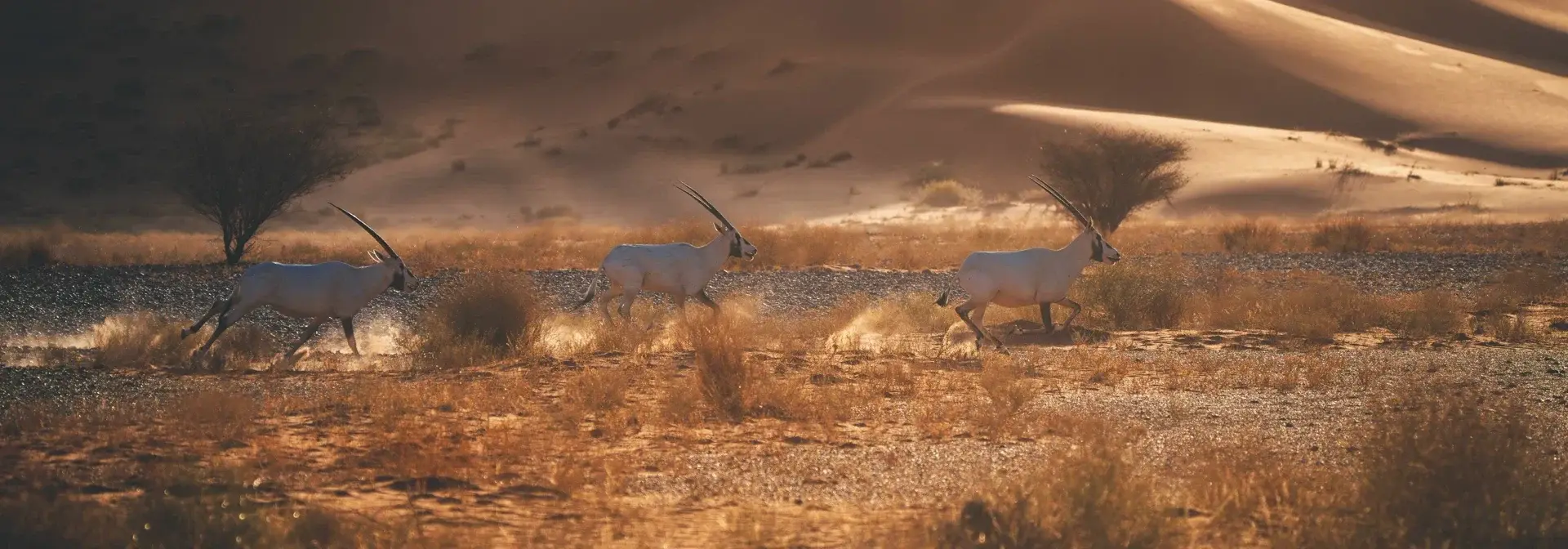
The Arabian Oryx, also known as the wadhi oryx, is a species of wild mammal in the Kingdom of Saudi Arabia and the largest wild mammal in the Arabian Peninsula.[1]
For about ninety years the Arabian Oryx was absent from its natural habitat in northern Saudi Arabia, before returning to the wild through national resettlement programmes in protected reserves, most notably King Salman bin Abdulaziz Royal Reserve and Uruq Bani Ma'arid Reserve.[1][2]
Physical Characteristics
Habitat in the Kingdom of Saudi Arabia
Within the Kingdom of Saudi Arabia, the Arabian Oryx inhabits protected reserves that lie inside its natural range. The most prominent is King Salman bin Abdulaziz Royal Reserve in the Northern Borders Region, a reserve extending over 130,700 square kilometres and the fourth largest terrestrial reserve in the world.[1]
Uruq Bani Ma'arid Reserve lies on the western edge of the Rub' al-Khali. It covers 12,787 square kilometres and was declared in 1417 AH.[2]
Absence from the Wild and Return
In northern Saudi Arabia the Arabian Oryx was absent from its natural habitat for about ninety years. The last place it was seen in the wild was Uruq Bani Ma'arid Reserve, which today carries an intensive and successful programme to resettle the Arabian Oryx, the reem gazelle and the mountain gazelle.[1][2]
The first Arabian Oryx calf to be born in its natural habitat was recorded in King Salman bin Abdulaziz Royal Reserve in the Northern Borders Region on 7 Dhu al-Qi'dah 1443 AH, corresponding to 6 June 2022, following the release of the oryx in the reserve in March 2022.[1]
Breeding and Resettlement Programmes
A national programme in the Kingdom of Saudi Arabia breeds native species threatened with extinction and resettles them in reserves and national parks across all regions of the Kingdom.[3] The National Center for Wildlife announced the release of more than 1,000 wild animals in the 2022 season in various reserves and national parks, after releasing 785 animals in the previous season.[3]
On 21 Jumada al-Akhirah 1443 AH, corresponding to 24 January 2022, 40 Arabian Oryx and 10 Arabian gazelles were released in Uruq Bani Ma'arid Reserve.[3] The Imam Turki bin Abdullah Royal Reserve Development Authority is working to resettle reem gazelles, the wadhi oryx and the red-necked ostrich in order to restore ecological balance and develop wildlife and biological diversity, while protecting, breeding and conserving the Arabian Oryx.[6]
The Kingdom is among the leading international centres specialising in breeding endangered creatures and settling them in their natural habitats in line with the most precise international standards.[7]
Reserves That Host the Arabian Oryx
Imam Turki bin Abdullah Royal Reserve contains about 138 species of wild creatures, among them the wadhi oryx, the reem gazelle and the Arabian wolf. It extends over 91,500 square kilometres and is the second largest of the royal reserves.[5]
Uruq Bani Ma'arid Reserve was added to the Green List of protected areas with effective and equitable management on 28 Dhu al-Hijjah 1446 AH, corresponding to 24 June 2025; the list comprises more than 90 reserves selected from among more than 300,000 reserves worldwide.[4] In King Abdulaziz Royal Reserve, the reserve's development authority has recorded the birth of wadhi oryx calves through satellite-supported tracking devices, in partnership with the National Center for Wildlife.[7]
Tourism and nature
Frequently Asked Questions
Q: What is the Arabian Oryx? A: A species of wild mammal and the largest wild mammal in the Arabian Peninsula, also known as the wadhi oryx.[1]
Q: What are the most notable features of the Arabian Oryx? A: An adult weighs about 80 kilograms, its horns are long and straight or slightly curved, the horns of males are thicker and shorter than those of females, and it has broad hooves that ease its movement over soft sand.[1]
Q: Where does the Arabian Oryx live in Saudi Arabia? A: In several protected reserves, including King Salman bin Abdulaziz Royal Reserve in the Northern Borders Region, Uruq Bani Ma'arid Reserve on the western edge of the Rub' al-Khali, Imam Turki bin Abdullah Royal Reserve and King Abdulaziz Royal Reserve.[1][2][5][7]
Q: How long was the Arabian Oryx absent from the wild? A: About ninety years from its natural habitat in northern Saudi Arabia; the last place it was seen in the wild was Uruq Bani Ma'arid Reserve.[1][2]
Q: When was the first Arabian Oryx calf recorded after its return to its natural habitat? A: On 7 Dhu al-Qi'dah 1443 AH, corresponding to 6 June 2022, in King Salman bin Abdulaziz Royal Reserve, following its release in the reserve in March 2022.[1]
Related topics
- HistoricKing Salman bin Abdulaziz Royal Nature ReserveKing Salman bin Abdulaziz Royal Nature Reserve is a royal nature reserve in the northwest of the Kingdom of Saudi Arabia and the largest reserve in the Middle East, with a total area of 130,700 square kilometres extending across four administrative regions. It contains broad biodiversity and rock art sites inscribed on the UNESCO World Heritage List.
- Reserves and biodiversityUruq Bani Maarid: Conserving Life in the Empty QuarterExplore the dunes and habitats of Uruq Bani Maarid, its wildlife reintroduction programmes, and the significance of its inscription as a natural World Heritage property in 2023.
- RegionNorthern Borders RegionA northern Saudi region administered from Arar, including Rafha, Turaif and Al Uwayqilah, with histories of pilgrimage routes, pastoral activity, Tapline settlement and mining.
- HistoricKing Khalid Royal ReserveKing Khalid Royal Reserve is a royal nature reserve located northeast of Riyadh on an area of 1,162 square kilometres, and its development is overseen by the Imam Abdulaziz bin Muhammad Royal Reserve Development Authority. It encompasses the Al-Urmah mountain range, geological and archaeological landmarks, and programmes for wildlife reintroduction and vegetation protection.
- HistoricAl-Waol Ibex ReserveAl-Waol Ibex Reserve is a nature reserve in the Riyadh Region, supervised and managed by the National Center for Wildlife, located about 120 km south of Riyadh city within the Tuwaiq Mountains range. It was inscribed on 9 October 2024 in the Green List of the International Union for Conservation of Nature, becoming the first reserve in the Kingdom to meet its standards.
Sources & references
- Saudi Press Agency (SPA) — First calf of the wadhi oryx in its natural habitat in King Salman bin Abdulaziz Royal Reserve
- Saudi Press Agency (SPA) — Uruq Bani Ma'arid Reserve and the Arabian Oryx
- Saudi Press Agency (SPA) — Release of the wadhi oryx and Arabian gazelles in Uruq Bani Ma'arid Reserve
- Saudi Press Agency (SPA) — Inclusion of Uruq Bani Ma'arid Reserve on the Green List
- Saudi Press Agency (SPA) — Imam Turki bin Abdullah Royal Reserve
- Saudi Press Agency (SPA) — Resettlement of wild creatures in Imam Turki bin Abdullah Royal Reserve
- Saudi Press Agency (SPA) — Births of the wadhi oryx in King Abdulaziz Royal Reserve