
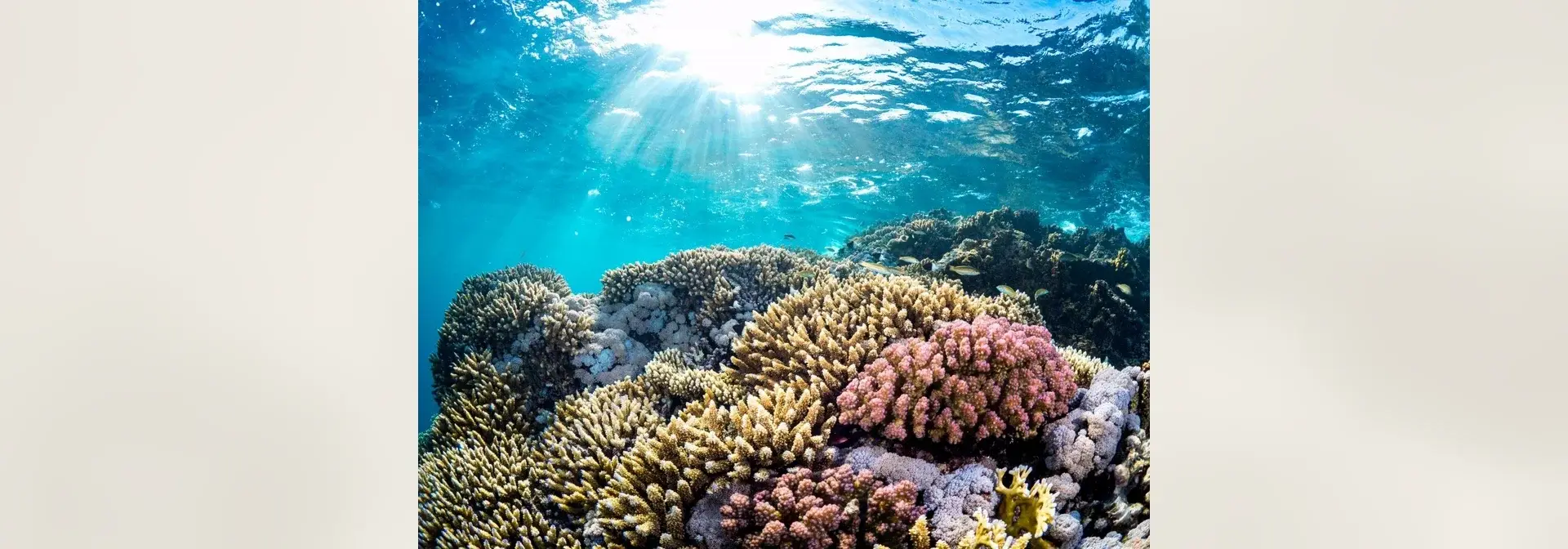
Overview
Coral reefs of Saudi Arabia are marine ecosystems that extend along the Kingdom's coasts on the Red Sea.[1] The Red Sea holds the world's second-longest coral reef system after the Great Barrier Reef, with its reefs extending 2,000 kilometres.[1]
The Kingdom has the longest coastline among the Red Sea states, at about 1,760 kilometres, distinguished by fringing reef systems and island-like formations.[1] Coral reefs support more than 25% of all known marine species, even though they occupy less than 1% of the ocean floor.[1]
Coral Reef Diversity in the Red Sea
The reefs of the Red Sea are known worldwide for their rich biological diversity, comprising more than 300 species of coral and 1,000 species of fish, many of which are found only in the Red Sea.[1] This diversity strengthens the role of coral reefs in providing habitats and breeding grounds for marine species.[1]
Environmental and Economic Importance
Coral reefs in Saudi Arabia contribute to several sectors. They are among the most prominent marine tourism attractions, with diving and snorkelling activities that make them a source of income for the residents of coastal areas.[1] They also support fisheries by providing breeding grounds and habitats for species of economic importance.[1]
Coral reefs act as natural barriers that protect coasts from erosion and damage caused by storms, and they hold genetic resources with biomedical potential that opens prospects for discovering compounds and medicines.[1] These assets support coastal tourism projects on the Red Sea, including the Red Sea Project.
Shams: The Organization Responsible for Coral Reef Protection
The General Organization for the Conservation of Coral Reefs and Sea Turtles in the Red Sea "Shams" was established by a decision of the Saudi government under Council of Ministers Resolution No. (250) dated 25/04/1443 AH, to be the body responsible for protecting, managing and sustaining coral reefs and sea turtles and their habitats on the Red Sea coast.[2]
Shams coordinates and oversees the coral reefs and turtle nesting habitats in the Red Sea, ensures their stewardship, enhancement and sustainability, and revives degraded coral reefs and nesting grounds along its shores.[2]
The Coral Reef Baseline Assessment Project
Shams is carrying out a large-scale survey of coral reefs along the Kingdom's coasts on the Red Sea, in support of the goals of Saudi Vision 2030 for economic diversification, environmental conservation and tourism promotion.[3] The study aims to provide an integrated database on the state of the reefs before any development project, and the project is expected to take three years.[3]
The survey includes measuring the biological diversity, composition and structure of coral reef and fish communities, and documenting their levels of reproduction, health and disease, and it supports the development of high-resolution maps of the Kingdom's Red Sea.[3]
Coral Reef Nurseries in Jeddah
Shams launched a project to establish coral reef nurseries in Jeddah, with its first phase beginning at Lameer Beach in cooperation with the 17sixty diving centre and with support from the Saudi Diving and Marine Sports Federation.[4] The programme began in mid-2024, and the nursery holds 380 coral colonies distributed at various depths and belonging to 13 genera.[4]
The results of the project showed that 298 colonies, representing 78.4% of the total, are in excellent health with fully living tissue, while the number of colonies whose size exceeds 10 centimetres reached 231.[4]
The Kingdom's Standing in Global Coral Reef Protection
Scientific Studies and Reef Resilience
Coral reefs in the northern Red Sea show exceptional resilience against the threat of coral bleaching, and research has demonstrated the ability of these reefs to withstand temperatures above the natural average without high rates of bleaching.[6]
A scientific study by researchers at King Abdullah University of Science and Technology (KAUST) revealed the possibility of priming coral to enhance its ability to resist disease before an outbreak, a discovery that opens prospects for developing proactive means of protecting coral reefs.[7]
Challenges and Response
Rising seawater temperatures stress coral reefs and cause the partnership between coral and algae (zooxanthellae) to break down, so the coral expels the algae and leaves its skeleton bare and white in a process known as coral bleaching.[8]
Overfishing is one of the main threats to marine environments, and it occurs when fishing takes place at a faster rate than fish can reproduce, harming coral reef habitats.[8] Coastal development, untreated discharge, and desalination and power plants add further pressure on the reefs of the Red Sea.[8] These challenges are met by national efforts for protection, restoration and scientific survey carried out by Shams in cooperation with national bodies.[2][3]
Tourism and nature
Frequently Asked Questions
Q: Where are coral reefs found in Saudi Arabia? A: Along the Kingdom's coasts on the Red Sea, and the Red Sea reef system extends 2,000 kilometres.[1]
Q: What is the global ranking of the Red Sea reefs? A: They form the world's second-longest coral reef system after the Great Barrier Reef.[1]
Q: Which body is responsible for protecting coral reefs and sea turtles in the Red Sea? A: The General Organization for the Conservation of Coral Reefs and Sea Turtles in the Red Sea "Shams", established by Council of Ministers Resolution No. (250) dated 25/04/1443 AH.[2]
Q: How many coral colonies are there in the Jeddah nurseries? A: 380 colonies belonging to 13 genera, of which 298 are in excellent health with fully living tissue.[4]
Q: What is Saudi Arabia's position in the International Coral Reef Initiative? A: Saudi Arabia chairs the International Coral Reef Initiative (ICRI) for its fourteenth term starting in 2025; it comprises 45 countries and covers 75% of the world's reefs.[5]
Conclusion
Coral reefs of Saudi Arabia combine high biological diversity across 2,000 kilometres in the Red Sea with national efforts for protection and sustainability led by Shams in support of the goals of Saudi Vision 2030.[1][3] Related topics on the platform include Wildlife in Saudi Arabia, Farasan Islands Reserve and Saudi Green Initiative.
Related topics
- HistoricWildlife of Saudi ArabiaWildlife in Saudi Arabia is a system of desert, sandy, valley, and plateau environments that shelter hundreds of species of mammals, birds, reptiles, and wild plants.[1][2] Nature reserves work to protect and develop it and to reintroduce endangered species into their habitats.[1][3]
- HistoricThe Red Sea ProjectThe Red Sea Project is a global tourism destination on the Red Sea coast in northwestern Saudi Arabia, developed by Red Sea Global within the Public Investment Fund's giga-projects. It spans more than 28,000 square kilometres, includes the world's fourth-largest flourishing coral reef, and aims to welcome one million visitors by 2030.
- TopicSaudi Green InitiativeThe Saudi Green Initiative is a national initiative announced by His Royal Highness the Crown Prince and Prime Minister on 27 March 2021, charting the Kingdom's direction in protecting land and nature along a clear and ambitious roadmap. It targets the planting of 10 billion trees, the raising of protected areas to more than 30 percent, and the supply of 50 percent of electricity generation from renewable energy by 2030.
- National visions and programmesSaudi Vision 2030: A Framework for TransformationAn introduction to Saudi Vision 2030, its social, economic and institutional themes, and the relationship between implementation programmes, long-term targets and measured results.
- RegionJeddah CityJeddah City is a Saudi city that is a gateway to the Two Holy Mosques and a station through which cultures have passed. Its history spans more than 1,400 years, and it is home to Historic Jeddah, inscribed on the World Heritage List in 2014, alongside modern development projects, most notably the Jeddah Central Project.
Sources & references
- General Organization for the Conservation of Coral Reefs and Sea Turtles in the Red Sea "Shams" — Coral Reefs in the Red Sea
- General Organization for the Conservation of Coral Reefs and Sea Turtles in the Red Sea "Shams" — Official Website
- General Organization for the Conservation of Coral Reefs and Sea Turtles in the Red Sea "Shams" — Coral Reef Conservation Projects in the Red Sea
- General Organization for the Conservation of Coral Reefs and Sea Turtles in the Red Sea "Shams" — Project to Propagate and Restore Coral Reefs in Jeddah
- General Organization for the Conservation of Coral Reefs and Sea Turtles in the Red Sea "Shams" — Saudi Arabia's Presidency of the International Coral Reef Initiative
- Saudi Press Agency (SPA) — Resilience of the Northern Red Sea Reefs
- Saudi Press Agency (SPA) — KAUST Study on Coral Disease Resistance
- General Organization for the Conservation of Coral Reefs and Sea Turtles in the Red Sea "Shams" — Threats