
Overview
Wildlife in the Kingdom of Saudi Arabia spans desert environments, sandy plains, valleys, plateaus, steppes, and floodplains, and includes species of mammals, birds, reptiles, invertebrates, and wild plants.[1][2] Nature reserves work to protect these environments, develop species, restore those that have declined, and release them back into their habitats.[1]
Imam Turki bin Abdullah Royal Reserve is among the prominent examples in this field, with a total natural-environment area of about 90,093 km² and more than 265 species of wildlife.[1] Uruq Bani Ma'arid Reserve in the Rub' al Khali offers a global model for returning desert animals to their natural habitats.[2]
Wildlife environments in the Kingdom
Natural environments in the Kingdom are distributed across diverse patterns that include sand dunes, valleys, plains, steppes, plateaus, and floodplains.[1] The Rub' al Khali desert encompasses integrated desert ecosystems, among them longitudinal dunes known as 'uruq', some reaching 200 km in length and 170 m in height, with a wavelength of between 2.5 and 4.5 km.[2]
Imam Turki bin Abdullah Royal Reserve
The total area of the natural environments in Imam Turki bin Abdullah Royal Reserve, per the final classification, is about 90,093 km², distributed as 44,442 km² of sand dunes, 22,869 km² of sandy plains, 15,072 km² of plateaus, 3,906 km² of steppes, 2,827 km² of valleys, and 977 km² of floodplains.[1]
The reserve's environments include sand dunes, valleys, plains, steppes, plateaus, and floodplains, which provide diverse habitats for wildlife and wild plants within its boundaries.[1]
Biodiversity in Imam Turki bin Abdullah Royal Reserve
Imam Turki bin Abdullah Royal Reserve holds more than 265 species of wildlife, including 28 species of mammals, 184 species of birds, 30 species of reptiles, and 23 orders of invertebrates.[1] Its most prominent species include the sand gazelle, the Arabian oryx, the red-necked ostrich, and the houbara bustard.[1]
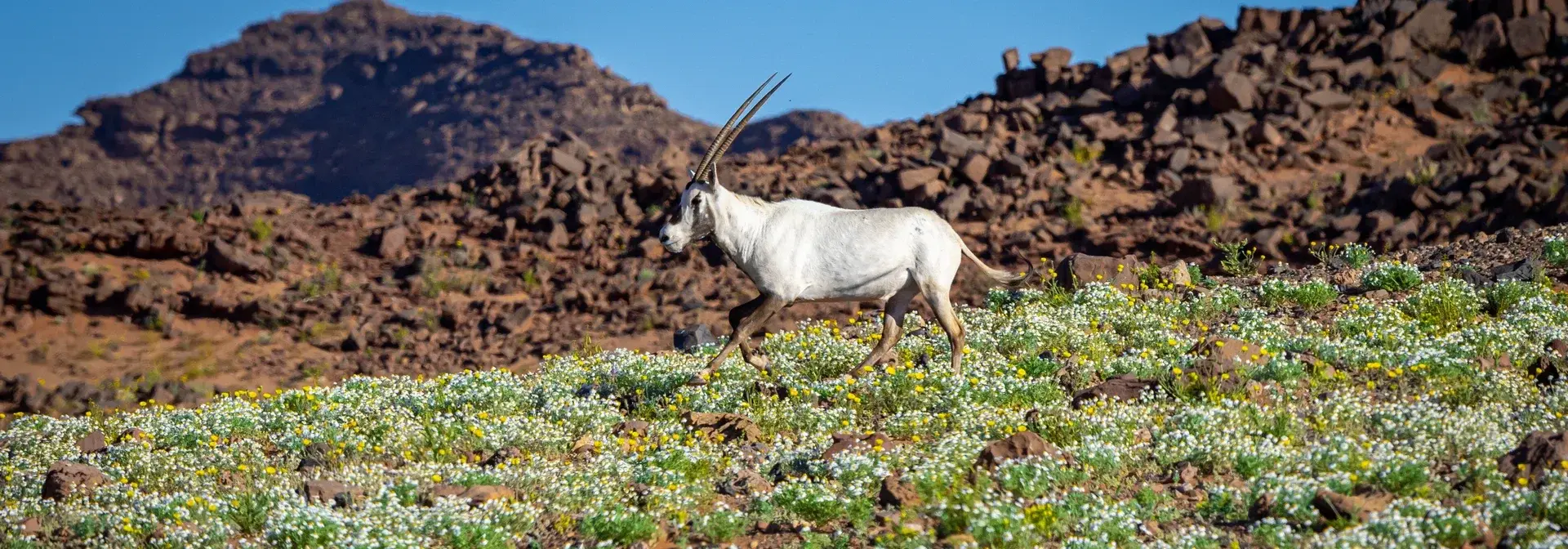
The Arabian oryx is an Arabian antelope with a bright white coat and long, straight horns; it lives in dry sandy plains and is regarded as a symbol of ecological balance.[1] The red-necked ostrich, for its part, is the largest bird on land and is distinguished by strong legs that let it run at speeds exceeding 70 km per hour.[1]
Wild plant cover
Imam Turki bin Abdullah Royal Reserve has recorded 235 plant species representing 47 plant families, including talh, sidr, awsaj, shih, arta, arfaj, ghada, and qaysum.[1] Plant cover in Uruq Bani Ma'arid Reserve is the richest in the Rub' al Khali, with 118 plant species and a high degree of settlement.[2]
Uruq Bani Ma'arid Reserve
The Uruq Bani Ma'arid property encompasses 1.27 million hectares of integrated desert ecosystems, together with a buffer zone of 80,600 hectares.[2] The property counted 526 recorded species at the time of inscription, forming an integrated ecosystem.[2]
The property contains 35 'uruq' (longitudinal dunes), some reaching 200 km in length and 170 m in height, with a wavelength ranging between 2.5 and 4.5 km.[2]
Reintroduction of endangered species
The site of Uruq Bani Ma'arid is distinguished globally for returning distinctive desert animals to their natural habitats, including the Arabian oryx (Oryx leucoryx) and the sand gazelle (Gazella marica).[2] Within the property are 19% of the total global population of the Arabian oryx, 25% of the Arabian sand gazelle, and 2% of the Arabian mountain gazelle.[2]
Nature reserves contribute to the national goals of protecting biodiversity, recovering endangered species, and releasing them into their natural environments, which has brought a marked increase in the numbers of rare species.[1]
Sharaan Nature Reserve
Sharaan Nature Reserve extends over an area of 1,540 km² and aims to protect and regenerate biodiversity in AlUla and to preserve native animal species such as the gazelle, the Arabian oryx, and acacia forests.[3]
The Royal Commission for AlUla works with the International Union for Conservation of Nature (IUCN) to restore and monitor natural reserves, and, in partnership with the College of African Wildlife Management (CAWM), trains the AlUla community to serve as rangers who manage protected areas, monitor them scientifically, and combat illegal hunting.[3]
Protection of the Arabian leopard
The Royal Commission for AlUla is committed to protecting the Arabian leopard, including breeding it and releasing it into the wild, and to establishing a global fund for environmental conservation.[3]
Tourism and nature
Frequently asked questions
Q: What are the most prominent wildlife environments in Saudi Arabia? A: Sand dunes, valleys, plains, steppes, plateaus, and floodplains, along with the desert ecosystems of the Rub' al Khali.[1][2]
Q: How many species of wildlife are there in Imam Turki bin Abdullah Royal Reserve? A: More than 265 species, including 28 species of mammals, 184 species of birds, 30 species of reptiles, and 23 orders of invertebrates.[1]
Q: Which species have been reintroduced in Uruq Bani Ma'arid Reserve? A: The Arabian oryx and the sand gazelle, along with the Arabian sand gazelle and the Arabian mountain gazelle.[2]
Q: What is the area of Sharaan Nature Reserve? A: 1,540 km² in AlUla.[3]
Q: How are endangered species protected? A: Through captive breeding, population growth, habitat protection, and release into natural environments, alongside dedicated programmes for the Arabian leopard.[1][3]
Conclusion
Wildlife in Saudi Arabia combines a diversity of environments with a wealth of plant and animal species, and the efforts of nature reserves that work to protect, restore, and repopulate rare species.[1][2][3]
Related topics on the platform include the Arabian oryx and the Arabian gazelle.
Related topics
- HistoricArabian OryxThe Arabian Oryx, also known as the wadhi oryx, is a species of wild mammal and the largest wild mammal in the Arabian Peninsula. It was absent from its natural habitat in northern Saudi Arabia for about ninety years, then was resettled in protected reserves and released in Uruq Bani Ma'arid Reserve and King Salman bin Abdulaziz Royal Reserve.
- HistoricArabian GazelleThe Arabian Gazelle is among the wildlife species that receive sustained protection in the Kingdom of Saudi Arabia through extensive nature reserves, breeding programmes and reintroduction into natural habitats. Imam Turki bin Abdullah Royal Reserve recorded three newborn Arabian Gazelles in the At-Taysiyah area during the second quarter of 2026.
- HistoricArabian LeopardThe Arabian Leopard is a subspecies of the endangered leopard, known scientifically as Panthera pardus nimr, and is one of the smallest and rarest leopard subspecies. The International Union for Conservation of Nature has classified it as Critically Endangered since 1996, and efforts to conserve it in the Kingdom of Saudi Arabia are tied to the Sharaan Nature Reserve and the Arabian Leopard Breeding and Conservation Centre in AlUla.
- Reserves and biodiversityUruq Bani Maarid: Conserving Life in the Empty QuarterExplore the dunes and habitats of Uruq Bani Maarid, its wildlife reintroduction programmes, and the significance of its inscription as a natural World Heritage property in 2023.