
Overview
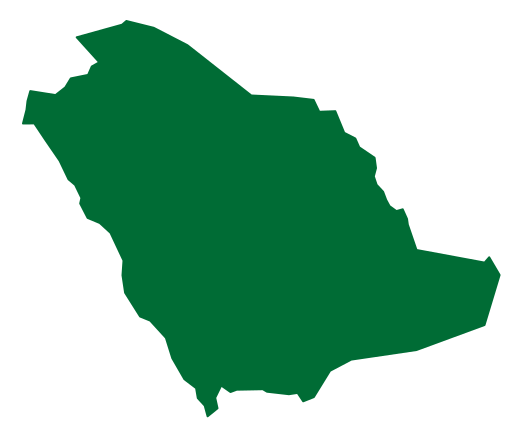
King Salman bin Abdulaziz Royal Nature Reserve is a royal nature reserve in the northwest of the Kingdom of Saudi Arabia and the largest reserve in the Middle East, with a total area of 130,700 square kilometres.[2][3] It extends across four administrative regions: Al-Jouf Region, Hail Region, Tabuk Region and Northern Borders Region, and it contains rock art sites inscribed on the UNESCO World Heritage List.[2]
The reserve was established among the royal reserves founded under the framework of the Council of Royal Reserves, which was created by royal order in Ramadan 1439 AH, corresponding to June 2018, and chaired by His Royal Highness the Crown Prince and Prime Minister Mohammed bin Salman bin Abdulaziz.[1]
Area and Geographical Scope
The reserve has a total area of 130,700 square kilometres, and it is the largest in the Middle East.[3] It extends across four administrative regions: Al-Jouf, Hail, Tabuk and the Northern Borders.[2]
Harrat Al-Harrah lies within the boundaries of the reserve in the northwest of the Kingdom and extends across the Northern Borders and Al-Jouf regions, with an area of 13,775 square kilometres.[5] Its area reaches about 14,000 square kilometres at the border with the Hashemite Kingdom of Jordan east of Wadi Sirhan, and it was previously an independent reserve until it was merged into King Salman bin Abdulaziz Royal Nature Reserve.[9]
Harrat Al-Harrah and Its Volcanic Features
Harrat Al-Harrah is one of the first high-conservation natural areas in the Kingdom, and its surface is formed of a volcanic plateau abounding in black basalt rocks.[5]
It contains a group of low volcanic mountains rising between 800 and 1,150 metres above sea level; Jabal Amud Al-Harrah is among its highest volcanic niches, along with volcanic cones including Jabal Las, Ar-Raha, Tawqa, Al-Hanu, Layla, Al-Mataha and Al-Makman.[5] The harrah embraces one of the largest volcanic craters in the Kingdom.[9]
Biodiversity and Reintroduction
The reserve is home to more than 550 species of wild and pastoral plants, and more than 350 species of wild animals, including mammals, reptiles and amphibians.[3]
More than 1,245 wild creatures have been resettled in it, and more than 120 births of various creatures have been recorded, among them the Reem gazelle, the Arabian wolf, the ibex, the oryx, the houbara bustard and the lappet-faced vulture.[3]
The reserve's development authority released 100 Reem gazelles in early 2021, then 65 gazelles in its Al-Khunfa Reserve on 19 January 2022, in cooperation with the Center for Wildlife Development.[4]
Rock Art in Jubbah
Jabal Umm Sinman in Jubbah lies about 90 km northwest of the city of Hail and is one of the two components of the 'Rock Art of the Hail Region' site inscribed on the UNESCO World Heritage List.[10] Its rock inscriptions cover about 10,000 years of history, and the site was inscribed among the Saudi sites added to the World Heritage List in 2015.[10]
These sites fall within the rock art of Hail, alongside other rock art sites in the Kingdom such as the Hima Cultural Area.
International Standing and Sustainability
On 22 November 2022, the reserve's registration on the World Database on Protected Areas (Protected Planet / WDPA) was announced, making it the first Saudi royal reserve to be registered on this global site.[2]
In October 2022, the reserve's development authority announced its commitment to join the Green List of the International Union for Conservation of Nature, during the seminar 'Natural Reserves: International Foundations and Standards', which it organised in Riyadh over two days in cooperation with the Union.[2]
Conservation and Vegetation Programmes
In March 2022, the reserve's development authority began planting 500,000 tree seedlings, 400,000 in Jubbah and 100,000 in At-Tubayq, in cooperation with the National Center for Vegetation Development, and irrigation and care continue until 2024.[6]
The authority established 4 advisory councils in the administrative regions intersecting its scope: Tabuk, Al-Jouf, the Northern Borders and Hail; each council consists of 10 members and a chair and meets at least twice a year.[7]
On 18 July 2023, the authority signed a memorandum of understanding with the Saudi Geological Survey in the presence of the reserve's chief executive Abdullah bin Ahmed Al-Amer and the authority's president Abdullah Al-Shamrani, to support cooperation in research, studies and projects and the exchange of data and maps.[8]
FAQ
Q: Where is King Salman bin Abdulaziz Royal Nature Reserve located? A: It is located in the northwest of the Kingdom of Saudi Arabia and extends across four administrative regions: Al-Jouf, Hail, Tabuk and the Northern Borders.[2]
Q: What is the reserve's area and its rank among the reserves of the region? A: Its total area is 130,700 square kilometres, and it is the largest reserve in the Middle East.[2][3]
Q: What biodiversity does the reserve hold? A: It is home to more than 550 species of wild and pastoral plants and more than 350 species of wild animals, with more than 1,245 wild creatures resettled and more than 120 births recorded.[3]
Q: What is the reserve's standing internationally? A: It was registered on the World Database on Protected Areas on 22 November 2022 as the first Saudi royal reserve, and it announced its commitment to join the Green List of the International Union for Conservation of Nature.[2]
Q: What are the most prominent heritage sites within the reserve? A: Its scope includes rock art sites in Jubbah, among them Jabal Umm Sinman about 90 km northwest of the city of Hail, inscribed on the UNESCO World Heritage List.[10]
Conclusion
King Salman bin Abdulaziz Royal Nature Reserve combines an area of more than 130,000 square kilometres, an extent across four administrative regions, a biodiversity of hundreds of plant and animal species, and rock art sites registered with UNESCO.[2][3][10]
Related topics on the platform include Farasan Islands Reserve, Ibex Reserve and King Salman bin Abdulaziz Al Saud.
Tourism and nature
Related people
- Kings of Saudi ArabiaKing Salman bin Abdulaziz Al SaudThe seventh Saudi king, Salman acceded in 2015 after serving in Riyadh, defence and the crown princeship. His reign has included Vision 2030 and administrative, economic and social changes.
- PersonPrince Mohammed bin Salman bin AbdulazizCrown Prince since 1438 AH/2017 CE and Prime Minister since 1444 AH/2022 CE, who launched Saudi Vision 2030; the first grandson of King Abdulaziz to lead the Council of Ministers.
Related topics
- RegionJawf RegionA northern Saudi region administered from Sakaka, encompassing Dumat Al Jandal, Al Qurayyat and Tabarjal, with farming, historical landmarks and solar and wind energy projects.
- RegionHail RegionA north-central Saudi region administered from Hail, associated with the Aja and Salma mountains, the Nafud desert, historical caravan routes and varied regional activities.
- RegionTabuk RegionA northwestern Saudi region administered from Tabuk city, combining Red Sea and Gulf of Aqaba coasts with inland centres such as Tayma and a history of trade and pilgrimage routes.
- RegionNorthern Borders RegionA northern Saudi region administered from Arar, including Rafha, Turaif and Al Uwayqilah, with histories of pilgrimage routes, pastoral activity, Tapline settlement and mining.
- HistoricRock Art of HailThe Rock Art of Hail is a World Heritage property in the Hail Region of Saudi Arabia, inscribed on the UNESCO list in 2015, comprising the largest rock art complexes in the Arabian Peninsula with engravings spanning about 10,000 years.
- HistoricHima Cultural AreaOne of the world's largest rock-art complexes, in Thar governorate north of Najran city, inscribed on the UNESCO World Heritage List in 2021.
- HistoricAl-Waol Ibex ReserveAl-Waol Ibex Reserve is a nature reserve in the Riyadh Region, supervised and managed by the National Center for Wildlife, located about 120 km south of Riyadh city within the Tuwaiq Mountains range. It was inscribed on 9 October 2024 in the Green List of the International Union for Conservation of Nature, becoming the first reserve in the Kingdom to meet its standards.