
Overview
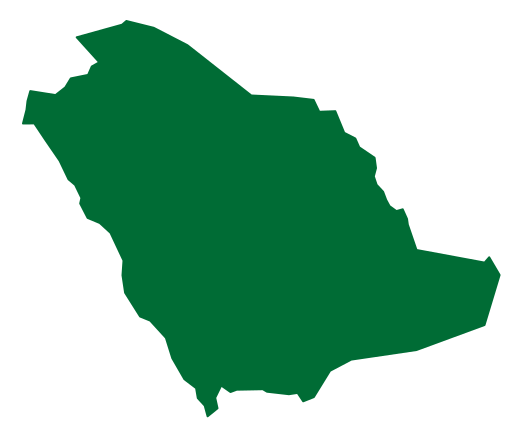
Harrat Al-Harrah Reserve is a high-conservation natural area in northwestern Saudi Arabia, located at the border with the Hashemite Kingdom of Jordan east of Wadi Sirhan, and extending across the Northern Borders and Al-Jawf regions within the boundaries of the King Salman bin Abdulaziz Royal Reserve.[1][2]
It is the first reserve established by the Saudi Wildlife Authority, combining a distinctive volcanic formation with vegetation cover and diverse wildlife.[3]
Location and Geographic Extent
Harrat Al-Harrah lies in the far north of Saudi Arabia, at the border with the Hashemite Kingdom of Jordan, east of Wadi Sirhan.[2]
It extends across two administrative regions, the Northern Borders and Al-Jawf, and lies within the boundaries of the King Salman bin Abdulaziz Royal Reserve as one of its main areas.[1][2] The areas of the encompassing reserve are distributed across four administrative regions: Al-Jawf, Hail, Tabuk, and the Northern Borders.[4]
Area and Status
Harrat Al-Harrah Reserve covers an area of 13,775 square kilometres.[1]
The King Salman bin Abdulaziz Royal Reserve that encompasses it is the largest of the six royal reserves in the Kingdom, covering 130,700 square kilometres; alongside Harrat Al-Harrah, it includes the Al-Khunfah and Al-Tubayq reserves and their adjacent areas.[4]
Geological Formation and Volcanic Craters
The surface of Harrat Al-Harrah consists of a volcanic plateau rich in black basalt rocks, with low volcanic mountains rising between 800 and 1,150 metres above sea level.[1]
Jabal Amud Al-Harrah is among its highest volcanic niches, along with volcanic cones that include the mountains of Las, Ar-Raha, Tawqah, Al-Hanw, Layla, Al-Mutahah, and Al-Makman.[1]
Depressions, water traps, and valleys spread across the centre and the edges of the reserve, including Al-Buraydiyah, Shuwayhit, Ma'arik, Al-U'ayli, and Ad-Dasm, alongside springs and water sources.[1] Harrat Al-Harrah is known for its volcanic craters, among them the Makman Mushawir crater, with its steeply sloped formation, which is one of the largest volcanic craters in the Kingdom.[4]
Vegetation Cover and Truffles
Harrat Al-Harrah is characterised by the diversity of its vegetation cover, made up of perennial and annual plants.[1] Its most important trees include the tarfah, athl, ghada, arti, and awsaj; its shrubs include the qaysum, ba'ithran, shih, and damran; and its grasses include the khuzama, khuzam, riblah, hummayd, 'abl, and hawzan.[1]
Among the most important tuberous fungi in the reserve is the faq', or truffle, for which Harrat Al-Harrah is known.[1]
Wildlife
Harrat Al-Harrah is home to a number of mammal and bird species, most importantly the reem gazelle, the idmi gazelle, the wolf, the Arabian fox, the sand fox, the striped hyena, the desert hare, and the jerboa, alongside many species of resident and migratory birds.[1]
The King Salman Reserve Development Authority has released large numbers of reem gazelles, oryx, ibex, and houbara bustards into Harrat Al-Harrah in recent years, in cooperation with the National Center for Wildlife Development, to breed and reintroduce locally endangered species.[2]
Protection and Management
Harrat Al-Harrah was previously an independent reserve, until it was merged with a number of reserves and sites within the King Salman bin Abdulaziz Royal Reserve.[2] The reserve's development authority is responsible for raising awareness of its areas, developing them, and protecting their natural components.[2]
The competent authorities organised entry to the reserve for truffle gathering, at 50 permits per day distributed among the centres, in cooperation with the governorates of the Al-Jawf and Northern Borders regions, with entry allowed from Tuesday to Friday.[3]
As part of protecting vegetation cover and ecological balance, the King Salman Reserve Development Authority launched joint field teams with the Ministry of Environment, Water and Agriculture and the Special Forces for Environmental Security to count and remove free-roaming camels from the environmentally sensitive Harrat Al-Harrah area, after the deadline set for their owners had passed.[5]
The authority also apprehended a number of violators of regulations within the reserve's boundaries and referred them to the competent authorities; the violations included entering prohibited areas without a permit, with fines ranging between 500 and 2,000 riyals.[8]
Tree Planting and Environmental Events
The King Salman Reserve Development Authority carried out a tree-planting campaign in Harrat Al-Harrah as part of the 'Nanthurha li-Ghadin Akhdar' (We Scatter It for a Greener Tomorrow) campaign, planting 200 talh tree seedlings with the participation of 14 volunteers and in cooperation with the Sidr Al-Jawf Green Association, and scattering 60 kilograms of seeds in February 2022.[6]
The authority also launched the 'Discover Harrat Al-Harrah' event during the reserve's spring season, which lasted 15 days and was held in the reserve's closed areas, with registration through the authority's official website.[7]
Frequently Asked Questions
Q: Where is Harrat Al-Harrah Reserve located? A: In northern Saudi Arabia at the border with the Hashemite Kingdom of Jordan, east of Wadi Sirhan, extending across the Northern Borders and Al-Jawf regions.[1][2]
Q: What is the area of Harrat Al-Harrah Reserve? A: 13,775 square kilometres; it is a main area within the King Salman bin Abdulaziz Royal Reserve.[1]
Q: What are the most prominent geological features of Harrat Al-Harrah? A: A volcanic plateau rich in black basalt rocks, low volcanic mountains rising between 800 and 1,150 metres, and volcanic craters, the most famous of which is Makman Mushawir.[1][4]
Q: What are the most prominent animals in the reserve? A: The reem gazelle, the idmi gazelle, the wolf, the Arabian fox, the sand fox, the striped hyena, the desert hare, and the jerboa, alongside resident and migratory birds.[1]
Q: How is entry to the reserve organised? A: Entry is allowed for specific purposes such as truffle gathering under permits, at 50 permits per day from Tuesday to Friday, and violations within the reserve's boundaries are apprehended.[3][8]
Conclusion
Protection, development, species reintroduction, and tree-planting efforts continue in Harrat Al-Harrah Reserve, alongside introducing visitors to its natural features.[2][6][7] Related topics on the platform include the Hail Region, the Great Nefud Desert, and the Ibex Reserve.
Related topics
- HistoricKing Salman bin Abdulaziz Royal Nature ReserveKing Salman bin Abdulaziz Royal Nature Reserve is a royal nature reserve in the northwest of the Kingdom of Saudi Arabia and the largest reserve in the Middle East, with a total area of 130,700 square kilometres extending across four administrative regions. It contains broad biodiversity and rock art sites inscribed on the UNESCO World Heritage List.
- RegionJawf RegionA northern Saudi region administered from Sakaka, encompassing Dumat Al Jandal, Al Qurayyat and Tabarjal, with farming, historical landmarks and solar and wind energy projects.
- RegionNorthern Borders RegionA northern Saudi region administered from Arar, including Rafha, Turaif and Al Uwayqilah, with histories of pilgrimage routes, pastoral activity, Tapline settlement and mining.
- RegionHail RegionA north-central Saudi region administered from Hail, associated with the Aja and Salma mountains, the Nafud desert, historical caravan routes and varied regional activities.
- HistoricThe Great Nafud DesertThe Great Nafud Desert is a vast sand sea in the north of the Kingdom of Saudi Arabia, covering about 65,000 km², or nearly 3.2% of the Kingdom's land area, with wide parts lying within the Imam Turki bin Abdullah Royal Reserve. It contains a diversity of dune forms and notable landmarks such as Jabal Al-Ulaym and Nafud Al-Ashyakh.
- HistoricAl-Waol Ibex ReserveAl-Waol Ibex Reserve is a nature reserve in the Riyadh Region, supervised and managed by the National Center for Wildlife, located about 120 km south of Riyadh city within the Tuwaiq Mountains range. It was inscribed on 9 October 2024 in the Green List of the International Union for Conservation of Nature, becoming the first reserve in the Kingdom to meet its standards.
Sources & references
- Saudi Press Agency (SPA) — Harrat Al-Harrah Reserve: location, area, formation, and wildlife
- Saudi Press Agency (SPA) — location of Harrat Al-Harrah, its status within the King Salman Reserve, and reintroduction
- Saudi Press Agency (SPA) — Harrat Al-Harrah as the first reserve and the organisation of truffle gathering
- Saudi Press Agency (SPA) — the King Salman Royal Reserve and the volcanic craters of Harrat Al-Harrah
- Saudi Press Agency (SPA) — removal of free-roaming camels from Harrat Al-Harrah
- Saudi Press Agency (SPA) — tree-planting campaign in Harrat Al-Harrah
- Saudi Press Agency (SPA) — the 'Discover Harrat Al-Harrah' event
- Saudi Press Agency (SPA) — apprehension of regulation violators within Harrat Al-Harrah Reserve