
Overview
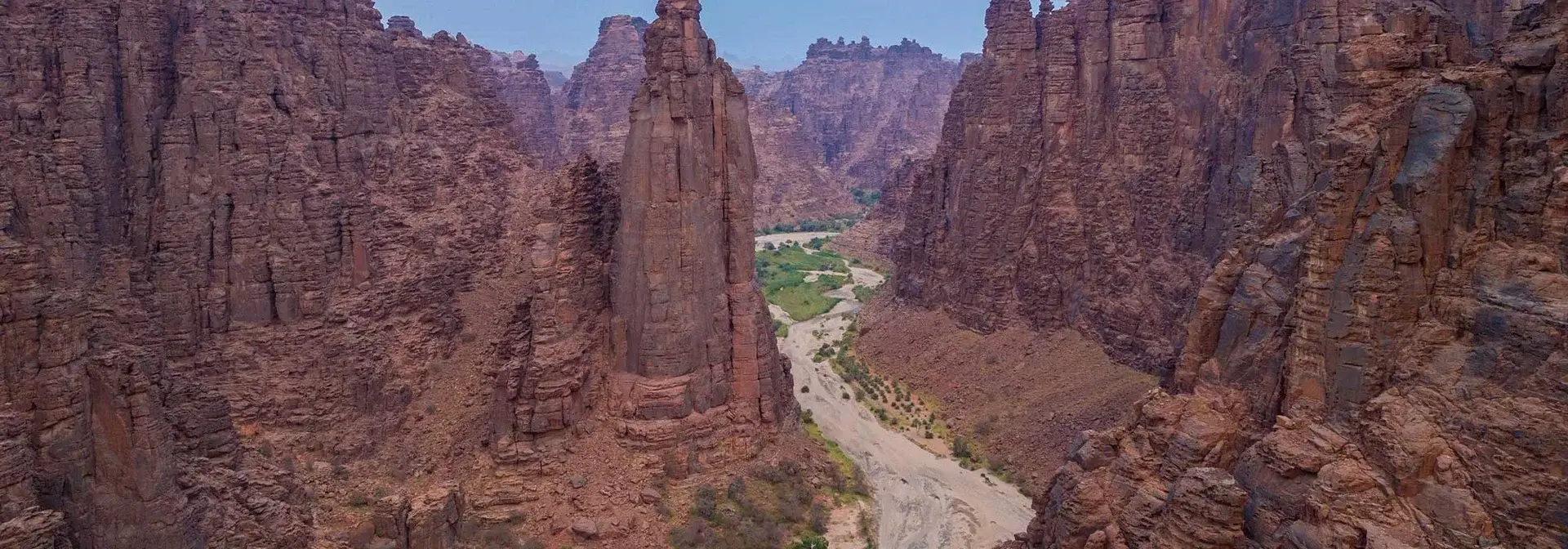
Wadi Disah is a valley in the north-west of the Prince Mohammed bin Salman Royal Reserve and the south-west of the Tabuk region in the north-west of the Kingdom of Saudi Arabia, and it lies about 200 km south-west of the city of Tabuk.[1][2]
The word "Disah" denotes a valley filled with palm trees.[1] The valley rises about 400 m above sea level, and freshwater springs and towering rock pillars are spread through it, alongside archaeological sites that testify to ancient civilisations which succeeded one another in the north-west of the Kingdom.[1][2]
Location and Geography
Disah lies in Wadi Dama, and Disah Park forms a mountain gorge between the Qaraqir mountains that begins from the upper reaches of Harrat ar-Rahah, whose floodwaters descend across the park to flow into the sea.[3][4]
Wadi Qaraqir is among the best known of Disah's valleys; it rises from the foothills of the Harrat, branches above into two channels, and flows out south of Duba.[5]
Natural Features and Springs
Wadi Disah holds a variety of mountain forms and rock edges that make up towering rock pillars, and freshwater springs are available in it.[1]
The springs of Disah rise from its mountains, and dense palms and reeds are spread through it. Among the springs of Wadi Qaraqir are the Blue Spring, Al-Qitar, At-Tarif and An-Namtiyah.[4][5]
Antiquities
Wadi Disah contains archaeological sites that include the facades of Nabataean tombs carved into the rock, and the remains of walls bearing Nabataean and Arabic inscriptions in Kufic script.[1]
Disah holds antiquities and ancient inscriptions that testify to civilisations which succeeded one another in the north-west of the Kingdom, and a related topic on the platform is the history of Hegra.[2][4]
Agriculture and Nabq
Disah's elevation of about 400 m above sea level and its soil equipped it to be an agricultural area producing the finest vegetables and fruits, among them mango of high quality, palms, reeds and dense papyrus.[3]
The farms of Disah produce five varieties of nabq, and palms complete their agricultural output; a related topic on the platform is date palm cultivation in Saudi Arabia.[3][6]
The Disah Festival
The farmers of Disah were encouraged to produce and cultivate strawberries in large quantities alongside nabq, in parallel with the launch of the Disah Festival in its second edition under the title "Nabq wa Habaq".[7]
Historical Milestones
Ibrahim ibn Shuja al-Dimashqi mentioned in a book he wrote in 623 AH that Disah is the first stopping place after Tabuk for those heading for the Hijaz.[8]
Young people from the Disah centre in Duba Governorate raised the flag of the Kingdom of Saudi Arabia on the summit of Jabal al-Raddah in Disah, at an elevation of 960 m above sea level.[9]
Wadi Disah Development Project
The Public Investment Fund, the sovereign wealth fund of the Kingdom of Saudi Arabia, announced the launch of the Wadi Disah development project, which lies within the Prince Mohammed bin Salman Royal Reserve.[1]
The valley lies inside the boundaries of the reserve, whose works are carried out by the Prince Mohammed bin Salman Royal Reserve Development Authority, and the Governor of the Tabuk region received its chief executive officer on 16 November 2022.[10]
Roads and Services
The Wadi Disah road was carried out in two phases; the first phase was completed in 1998 and the second in 2005.[2]
The road is one of the projects of the Ministry of Transport and Logistic Services in the Tabuk region, and it serves tourist traffic and enhances quality of life by providing roads of a high standard of safety and quality that lead to tourist and heritage areas; a related topic on the platform is the Quality of Life Program.[11]
Frequently Asked Questions
Q: Where is Wadi Disah located? A: In the north-west of the Prince Mohammed bin Salman Royal Reserve and the south-west of the Tabuk region, about 200 km south-west of the city of Tabuk.[1][2]
Q: What does the name "Disah" mean? A: A valley filled with palm trees.[1]
Q: What are the most prominent features of Wadi Disah? A: Towering rock pillars, freshwater springs and a mountain gorge between the Qaraqir mountains, alongside Nabataean tombs carved into the rock and Nabataean and Kufic inscriptions.[1][4]
Q: What are the main products of Disah's farms? A: Mango, palms, reeds and papyrus, and five varieties of nabq alongside strawberries.[3][6][7]
Q: When was the Wadi Disah road completed? A: In two phases; the first phase was completed in 1998 and the second in 2005.[2]
Conclusion
Related topics
- RegionTabuk RegionA northwestern Saudi region administered from Tabuk city, combining Red Sea and Gulf of Aqaba coasts with inland centres such as Tayma and a history of trade and pilgrimage routes.
- HistoricPrince Mohammed bin Salman Royal ReservePrince Mohammed bin Salman Royal Reserve is a royal reserve in the northwest of the Kingdom of Saudi Arabia. It extends over an area of 24,500 square kilometers and encompasses 15 ecosystems, containing more than 50% of the Kingdom's wildlife species. Established by royal decree and overseen by the Council of Royal Reserves chaired by His Royal Highness the Crown Prince and Prime Minister, it combines wildlife reintroduction, ecological tourism and biodiversity conservation.
- TopicThe Public Investment FundThe Public Investment Fund is a Saudi fund established in 1971 CE/1391 AH under Royal Decree No. (M/24), and linked in 1436 AH/2015 CE to the Council of Economic and Development Affairs. The assets it manages exceed SAR 3.4 trillion, and its activity spans three investment portfolios and giga-projects including NEOM, Qiddiya, the Red Sea, Roshn, and Diriyah.
- Archaeological sitesHistory of HegraHegra, also called Mada'in Salih, is an archaeological site in AlUla Governorate whose tombs, wells and inscriptions illuminate Nabataean life and caravan routes.
- Agricultural heritage and traditional knowledgeDate Palm Cultivation in Saudi ArabiaDate palm cultivation in Saudi Arabia combines food production with knowledge of irrigation, pollination and fruit care. Al-Ahsa illustrates its links to farming heritage.
- TopicQuality of Life ProgramThe Quality of Life Program is one of the programs realizing Saudi Vision 2030; it was launched in 2018 to improve and enrich the life of the individual and the family. It works on ten strategic objectives within seven sectors and carries out its work in cooperation with 23 partner entities through 173 initiatives and 42 strategic indicators.
Sources & references
- Saudi Press Agency (SPA) — "Economy / The Public Investment Fund announces the Wadi Disah development project within the Prince Mohammed bin Salman Reserve"
- Saudi Press Agency (SPA) — "General / The Wadi Disah road enhances tourism in Wadi Disah in Tabuk"
- Saudi Press Agency (SPA) — "Tourism and Entertainment / Wadi Disah in Tabuk .. stunning nature sought by foreign tourists"
- Saudi Press Agency (SPA) — "General / Tabuk tourism reveals its future project to develop Disah Park"
- Saudi Press Agency (SPA) — "General / Depth of history and magic of nature .. Disah, a tourist destination in the Saudi winter"
- Saudi Press Agency (SPA) — "General / The nabq tree... the agricultural identity of Disah in the Tabuk region"
- Saudi Press Agency (SPA) — "General / Success of strawberry cultivation in Disah in the Tabuk region"
- Saudi Press Agency (SPA) — "Report / The Disah tourist site in the Tabuk region, the first stopping place for those heading for the Hijaz in the past"
- Saudi Press Agency (SPA) — "General / Young people of the Disah centre in Tabuk raise the banner of Tawhid on the summit of the Disah mountains"
- Saudi Press Agency (SPA) — "General / His Highness the Governor of Tabuk receives the head of the Prince Mohammed bin Salman Royal Reserve Development Authority"
- Saudi Press Agency (SPA) — "General / The Wadi Disah road in the Tabuk region.. one of the Ministry of Transport's projects serving tourist traffic"