
Lineage and early life
Imam Muhammad bin Saud bin Muhammad bin Muqrin (1090–1179 AH/1679–1765 CE) founded the First Saudi State in 1139 AH/1727 CE and led its armies in its early years, making Diriyah its capital and Islamic law its constitution. [1]
His forebears belonged to Banu Hanifah, who had settled along Wadi Hanifah; his ancestors returned to central Arabia in 850 AH/1446 CE and founded Diriyah. His father, Saud bin Muhammad, ruled the emirate of Diriyah from 1132 AH/1719 CE. [1]
Founding the state
He took charge of Diriyah in 1139 AH/1727 CE, secured it and the pilgrimage and trade routes through it, organised its economy and widened its ties with tribes and towns, turning the emirate into a state. [1]
In 1157 AH/1744 CE Sheikh Muhammad ibn Abd al-Wahhab moved to Diriyah, and the imam supported his reform call. He led campaigns to unite central Arabia, including twelve battles for Riyadh, and lost his sons Faisal and Saud in a battle in 1160 AH/1746 CE. [1]
Related people
Rule and legacy
Related topics
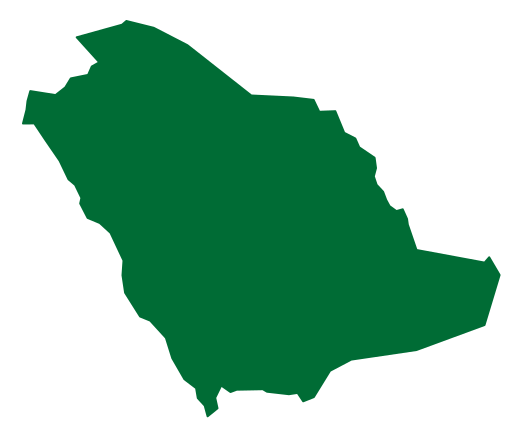
- Saudi statesThe First Saudi StateA state centred on Diriyah under Imam Muhammad bin Saud, officially dated in Saudi chronology to 1727. It expanded across Najd and other regions before its capital fell in 1818.
- GovernorateDiriyah GovernorateA governorate north-west of Riyadh on Wadi Hanifah, founded in 850 AH/1446 CE, capital of the First Saudi State and home to the World Heritage site of At-Turaif.
- HistoricAt-Turaif DistrictA historic district at the heart of Diriyah, built in the mid-eighteenth century CE, seat of the First Saudi State and a UNESCO World Heritage site since 2010.
- Urban historyHistory of DiriyahDiriyah developed beside Wadi Hanifah and became the First Saudi State's capital. At-Turaif preserves evidence of its political history and Najdi architecture.