
What was the First Saudi State?
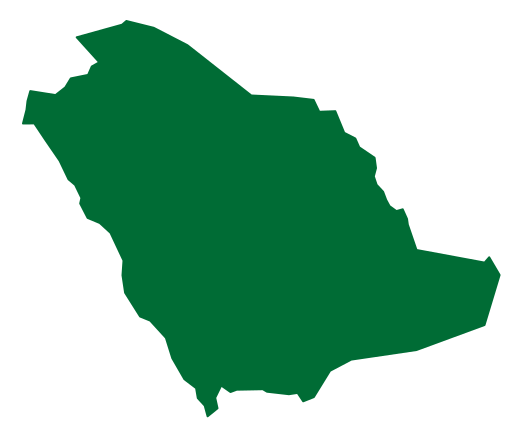
The First Saudi State was the earliest phase of Al Saud rule centred on Diriyah, its capital, before expanding into Najd and other parts of the Arabian Peninsula. Imam Muhammad bin Saud assumed power in Diriyah in 1727, the year Saudipedia and the official Founding Day website use for the state's beginning. English Wikipedia also calls it the Emirate of Diriyah. This historical state was not the Kingdom named in 1932, and the two entities should not be assumed to have had identical borders.
Founding question: why do 1727 and 1744 both appear?
The year 1727 marks Muhammad bin Saud's accession in Diriyah and the state's beginning in official Saudi chronology. The year 1744 concerns Sheikh Muhammad ibn Abd al-Wahhab's move to Diriyah and Muhammad bin Saud's support for his religious movement; Saudipedia's founder biography confirms this sequence. English Wikipedia's state article begins its period in 1744 and discusses the official adoption of 1727 separately. The dates therefore reflect different ways of defining the period's beginning, not a single founding event occurring twice; the political and religious alliance followed the accession.
Diriyah: the capital and At-Turaif
Diriyah was the state's political decision-making centre, and its At-Turaif district became an important seat of government. Its surviving palaces, adobe buildings and geometric decoration illustrate Najdi architectural traditions. UNESCO links the district's significance to its growing political and religious role in the eighteenth and early nineteenth centuries and inscribed it on the World Heritage List in 2010. The designation covers At-Turaif, not the whole city of Diriyah or all the First Saudi State's territories.
Rulers: from Muhammad bin Saud to Abdullah bin Saud
Four imams ruled in succession: Muhammad bin Saud, who assumed power in Diriyah in 1727 and ruled until 1765; his son Abdulaziz bin Muhammad, 1765–1803; Saud bin Abdulaziz, 1803–1814; and Abdullah bin Saud, 1814–1818. This sequence traces leadership through successive generations of the family. Abdulaziz's reign was associated with territorial expansion, and the state's influence reached widely under Saud, while Abdullah faced the final phase of the Ottoman campaigns.
Expansion from Najd into other Arabian regions
The state did not acquire its territories all at once. Its rule spread from Diriyah to Najdi towns, and Riyadh came under Abdulaziz bin Muhammad in 1773. Its influence later extended into Al-Ahsa, parts of eastern Arabia, Asir and the Hejaz, including Makkah and Madinah. Local support, alliances and military campaigns all formed part of this expansion. Control of the Hejaz and its holy cities became a direct point of competition with the Ottoman Empire; these regional references do not describe fixed borders throughout the state's existence.
1811–1818: campaigns and the fall of the capital
The Ottoman Empire tasked Muhammad Ali Pasha, its governor in Egypt, with confronting the Saudi state, and his campaigns began in 1811. His son Ibrahim Pasha subsequently led forces into Najd and besieged Diriyah. The siege ended with Imam Abdullah bin Saud's surrender and the capital's fall in 1818, bringing the First Saudi State's rule to an end. Destruction in Diriyah and the removal of members of the ruling family followed. The endpoint concerns the loss of the seat of government, not the disappearance of the town or the Saudi family from history.
What continued after 1818?
Diriyah's fall did not permanently end the history of Al Saud rule. Imam Turki bin Abdullah restored Saudi rule from Riyadh in 1824, beginning the Second Saudi State with a different capital. The first state's significance lies in the emergence of regional government from Diriyah, its political and religious alliance, and urban centres whose surviving remains continue to be studied. Founding Day, observed on 22 February, commemorates the officially recognised beginning in 1727; National Day on 23 September concerns the Kingdom's unification and naming in 1932.


