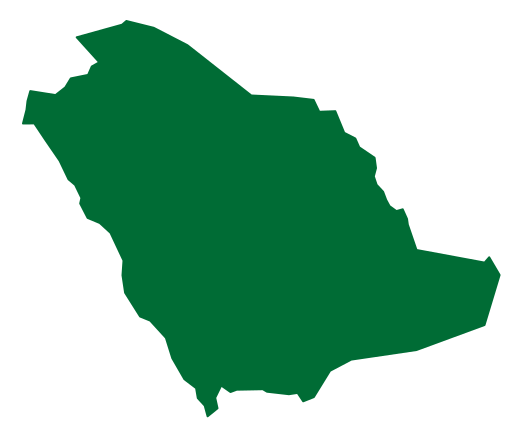

Overview
Elephant Rock (Jabal AlFil) is a massive rock formation in AlUla Governorate, in the Madinah Region. It resembles an elephant in form and rises about 52 metres above ground, and it forms an important part of the tourist landmarks that draw visitors from countries around the world [1].
It is among the most prominent geological formations in AlUla, sculpted by natural forces from sandstone until it took the form of a giant elephant amid the desert sands, becoming a landmark at the forefront of what combines, for the visitor, the beauty of nature with the region's deep-rooted history [3][6].
Location and Geological Formation
Elephant Rock lies in AlUla Governorate, within the Madinah Region. AlUla is among the richest homes of geological formations in the Kingdom: its oldest rocks date back nearly a billion years and are classed among the earliest evidence of life in Saudi Arabia, containing layers of fossilised microbial mats dating back about 600 million years, while human settlement there extends 200,000 years [1][5].
Over thousands of years, natural erosion shaped Elephant Rock until it took its distinctive form, and towering rock formations surround it, lending the site a singular visual scene and offering multiple angles for photography [3]. The rock is described as sandstone sculpted by rain, wind and sand over millions of years until it acquired the elephant's shape [6].
Facilities and Visitor Experiences
The Royal Commission for AlUla has developed the facilities adjacent to the rock, creating car parks, pedestrian walkways and private seating for individuals and families, and providing a number of restaurants and cafés that serve food and drinks throughout the week [1]. It has also developed the infrastructure around the site and services that ease access to it without compromising its historical and natural features [2].
At Elephant Rock the visitor finds an experience that combines the beauty of nature with history, including strolling among the rock formations, taking photographs and drinking Saudi coffee, alongside learning about the region's history on guided tours [2]. The Royal Commission for AlUla lists the "Elephant Rock by Horseback" experience among its approved tourism experiences [7].
Access and Visiting Hours
Elephant Rock is a 20-minute drive from AlUla Old Town. It can be reached on a tourist tour with a specialist guide or by private car via a site near Highway 70, where free parking is available and the visitor passes along a wooden walkway linking the car park to the rock [6].
The site welcomes its visitors daily from 4 p.m. until midnight, and its charm grows at sunset as the colours of the rocks shift under distinctive lighting [6].
Tourist Standing and Preservation of the Landmark
Elephant Rock is one of the prominent tourist destinations in AlUla Governorate, thanks to its unique natural beauty in the form of a standing elephant, and it has become a key attraction for tourists from countries around the world [2]. It is likewise among the most prominent natural destinations sought by residents and visitors during the summer season, with its rock formations and ever-renewing natural scenery [3].
In the evening hours the site takes on a different character, as the colours of the rocks grade with the light of sunset, and its open spaces offer a calm atmosphere that lets visitors enjoy the clear sky and watch the stars [3]. During the holy month of Ramadan, residents and visitors make for the rock to have iftar in an open setting surrounded by rock formations and the golden sands for which the governorate is known [4].
The "Witness Rock" campaign, launched by the Royal Commission for AlUla as a continuation of the "Our Heritage, Our Responsibility" campaign, aims to raise awareness of preserving rock formations and cultural heritage; it showcases famous geological examples, among them Elephant Rock, alongside the Hegra site inscribed on the UNESCO World Heritage List [5].
Frequently Asked Questions
Q: Where is Elephant Rock located? A: In AlUla Governorate, in the Madinah Region.
Q: How tall is Elephant Rock? A: About 52 metres above ground.
Q: How did Elephant Rock form? A: Natural erosion by rain, wind and sand sculpted it over millions of years until it took its form from sandstone.
Q: When does the site open and how can it be reached? A: It welcomes visitors daily from 4 p.m. until midnight, and it is a 20-minute drive from the Old Town near Highway 70, where free parking and a wooden walkway lead to the site.
Q: What experiences are available at the site? A: Strolling among the rock formations, photography, drinking Saudi coffee and guided tours, alongside the "Elephant Rock by Horseback" experience among the approved tourism experiences.
Conclusion
Elephant Rock combines a unique geological formation with a prominent tourist standing in AlUla Governorate, alongside nearby landmarks on the platform such as the Geography of AlUla, the Hima Cultural Area and Jabal Al-Lawz [2][5].
Related topics
- Governorate and oasis geographyGeography of AlUlaAlUla is a governorate in Madinah Region in northwestern Saudi Arabia, where cultivated oases and settlements lie among wadis and desert escarpments.
- HistoricAlUla Old TownAlUla Old Town is a historic settlement in the centre of AlUla Governorate, preserving an earthen urban fabric of hundreds of houses, markets and historic passageways. It was selected among the Best Tourism Villages in the World for 2022.
- Archaeological sitesHistory of HegraHegra, also called Mada'in Salih, is an archaeological site in AlUla Governorate whose tombs, wells and inscriptions illuminate Nabataean life and caravan routes.
- HistoricHima Cultural AreaOne of the world's largest rock-art complexes, in Thar governorate north of Najran city, inscribed on the UNESCO World Heritage List in 2021.
- HistoricJabal Al-LawzJabal Al-Lawz is a mountain peak in north-western Saudi Arabia, located within the Madyan Mountains in the Tabuk region and rising 2,580 metres above sea level. It is known for the snow that settles on its summit in winter, and it contains rock carvings dating back more than ten thousand years.
- RegionMadinah RegionA western Saudi region combining Madinah, Yanbu, AlUla and other governorates, with Islamic landmarks, oases, archaeological sites and a Red Sea coastline.
Sources & references
- Saudi Press Agency (SPA) — "Elephant Rock".. a unique tourist landmark attracting visitors to AlUla
- Saudi Press Agency (SPA) — Elephant Rock in AlUla Governorate.. a tourist landmark drawing visitors from around the world
- Saudi Press Agency (SPA) — Elephant Rock in AlUla.. a summer destination where nature and varied experiences harmonise
- Saudi Press Agency (SPA) — Elephant Rock in AlUla.. a favourite destination for residents and visitors for Ramadan iftar
- Saudi Press Agency (SPA) — Royal Commission for AlUla launches a new campaign titled "Witness Rock" to raise awareness of natural assets
- Royal Commission for AlUla — Experience AlUla: "Elephant Rock" page
- Royal Commission for AlUla — Experience AlUla: "Elephant Rock by Horseback"