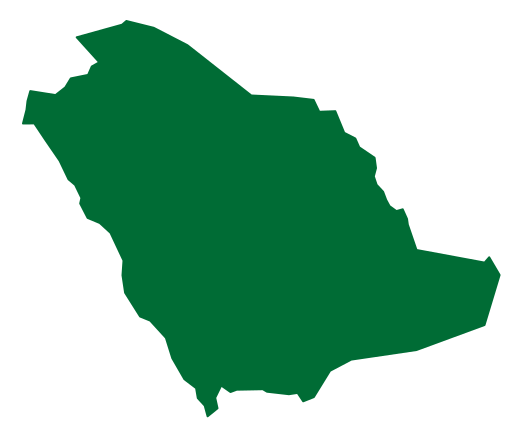

The city and its administrative region
Madinah is the regional administrative seat and a city central to Islamic history. The wider region includes governorates such as Yanbu, AlUla, Khaybar, Badr and Al Mahd, rather than being confined to the city itself. AlUla is a governorate of Madinah Region, not a separate administrative region. This distinction matters when reading maps or comparing information about Saudi cities and regions. [1][2]
From the coast to inland oases
The region combines a Red Sea coast with inland wadis, oases and volcanic landscapes. Yanbu has maritime and industrial functions, while oasis environments and archaeological sites are prominent in AlUla and Khaybar. Local conditions differ between coast and interior, so neither an image of the Prophet's Mosque nor an oasis landscape alone represents the region's full environmental and economic diversity. [1][2]
Different layers of history
Madinah contains the Prophet's Mosque, Quba Mosque and places associated with Islamic history, whereas Hegra in the AlUla area preserves evidence of Nabataean civilisation. Together, these places illuminate the long history of settlement and movement in western Arabia. Hegra is distinct from Madinah city: attributes of one should not be transferred to the other simply because both belong to the same administrative region. [1][2]
Services and economic activity
Visitor services, education and commerce operate alongside coastal industry and mining associated with Mahd adh Dhahab. Roads and airports support movement between the region's centres. The encyclopedia's separate article on AlUla explores its oasis environment in more detail. Current arrangements for visiting archaeological and religious sites should be checked with the responsible organisations rather than inferred from a general regional introduction. [1][2]


.jpg)