

Overview
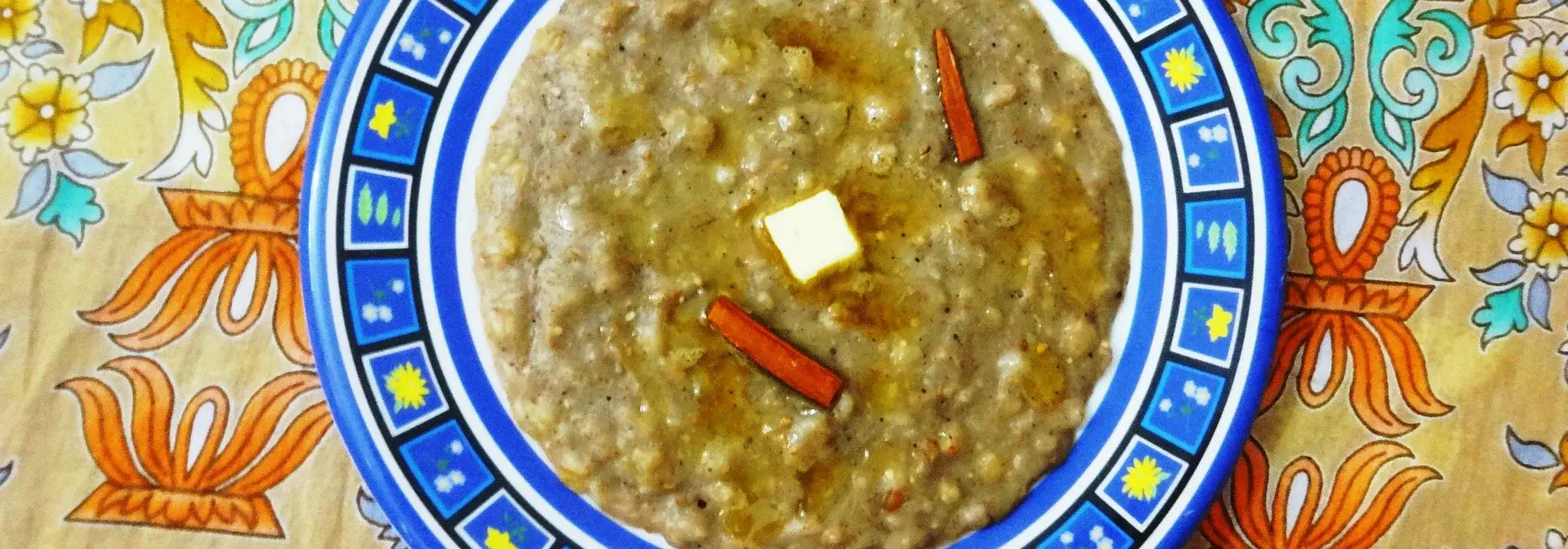
Harees is a popular traditional dish made from wheat grain, meat and ghee, and it is present in Saudi Arabia, the United Arab Emirates and Oman, where it appears in folk stories, sayings and poetry.[2] Preparing and serving it is viewed as a sign of hospitality and generosity and as a means of promoting social connection and cultural affinity between people and communities.[2] Harees was inscribed in 2023 on the Representative List of the Intangible Cultural Heritage of Humanity.[1][2]
Preparation and Serving
The preparation of harees is based on wheat grain, meat and ghee, and it is cooked in large quantities because of the effort required to clean and grind the grain.[2] It is typically eaten at breakfast and dinner.[2]
The dish is served in large dishes that are shared by several people, and it is eaten with the thumb and forefinger while sitting on one knee.[2]
Occasions and Social Presence
Harees is prepared for several occasions, and it is particularly popular during Ramadan, in the honouring of guests and at social events such as weddings.[2] It is also popular during the pilgrimage season because of the simplicity of its ingredients and the ability to prepare and serve it in large quantities.[2]
Transmission of Knowledge
The skills and knowledge related to harees are passed on from mothers to daughters, as well as in educational institutes, restaurants and hotels, and through the media and official institutions.[2]
Inscription on the Representative List
Harees was inscribed in 2023 on the Representative List of the Intangible Cultural Heritage of Humanity, during the eighteenth session of the Intergovernmental Committee for the Safeguarding of the Intangible Cultural Heritage, which was held in Kasane in the Republic of Botswana from 4 to 9 December 2023.[1]
Along with harees, the arts, skills and practices related to the craft of metal engraving (gold, silver and copper) were inscribed on the Representative List.[1] With this, the number of intangible cultural elements inscribed for the Kingdom on the List rose from 11 elements to 13 elements.[1]
Frequently Asked Questions
Q: What is harees? A: It is a popular traditional dish made from wheat grain, meat and ghee, and it is typically eaten at breakfast and dinner.[2]
Q: On which occasions is harees present? A: It is particularly popular during Ramadan, in the honouring of guests and at social events such as weddings, and it is also present during the pilgrimage season.[2]
Q: How is harees served? A: It is served in large dishes that are shared by several people, and it is eaten with the thumb and forefinger while sitting on one knee.[2]
Q: When was harees inscribed on the Representative List of the Intangible Cultural Heritage of Humanity? A: In 2023, during the eighteenth session of the Intergovernmental Committee for the Safeguarding of the Intangible Cultural Heritage.[1][2]
Q: How many intangible cultural elements are inscribed for the Kingdom after the inscription of harees? A: 13 elements, after they had been 11 before it.[1]
Conclusion
Harees brings together its character as a traditional dish made from wheat grain, meat and ghee and served in large dishes that are shared by several people, and its presence during Ramadan, in the honouring of guests, at social occasions and during the pilgrimage season.[2] It was inscribed in 2023 on the Representative List of the Intangible Cultural Heritage of Humanity.[1][2] Related topics on the platform include Kabsa and Arabic coffee in Saudi Arabia and Saudi Ardah and the Janadriyah Festival.
Related topics
- HistoricKabsaKabsa is a traditional Saudi dish and one of the popular foods of the Kingdom of Saudi Arabia, known across the Gulf Cooperation Council states as machboos and in Al-Ahsa Governorate as majboos. It has been adopted by George Mason University in the United States on the menu of its international restaurant, and it appears at heritage festivals and events inside the Kingdom and beyond.
- Hospitality, food and drinkArabic Coffee in Saudi ArabiaArabic coffee in Saudi Arabia brings together preparation and hospitality, with roast levels, flavourings and customs varying among regions and households.
- Performing arts and intangible heritageSaudi ArdahA collective performing tradition, also known as Najdi ardah, combining chanted poetry, drumming and movement at social and national occasions.
- HistoricAl-Janadriyah FestivalAl-Janadriyah Festival is the National Festival for Heritage and Culture in the Kingdom of Saudi Arabia. Its beginnings go back to 1405 AH, corresponding to 1985, and it is held at the Heritage Village in Al-Janadriyah to showcase heritage, culture and the arts with international participation. The Ministry of the National Guard organised it over the past decades, and the task of holding and organising it later passed to the Ministry of Culture.
- HistoricSaudi Traditional DressSaudi traditional dress is a clothing heritage that expresses the identity of the Kingdom of Saudi Arabia and the diversity of its regions. Men's dress rests on the thobe, the agal, and the ghutra, women's dress ranges from the munaykhal and mushallal thobes to the darra'a and the kartah, and the King Abdulaziz Foundation for Research and Archives documents the dress of the Kingdom's regions in a specialised series of publications.