

Overview
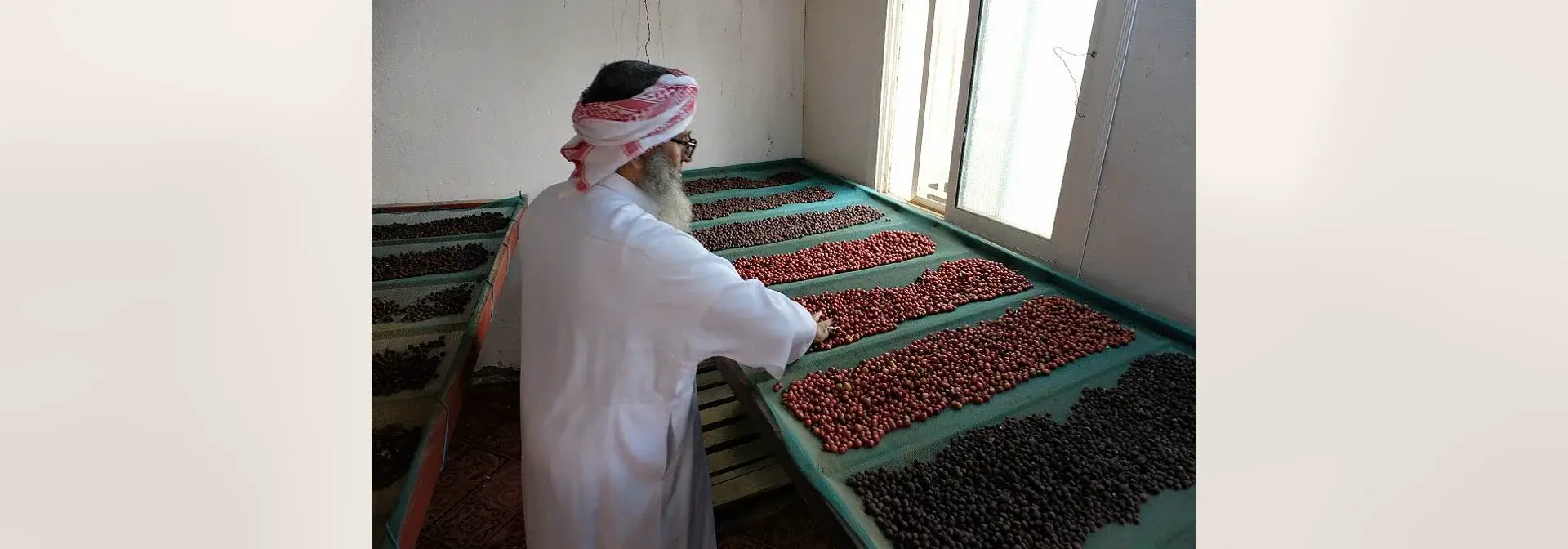
Khawlani Coffee is a variety of coffee cultivated in the mountain highlands of the southwestern part of the Kingdom of Saudi Arabia, and it is grown across Jazan Region and the neighbouring highland areas. [1]
Ad-Dayer Governorate, in the eastern part of Jazan Region, ranks first in the Kingdom in the number of Khawlani coffee farms and trees, with 994 farms containing more than 218,000 trees and an output exceeding 600,000 kilograms a year. [1]
Geographical Location and Harvest Season
Khawlani coffee trees are cultivated in the mountain highlands of the southwestern part of the Kingdom, within the Sarawat Mountains, and their farms spread across the mountain governorates of Jazan. [1]
The harvest season of Khawlani coffee in Jazan begins in October and continues until January every year. [6]
In Asir Region, farmers in Al-Huruf village on Jabal Al Maghlaf in Al-Majardah Governorate, at an elevation of more than 1,350 metres above sea level, have begun rehabilitating coffee farms whose production had ceased decades earlier. [10]
The Saudi Khawlani Coffee Festival
The Saudi Khawlani Coffee Festival was launched in late November 2013 CE in Ad-Dayer Bani Malik Governorate, as an annual occasion to celebrate the crop and its farmers. [2]
The ninth edition of the festival brought together 150 farms, whose owners presented the journey of the Khawlani bean from ripening and picking through drying to roasting and grinding. [1]
In the tenth edition in 2023 CE, more than 100 farmers took part, displaying more than 500 tons of Saudi Khawlani coffee. [3]
Growth of the Coffee Sector and State Support
The number of coffee farmers in the governorates of Ad-Dayer, Fayfa, Al-Aridah, Al-Aydabi, Al-Rayth and Harub rose from 592 farmers in the first edition of the festival to 1,802 farmers. [2]
Coffee trees grew from 70,000 in 2013 CE to 332,857 trees, of which 203,504 were productive. [2]
The Ministry of Environment, Water and Agriculture has sought to achieve the targets of Saudi Vision 2030 through the project to rehabilitate agricultural terraces in Jazan, the application of rainwater harvesting techniques and modern irrigation systems, and the development of crop farming. [2]
The Jazan Mountain Regions Development and Construction Authority contributed to supporting coffee farmers by providing more than 344,000 seedlings from its agricultural research station and distributing them to farmers from 2016 CE to the end of 2020 CE. [6]
In December 2025 CE, the Saudi Coffee Company distributed more than 30,000 coffee seedlings to coffee farmers in Jazan, at the Saudi Coffee Center in Ad-Dayer Governorate. [8]
Expansion in the Highlands of Asir
In Asir Region, more than 634,000 coffee trees were planted between 2022 and 2025 CE, across more than 7,000 hectares distributed over 14 governorates. [7]
The Coffee Association of Asir Region, in partnership with the National Center for Vegetation Cover Development and Combating Desertification, announced the launch of a programme to plant one million coffee trees during 2026–2028 CE, within the Productive Mountains Development initiative, “Mountain Economy”, which aims to enhance the sustainability of natural resources, empower farmers and develop the economy of the mountain governorates. [7]
International Recognition and Documentation
The Heritage Commission set a Guinness World Records record for the longest phrase written on a board using 6,088 Khawlani coffee beans, which together formed the phrase “Heritage Commission”. [4]
Saudi Khawlani coffee is inscribed on the Representative List of the Intangible Cultural Heritage of Humanity of the United Nations Educational, Scientific and Cultural Organization (UNESCO) as the tenth Saudi element registered on it. [4]
Saudi Coffee and Cultural Identity
The Ministry of Culture, in cooperation with the Ministry of Commerce, adopted the designation of Arabic coffee as “Saudi coffee” in all restaurants and cafés of the Kingdom, as part of celebrating it as a cultural element that expresses Saudi identity and the distinctiveness of the relationship of Saudis with their coffee. [5]
The Ministry of Culture designated the year 2022 CE as “the Year of Saudi Coffee”, with the support of the Quality of Life Program, within a national initiative that included programmes, events and competitions organised by the Ministry and the Culinary Arts Commission over a full year, in partnership with government bodies, the private sector, restaurants, hotels, cafés and coffee roasteries. [5]
This initiative is linked to the heritage associated with Arabic coffee and the traditions of preparing and serving it. [5]
Rural Tourism in the Coffee Farms
Coffee farms in the mountain sector of Jazan Region have witnessed transformations that helped reshape the traditional agricultural landscape into an integrated rural tourism destination, combining agricultural production with the tourism experience in a unique natural environment. [9]
Tourism and nature
Frequently Asked Questions
Q: What is Khawlani Coffee? A: A variety of coffee cultivated in the mountain highlands of the southwestern part of the Kingdom of Saudi Arabia, grown across Jazan Region. [1]
Q: Which governorate leads the cultivation of Khawlani coffee in the Kingdom? A: Ad-Dayer Governorate, in the eastern part of Jazan Region, with 994 farms containing more than 218,000 trees. [1]
Q: When was the Saudi Khawlani Coffee Festival launched? A: It was launched in late November 2013 CE in Ad-Dayer Bani Malik Governorate. [2]
Q: What is the harvest season of Khawlani coffee in Jazan? A: It extends from October to January every year. [6]
Q: What is the status of Saudi Khawlani coffee worldwide? A: It is inscribed on the Representative List of the Intangible Cultural Heritage of Humanity of UNESCO as the tenth Saudi element registered on it. [4]
Related topics
- RegionJazan RegionA southwestern Saudi region administered from Jazan city, combining the Red Sea coast, Farasan Islands, plains and mountains with farming, fishing, commerce and industry.
- RegionAsir RegionA southwestern Saudi region administered from Abha, combining Sarawat highlands, Tihamah and the coast, with agricultural terraces, historic villages and distinctive local cultural traditions.
- Hospitality, food and drinkArabic Coffee in Saudi ArabiaArabic coffee in Saudi Arabia brings together preparation and hospitality, with roast levels, flavourings and customs varying among regions and households.
- National visions and programmesSaudi Vision 2030: A Framework for TransformationAn introduction to Saudi Vision 2030, its social, economic and institutional themes, and the relationship between implementation programmes, long-term targets and measured results.
- TopicQuality of Life ProgramThe Quality of Life Program is one of the programs realizing Saudi Vision 2030; it was launched in 2018 to improve and enrich the life of the individual and the family. It works on ten strategic objectives within seven sectors and carries out its work in cooperation with 23 partner entities through 173 initiatives and 42 strategic indicators.
Sources & references
- Saudi Press Agency (SPA): “The Ninth Saudi Khawlani Coffee Festival in Ad-Dayer Governorate”
- Saudi Press Agency (SPA): “The Saudi Khawlani Coffee Festival since its Launch in Late November 2013 CE in Ad-Dayer Bani Malik Governorate”
- Saudi Press Agency (SPA): “The Opening of the Tenth Saudi Khawlani Coffee Festival”
- Saudi Press Agency (SPA): “The Heritage Commission Sets a Guinness World Records Record”
- Saudi Press Agency (SPA): “Adoption of the Designation of Arabic Coffee as Saudi Coffee and the Naming of 2022 CE as the Year of Saudi Coffee”
- Saudi Press Agency (SPA): “The Harvest Season of Khawlani Coffee in Jazan”
- Saudi Press Agency (SPA): “An Economic Initiative to Plant One Million Coffee Trees in Asir”
- Saudi Press Agency (SPA): “The Saudi Coffee Company Distributes More Than 30,000 Coffee Seedlings to Jazan Farmers”
- Saudi Press Agency (SPA): “Coffee Farms in the Mountain Sector of Jazan, a Destination for Rural Tourism”
- Saudi Press Agency (SPA): “Rehabilitation of the Coffee Farms of Al-Huruf Village in Al-Majardah Governorate”