
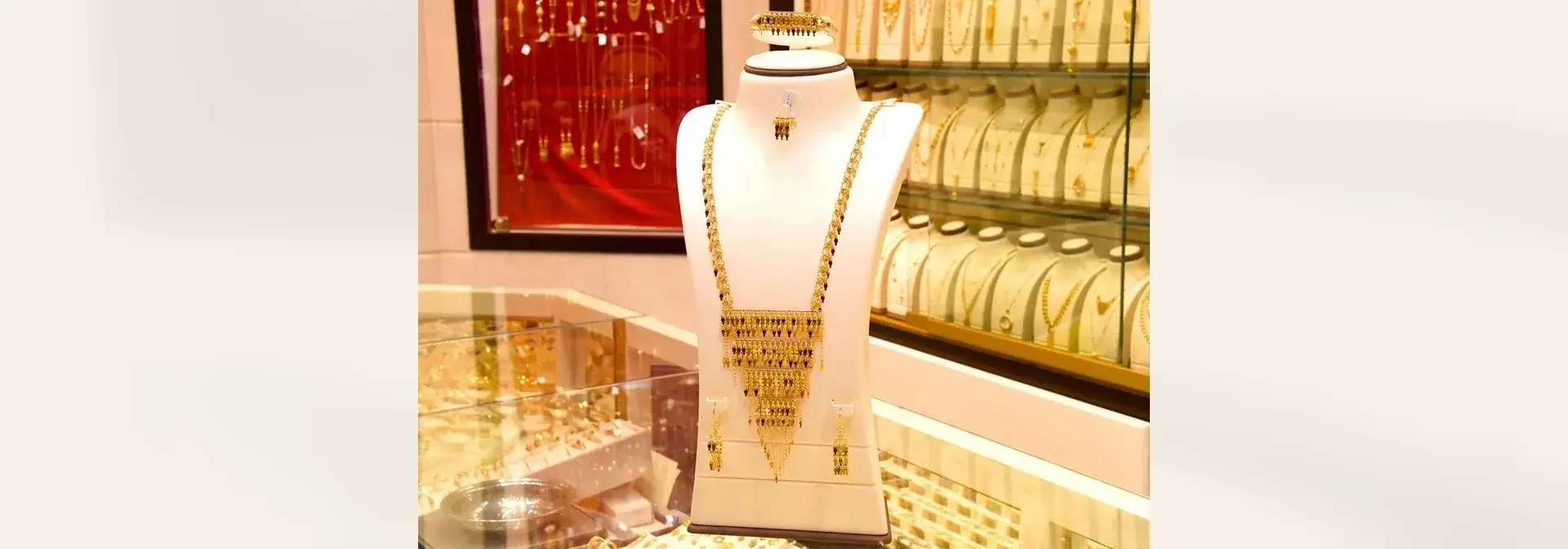
Overview
Saudi traditional jewellery is the tools and objects used for personal adornment, including bracelets, rings, hairpins and earrings, made from the precious metals gold, silver and platinum, whether in the form of worked articles, ingots or coins. [5]
The crafting of jewellery in the Kingdom of Saudi Arabia is an economic and craft activity with traditional roots, linked in practice to the craft of metal engraving and to Saudi handicrafts as a whole, and the official bodies concerned regulate this activity, license it and support those who work in it. [1][6]
Definition of Jewellery and Precious Metals
The Technical Regulation for Ornamental Jewellery and Accessories defines jewellery as the tools and objects used for personal adornment, such as bracelets, rings, hairpins, earrings and the like, and defines precious metals as gold, silver and platinum, whether in the form of worked articles, ingots or coins. [5]
The regulation applies to jewellery and decorative accessories made from metals, plastics, glass or textiles, and excludes from its scope precious metals, jewellery, plated items and their worked articles. [5]
Statutory Regulation of the Jewellery Industry
The manufacture and trade of jewellery and worked articles of gold, silver and precious stones in the Kingdom of Saudi Arabia are regulated by the Precious Metals and Gemstones Law, issued by Royal Decree No. (M/42) dated 10/7/1403 AH. [1]
Under Royal Decree No. (M/87) dated 3/4/1446 AH, supervision of the manufacture of precious metals and gemstones, their worked articles and items plated, clad or inlaid with them, and oversight thereof, passed to the Ministry of Industry and Mineral Resources, while the Ministry of Commerce supervises their trade and exercises oversight over it. [2]
At its session in Riyadh on Tuesday, 28 Rabi' al-Awwal 1446 AH, corresponding to 1 October 2024, chaired by His Royal Highness the Crown Prince and Prime Minister, the Council of Ministers approved an amendment to the Precious Metals and Gemstones Law. [4]
Licensing and Hallmark Stamps
The manufacture of precious metals and gemstones, including the crafting of jewellery, may not be practised without a licence from the Ministry of Industry and Mineral Resources, in accordance with the controls and conditions set by the regulations. [2]
Owners of precious-metal factories and workshops are required to use hallmark stamps to distinguish their articles, registered in accordance with the regulations. [1] Under Royal Decree No. (M/13) dated 25/1/1443 AH, anyone who practises the manufacture of precious metals and their worked articles, or of gemstones, without a licence is punished by imprisonment for a term not exceeding six months and a fine not exceeding ninety thousand riyals, or by either of these two penalties. [3]
Safety Limits and Application Periods
The technical regulation set the permitted limits of heavy metals in ornamental jewellery at 0.05% lead by weight and 0.01% cadmium by weight, and its provisions apply within a period not exceeding 180 days from the date of publication in the Official Gazette, with suppliers granted a period not exceeding 365 days to regularise their position in the market. [5]
Jewellery under the Crafts and Handicrafts Law
The Implementing Regulations of the Crafts and Handicrafts Law included the list of fields of craft and handicraft activities, and the craft of jewellery and gemstones came sixth, alongside the crafts of metalwork, leatherwork, textiles and traditional building. [6]
The law defines the craft licence as the licence that authorises its holder to practise a specific craft or handicraft for commercial purposes, or that authorises its holder to trade principally in handicraft products, including the products of the craft of jewellery and gemstones. [6]
The craft of jewellery and gemstones intersects with established traditional crafts in the Kingdom of Saudi Arabia, such as Al-Sadu, Al-Qatt Al-Asiri and Saudi traditional dress, and all of them fall within the framework of the national handicrafts. [6]
Metal Engraving and the Year of Handicrafts
The arts, skills and practices associated with the craft of metal engraving (gold, silver and copper) were inscribed on the Representative List of the Intangible Cultural Heritage of Humanity, announced during the eighteenth session of the Intergovernmental Committee for the Safeguarding of the Intangible Cultural Heritage, held in Kasane in the Republic of Botswana in 2023. [7]
The Council of Ministers approved the naming of 2025 as the Year of Handicrafts, an initiative that covers handicrafts including the craft of jewellery and gemstones, and it falls within the track of support for crafts, within the Janadriyah Festival and the National Culture Strategy. [8]
Frequently Asked Questions
Q: What is jewellery? A: The tools and objects used for personal adornment, such as bracelets, rings, hairpins, earrings and the like. [5]
Q: What are the precious metals under Saudi regulation? A: Gold, silver and platinum, whether in the form of worked articles, ingots or coins. [5]
Q: May the manufacture of precious metals and gemstones be practised without a licence? A: No, a licence from the Ministry of Industry and Mineral Resources is required. [2]
Q: What is the penalty for practising the manufacture of precious metals without a licence? A: Imprisonment for a term not exceeding six months and a fine not exceeding ninety thousand riyals, or either of these two penalties. [3]
Q: What are the permitted limits of heavy metals in ornamental jewellery? A: 0.05% lead by weight and 0.01% cadmium by weight. [5]
Conclusion
The Kingdom of Saudi Arabia regulates the manufacture and trade of jewellery through a system of laws and regulations covering the licensing of the industry, hallmark stamps, safety requirements and application periods, with the craft of jewellery and gemstones recognised as a craft field and 2025 named the Year of Handicrafts. [1][2][5][8]
Related topics
- HistoricSaudi Traditional HandicraftsSaudi traditional handicrafts are a productive activity based primarily on manual work that draws its designs and artistic elements from the cultural heritage inherited across the regions of the Kingdom. The Law of Crafts and Handicrafts was issued by Royal Decree No. (M/49) dated 1447/03/02 AH to regulate the activity, develop it and protect it from extinction. [1][3]
- HistoricSaudi Traditional DressSaudi traditional dress is a clothing heritage that expresses the identity of the Kingdom of Saudi Arabia and the diversity of its regions. Men's dress rests on the thobe, the agal, and the ghutra, women's dress ranges from the munaykhal and mushallal thobes to the darra'a and the kartah, and the King Abdulaziz Foundation for Research and Archives documents the dress of the Kingdom's regions in a specialised series of publications.
- HistoricAl-Sadu WeavingAl-Sadu is a handweaving craft based on weaving threads of camel hair, goat hair and sheep wool. It is known among the people of the Kingdom of Saudi Arabia, who used it to make hair houses, carpets, daily necessities and tribal clothing, and its weaving was registered on the Representative List of the Intangible Cultural Heritage at UNESCO.
- TopicAl-Qatt Al-AsiriA traditional art of painted wall decoration in Asir homes, practised by women, added to UNESCO's Representative List of the Intangible Cultural Heritage in 2017.
- HistoricAl-Janadriyah FestivalAl-Janadriyah Festival is the National Festival for Heritage and Culture in the Kingdom of Saudi Arabia. Its beginnings go back to 1405 AH, corresponding to 1985, and it is held at the Heritage Village in Al-Janadriyah to showcase heritage, culture and the arts with international participation. The Ministry of the National Guard organised it over the past decades, and the task of holding and organising it later passed to the Ministry of Culture.
- HistoricArabic CalligraphyArabic Calligraphy is the art of writing the Arabic letters, and in the Kingdom of Saudi Arabia it receives care that extends to serving the Qur'anic text and developing its digital tools. Foremost among the manifestations of that is the collection of computerised fonts produced by the King Fahd Complex for the Printing of the Holy Qur'an, alongside the International Competition for Writing the Holy Qur'an.
- TopicNational Culture StrategyThe National Culture Strategy is a national strategy approved by the Council of Ministers on 27 March 2019 to organise and develop the cultural sector in the Kingdom of Saudi Arabia. It rests on three pillars — culture as a way of life, culture for economic growth, and culture for enhancing the Kingdom's international standing — and covers the sixteen cultural sectors within the framework of Saudi Vision 2030.
- MuseumSaudi National Museum: Reading History through ObjectsAn introduction to Riyadh's National Museum, its setting within the King Abdulaziz Historical Center, and the use of objects and multimedia to explore the Arabian Peninsula's past.
Sources & references
- Umm Al-Qura Gazette (Official Gazette): the Precious Metals and Gemstones Law and hallmark stamps — Royal Decree No. (M/42) dated 10/7/1403 AH
- Umm Al-Qura Gazette (Official Gazette): transfer of supervision over the manufacture of precious metals and gemstones and the licensing requirement — Royal Decree No. (M/87) dated 3/4/1446 AH
- Umm Al-Qura Gazette (Official Gazette): penalty for practising the manufacture of precious metals without a licence — Royal Decree No. (M/13) dated 25/1/1443 AH
- Umm Al-Qura Gazette (Official Gazette): approval by the Council of Ministers of the amendment to the Precious Metals and Gemstones Law
- Umm Al-Qura Gazette (Official Gazette): the Technical Regulation for Ornamental Jewellery and Accessories — Saudi Standards, Metrology and Quality Organization
- Umm Al-Qura Gazette (Official Gazette): the Implementing Regulations of the Crafts and Handicrafts Law
- Umm Al-Qura Gazette (Official Gazette): inscription of the craft of metal engraving on the Representative List of the Intangible Cultural Heritage
- Umm Al-Qura Gazette (Official Gazette): naming of 2025 as the Year of Handicrafts