

Overview
Geographic Location
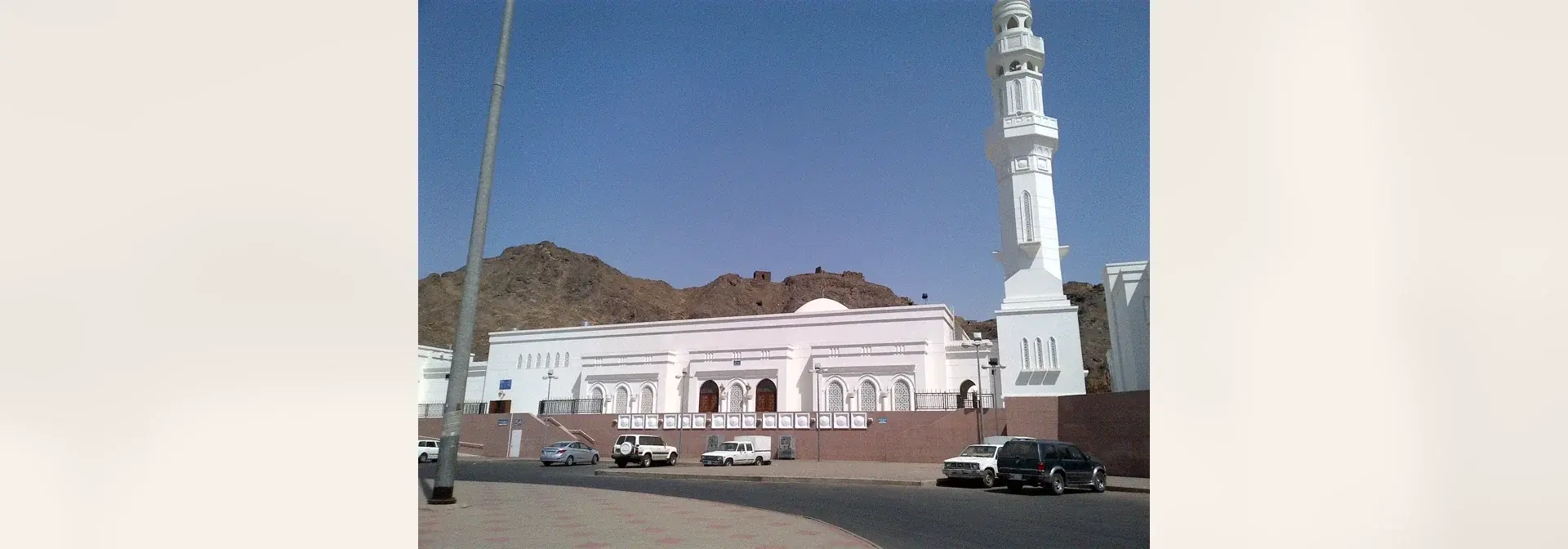
Jabal Sal'a lies 500 metres north-west of the Prophet's Mosque and is also called Jabal Thawab; it extends from north to south for about a thousand metres, and the area is known today as the Seven Mosques. Masjid Al-Fath stands on the western side of the mountain, and the trench began near it.[2]
The mosques stand on the western side of Jabal Sal'a, at part of the site of the trench that the Muslims dug in the Prophetic era to defend Madinah when the armies of Quraysh and the tribes allied with them advanced on it in the fifth year of the Hijrah.[1]
Origins and History
The idea of taking the places where the Prophet, peace be upon him, had prayed as mosques came at the direction of the Umayyad Caliph Al-Walid ibn Abd al-Malik to Umar ibn Abd al-Aziz.[11] Umar ibn Abd al-Aziz built the mosques in stone during his governorship of Madinah between 87 AH and 93 AH; they were renewed in 575 AH by order of the vizier Sayf al-Din ibn Abi al-Hayja, and rebuilt in the reign of the Ottoman Sultan Abdülmecid I in 1268 AH, corresponding to 1851 CE.[5]
The group began as four mosques and remained so until the middle of the fourteenth Hijri century, when the Levantine traveller Abd al-Ghani al-Nabulsi recorded that they were five mosques with the addition of Masjid Bani Haram, known as Masjid Al-Nabi; Masjid Umar ibn Al-Khattab and Masjid Sa'd ibn Mu'adh were added later.[11]
The events of the Battle of the Trench took place at this site: the polytheists gathered on the western side of Jabal Sal'a, and the trench that the Muslims dug in the fifth year of the Hijrah separated them from the Muslims, while the Prophet, peace be upon him, took the slope of Jabal Sal'a as the headquarters of the Muslim leadership.[2]
The Six Mosques and Their Order
The mosques of the group run in succession from north to south in this order: Masjid Al-Fath, Masjid Salman Al-Farisi, Masjid Abu Bakr Al-Siddiq, Masjid Umar ibn Al-Khattab, Masjid Ali ibn Abi Talib and Masjid Fatimah.[1]
Masjid Salman Al-Farisi, the second of the mosques, lies immediately south of Masjid Al-Fath, twenty metres from it, at the foot of Jabal Sal'a; it consists of a single arcade 7 metres long and wide, with a small step two metres wide.[8] Masjid Ali ibn Abi Talib lies east of Masjid Fatimah on an elevated, rectangular hillock; it is 8.5 metres long and 6.5 metres wide and has a small step.[8]
Masjid Fatimah Al-Zahra is the last of the group's mosques and is called in historical sources Masjid Sa'd ibn Mu'adh; it is the smallest of the group's mosques, with an area of 4 by 3 metres, and its last construction followed the style of the group's buildings in the Ottoman era in 1268 AH, corresponding to 1851 CE.[8]
Masjid Al-Fath
Masjid Al-Fath is the first of the group's mosques in the order from the north and is also called Al-Masjid Al-A'la; it is built on a hillock on the western slope of Jabal Sal'a.[3] It was named Al-Fath because during the Battle of the Confederates it served as a place of prayer for the Messenger of Allah, peace be upon him, and because Surah Al-Fath was revealed at its site.[3]
Umar ibn Abd al-Aziz built it during his governorship of Madinah in the Umayyad era, and it received repairs and restoration in earlier ages down to the Saudi era.[4] It was rehabilitated and expanded in a modern architectural style; it accommodates more than four thousand worshippers and is overseen by the Ministry of Islamic Affairs, Call and Guidance.[6]
Masjid Al-Khandaq, also called Masjid Al-Fath, saw its largest expansion in a modern architectural style that highlights the aesthetic value of the trench area on the slope of Jabal Sal'a and rehabilitates its historic identity; it accommodates four thousand worshippers.[7]
Care of the Historic Mosques and Development
The Madinah Region Development Authority prepared a plan for the care of the historic mosques across the region to rehabilitate and restore them, including the Seven Mosques, Masjid Al-Jumu'ah and Masjid Al-Rayah.[10]
Within the care given to Madinah's historic mosques, Masjid Al-Qiblatayn occupies an area of 3,920 square metres on Khalid ibn Al-Walid Road and is undergoing development under the name Qiblatayn Cultural Centre Project, overseen by the Madinah Region Development Authority, which seeks to expand the mosque to accommodate 6,260 worshippers in line with Vision 2030.[9]
Frequently Asked Questions
Q: Where are the Seven Mosques located? A: On the western side of Jabal Sal'a in Madinah, at part of the site of the trench.[1]
Q: How many mosques are there? A: Six mosques in fact, not seven.[1]
Q: What are the names of the group's mosques? A: Masjid Al-Fath, Masjid Salman Al-Farisi, Masjid Abu Bakr Al-Siddiq, Masjid Umar ibn Al-Khattab, Masjid Ali ibn Abi Talib and Masjid Fatimah, in this order from north to south.[1]
Q: Why was Masjid Al-Fath given this name? A: Because during the Battle of the Confederates it served as a place of prayer for the Messenger of Allah, peace be upon him, and because Surah Al-Fath was revealed at its site.[3]
Q: What is the capacity of Masjid Al-Fath? A: It accommodates more than four thousand worshippers after its rehabilitation and expansion.[6]
Conclusion
The Seven Mosques are among the historic landmarks of Madinah, and attention to them continues within the plans for the care of the historic mosques across the region.[10] Related topics on the platform include the history of Madinah, Quba Mosque, Masjid Al-Qiblatayn and the Prophet's Mosque.
Related topics
- RegionMadinah RegionA western Saudi region combining Madinah, Yanbu, AlUla and other governorates, with Islamic landmarks, oases, archaeological sites and a Red Sea coastline.
- HistoricThe Prophet's MosqueThe Prophet's Mosque is the mosque of the Prophet Muhammad ﷺ in Madinah, built in the first year of the Hijrah over an area of 1,050 square meters. Several constructions followed across the Islamic eras, and the mosque saw its widest expansions in the Saudi era.
- HistoricMasjid Al-QiblataynMasjid Al-Qiblatayn is a historic mosque in Madinah in the Kingdom of Saudi Arabia that witnessed the change of the qiblah from Al-Aqsa Mosque to the Sacred Mosque in the second year of the Hijri calendar. The site now hosts the Al-Qiblatayn Civilizational Center Project, which raises its capacity and improves services for its worshippers and visitors.
- EventHistory of MadinahThe history of Madinah is the history of a city in the west of the Kingdom of Saudi Arabia, known before the Prophetic Hijrah as Yathrib and later named Madinah; it is the seat of the Prophet's Mosque and the first capital of the Islamic state. Its history extends from before Islam to the Saudi era, through the building of the Prophet's Mosque and the city's historical landmarks.
- ReligiousQuba MosqueThe first mosque built in Islam, founded in the first year of the Hijra south-west of Madinah on the Hijra road, and the city's second-largest mosque after the Prophet's Mosque.
- EventBattle of the TrenchThe Battle of the Trench, also known as the Battle of the Confederates, took place in the fifth year of the Hijrah, when the armies of Quraysh and the tribes allied with them marched on Madinah, and during the Prophetic era the Muslims dug a trench in its defence. The northern area was chosen as the main line of defence, and part of the site of the trench lies on the western side of Jabal Sal'a, where the Seven Mosques stand.
Sources & references
- Saudi Press Agency (SPA) — The Seven Mosques in Madinah
- Saudi Press Agency (SPA) — Jabal Sal'a and the Seven Mosques area
- Saudi Press Agency (SPA) — Masjid Al-Fath and Al-Masjid Al-A'la
- Saudi Press Agency (SPA) — The building of Masjid Al-Fath and its construction
- Saudi Press Agency (SPA) — Dates of the construction of the mosques
- Saudi Press Agency (SPA) — The rehabilitation of Masjid Al-Fath and its capacity
- Saudi Press Agency (SPA) — The expansions of Masjid Al-Khandaq (Masjid Al-Fath)
- Saudi Press Agency (SPA) — Description of the six mosques
- Saudi Press Agency (SPA) — Qiblatayn Cultural Centre Project
- Saudi Press Agency (SPA) — Plan for the care of the historic mosques
- Saudi Press Agency (SPA) — The history of the Seven Mosques and the development of their number