
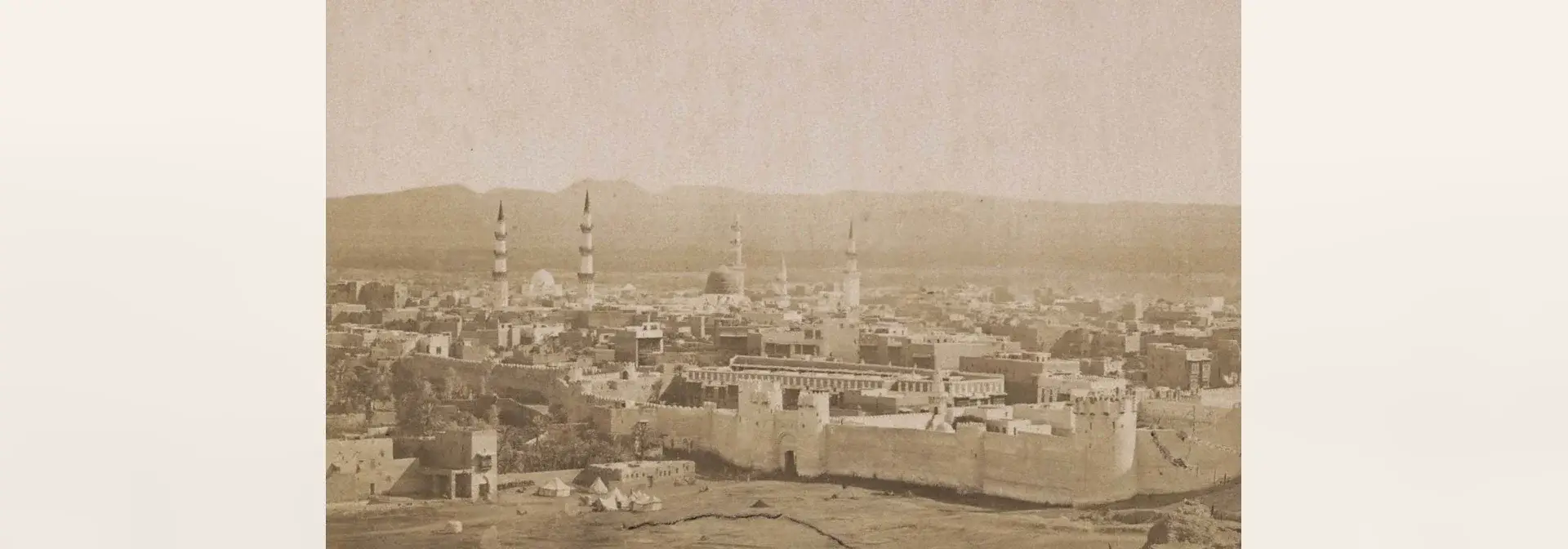

Overview
The history of Madinah is the history of a city in the west of the Kingdom of Saudi Arabia, within the borders of the Madinah region. It was known before the Prophetic Hijrah as Yathrib, then its name was changed to Madinah, and it became the seat of the Prophet's Mosque and the first capital of the Islamic state.[1][2]
The city's roots extend back centuries before Islam: the Amalekites settled it, and its founding is held to have preceded the Hijrah by more than 1500 years, before it witnessed the Prophetic Hijrah and the building of the Prophet's Mosque and became the base of the first Islamic state.[1][2]
Yathrib Before the Hijrah
Before the Hijrah, Madinah was known as Yathrib, a name that appears in the Qur'an on the tongue of a group of the hypocrites; the Prophet, peace be upon him, then changed it to Madinah and forbade the use of the old name.[1]
Yathrib was the name of a man from among the descendants of Nuh, peace be upon him, who founded the settlement, so it was named after him. Its founding is held to have been carried out by a migrant human group seeking a home that would provide food and safety, and the settlement is thought to have existed more than 1500 years before the Hijrah.[1]
The Amalekites settled Yathrib in ancient times. Before Islam the settlement knew paganism, Judaism and Hanifism, and it witnessed long wars between the Aws and the Khazraj that began with the war of Samir and ended with the second battle of Al-Fijar.[1]
The old economy of Yathrib rested on agriculture, in keeping with the character of its site for the settlement's founder. The cultivation of dates and grains such as barley, maize and wheat spread there, and its active trade movement established four markets, the first of which was the market of Al-Jurf.[1]
The Prophetic Hijrah and the Building of the Prophet's Mosque
The Prophet, peace be upon him, reached Quba on the twelfth of Rabi' al-Awwal, migrating from Makkah, and he founded there Quba Mosque. He stayed in Quba from the noon of Monday until the morning of Friday, the sixteenth of Rabi' al-Awwal.[2][6]
He then went to the spot where the she-camel had knelt, a vacant plot containing the remains of palm trees and old graves. He asked about its owners and was told it belonged to two orphan boys of the Banu al-Najjar, so he bought it from them and ordered it to be levelled and the Prophet's Mosque to be built.[2]
The Prophet, peace be upon him, took part in building the mosque himself, carrying stones and mud bricks, and the work was completed in a short time. From his arrival a series of changes began in Madinah, among them the abolition of the name Yathrib and the adoption of new names for it: Taybah, Tabah and Madinah.[2]
The Prophet's Mosque and Its Expansions
The Prophet's Mosque was built in the first year of the Hijrah, after the Prophet's arrival as a migrant, with an area of 1050 square metres; it was then followed by the expansions of the Rashidun, Umayyad, Abbasid and Ottoman caliphs down to the Saudi era.[4]
During the caliphate of Uthman ibn Affan, in 29 AH, an expansion and renovation of the Prophet's Mosque was carried out, and in the thirtieth year of the Hijrah he ordered the writing of a mus'haf gathering all the surahs and verses in a single recension.[3]
Madinah as the Capital of the Caliphate
The Prophet, peace be upon him, died in the eleventh year of the Hijrah, and with his death the most important and greatest stage in the history of Madinah came to an end: the stage of building the first Islamic community and the first Islamic state.[2]
After the death of the Prophet, peace be upon him, the pledge of allegiance to Abu Bakr Al-Siddiq was given at the meeting held in the Saqifah of Banu Sa'idah, and among his most important achievements was fighting the apostates in the wars known as the Ridda wars in the first year of the caliphate.[3]
Only a few months of the thirteenth year of the Hijrah had passed when Madinah became the capital of a region that included the whole of the Arabian Peninsula, Jordan, part of Palestine, the south of the Levant and the east of Iraq.[3]
The City Walls and Fortifications
Throughout its history Madinah was fortified by defensive walls. In 545 AH a solid wall was built around the city in place of an old, dilapidated one, and it protected the city thereafter from raiders.[3]
In 557 AH Nur al-Din Zangi performed the Hajj and visited Madinah, and some residents living outside the wall appealed to him; he ordered a new wall to be built encompassing the city's houses both inside and outside the old wall, and its construction was completed in 558 AH.[3]
During the Ottoman era Sultan Suleiman the Lawgiver ordered the building of a high, strong stone wall surrounding the city on its sides. Work began in Muharram 939 AH and the construction took seven and a half years; the wall was provided with towers equipped with cannons, and a citadel completing the wall was erected at Bab al-Shami, while a military garrison was appointed for the city.[3]
Quba Mosque
Quba Mosque is the first mosque in Islam. The Prophet, peace be upon him, founded it and laid out its plan with his own hand when he reached Madinah as a migrant, sharing in the placing of its first stones, and the Companions then completed it.[6]
Uthman ibn Affan later renovated it, and Umar ibn Abdulaziz established in it a courtyard, arcades and the first minaret. Its renovation continued in the years 435 AH, 555 AH, 671 AH, 733 AH, 840 AH and 881 AH, the last of them in the Ottoman era in the time of Sultan Abdulmajid.[6]
The Battle of Uhud and Its Landmarks
In the third year of the Hijrah the Battle of Uhud took place between the south-western base of Mount Uhud and Mount al-Rumah, also called Mount Aynayn. The armies of Quraysh and their allies marched on Madinah, and the Muslims confronted them in this place; the Prophet, peace be upon him, placed the archers on the mountain and instructed them not to leave it under any circumstances until his order reached them.[7]
The battle was fought and the Muslims gained the upper hand, then most of the archers came down from the mountain, paid no heed to the calls of their commander and followed the polytheists to gather spoils, whereupon the horsemen of the polytheists wheeled around the mountain and surprised them. More than seventy Companions were martyred, among them Hamzah ibn Abd al-Muttalib, may Allah be pleased with him, the uncle of the Prophet, peace be upon him, and they were buried at the site of the battle at the base of Mount Uhud between it and Mount Aynayn.[7]
Related people
- PersonPrince Mohammed bin Salman bin AbdulazizCrown Prince since 1438 AH/2017 CE and Prime Minister since 1444 AH/2022 CE, who launched Saudi Vision 2030; the first grandson of King Abdulaziz to lead the Council of Ministers.
- Kings of Saudi ArabiaKing Abdulaziz bin Abdulrahman Al SaudFounder and first king of Saudi Arabia, Abdulaziz recovered Riyadh in 1902 and led the unification proclaimed in 1932. His reign saw the development of state institutions and the beginnings of the oil industry.
- Kings of Saudi ArabiaKing Fahd bin Abdulaziz Al SaudThe fifth Saudi king, Fahd acceded in 1982. His reign included the Basic Law of Governance, the Shura Council and provincial laws, expansions of the Two Holy Mosques and the Gulf War.
- Kings of Saudi ArabiaKing Saud bin Abdulaziz Al SaudThe Kingdom’s second king and first crown prince after unification, Saud reigned from 1953 to 1964. His reign saw the Ministry of Education, King Saud University and expanding government services.
The Wells and Historic Mosques
Among the prophetic wells in Madinah is Bir Gharas, which was dug about fifteen centuries ago and has received care as a prominent historical landmark; it has been redeveloped, restored and revived, and it now receives visitors and residents.[8]
The second phase of the project of His Royal Highness the Crown Prince and Prime Minister for the development of historic mosques included four mosques in the Madinah region.[8]
Saudi Care for the Prophet's Mosque
Saudi interest in the Prophet's Mosque began with the visit of King Abdulaziz to Madinah in Sha'ban 1345 AH, after which several repairs were made to the mosque in the years 1348 AH, 1350 AH and 1354 AH.[4]
The expansion of the Prophet's Mosque was announced in an official address in 1368 AH, and the first Saudi expansion works began in 1370 AH with the preparation of the area around the mosque and the compensation of the owners of the neighbouring buildings; King Saud then continued the expansion and development work until the construction in his reign was completed in 1375 AH.[4]
The foundation stone of the expansion project of King Fahd for the Prophet's Mosque was laid in 1405 AH. The project included a new building alongside the existing one, with an area of 82000 square metres accommodating 167000 worshippers, bringing the total area of the mosque to 98500 square metres.[5]
Frequently Asked Questions
Q: What was the name of Madinah before the Hijrah? A: Yathrib, which the Prophet, peace be upon him, changed to Madinah and forbade the use of the old name.
Q: When did the Prophet, peace be upon him, reach Quba as a migrant? A: On the twelfth of Rabi' al-Awwal, and he stayed there until the morning of Friday, the sixteenth of Rabi' al-Awwal.
Q: When was the Prophet's Mosque built and what was its first area? A: It was built in the first year of the Hijrah with an area of 1050 square metres.
Q: When did Madinah become the capital of the Islamic state? A: From the thirteenth year of the Hijrah, when its domain came to include the whole of the Arabian Peninsula, Jordan, part of Palestine, the south of the Levant and the east of Iraq.
Q: What are the most prominent expansions of the Prophet's Mosque in the Saudi era? A: The first Saudi expansion, which ended in 1375 AH, then the expansion of King Fahd, whose foundation stone was laid in 1405 AH and which added a building with an area of 82000 square metres.
Summary
The history of Madinah combines the extension of its roots back before Islam in Yathrib, its standing as the place of the Prophet's Hijrah and the cradle of the first Islamic state, and what followed in the way of the construction of the Prophet's Mosque, the city walls and its historical landmarks, together with the continuity of Saudi care for it to the present day.[1][3][4]
Related topics
- RegionMadinah RegionA western Saudi region combining Madinah, Yanbu, AlUla and other governorates, with Islamic landmarks, oases, archaeological sites and a Red Sea coastline.
- HistoricThe Prophet's MosqueThe Prophet's Mosque is the mosque of the Prophet Muhammad ﷺ in Madinah, built in the first year of the Hijrah over an area of 1,050 square meters. Several constructions followed across the Islamic eras, and the mosque saw its widest expansions in the Saudi era.
- ReligiousQuba MosqueThe first mosque built in Islam, founded in the first year of the Hijra south-west of Madinah on the Hijra road, and the city's second-largest mosque after the Prophet's Mosque.
- HistoricThe Grand Mosque (Al-Masjid Al-Haram)The Grand Mosque (Al-Masjid Al-Haram) is the mosque at the centre of which stands the Kaaba in Makkah, and successive states and restorations followed upon its construction across the ages. In the Saudi era it witnessed major expansions and construction works, most notably the Third Saudi Expansion and the raising of the capacity of the Mataf and the courtyards.
- RegionMakkah CityMakkah City is a Saudi city in the west of the Kingdom of Saudi Arabia, home to the Grand Mosque and the qibla of Muslims, with a history of more than four thousand years. The city and the Holy Sites are seeing continuous development to raise the standard of services provided to pilgrims and Umrah performers under Saudi Vision 2030.