
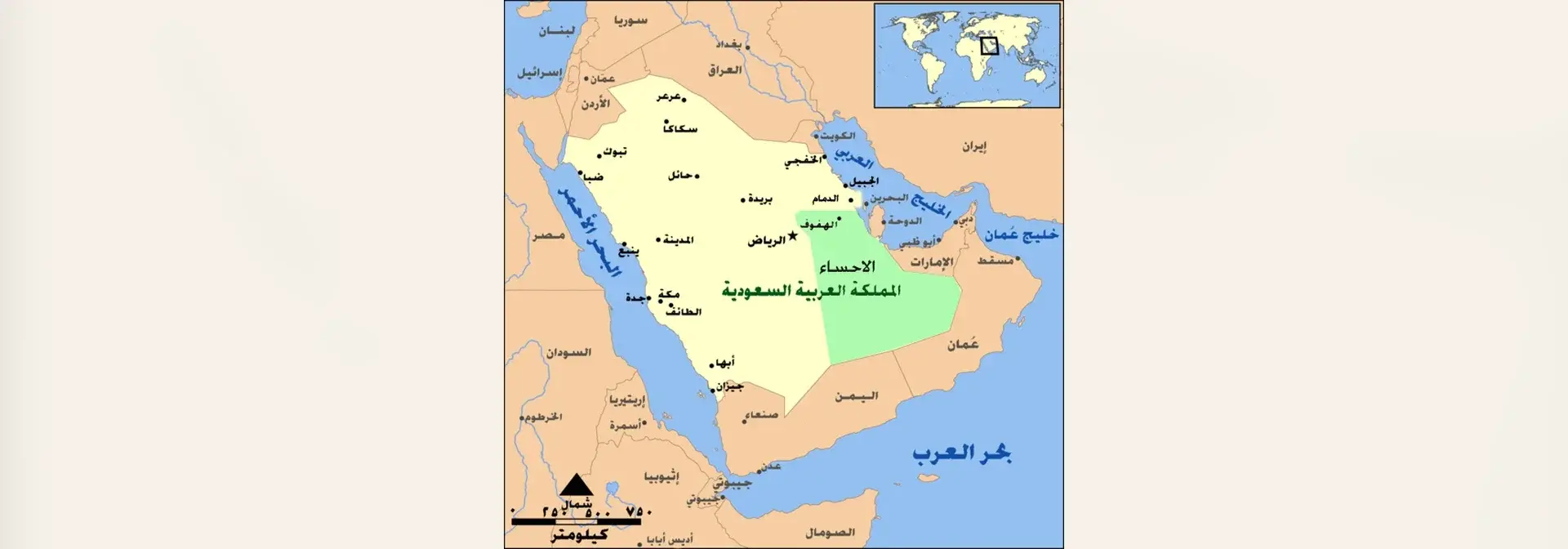

Overview
The Conquest of Al-Ahsa was a campaign led by the founding King Abdulaziz bin Abdulrahman Al Saud in 1331 AH/1913 CE, which ended with Al-Ahsa coming under his rule and with the capture of Ibrahim Palace and the soldiers and equipment within it.[1][4]
King Abdulaziz arrived in Al-Ahsa and stayed at the Mulla House, known as the Bay'ah House, in the city of Hofuf, where the people of Al-Ahsa gave him their pledge of allegiance, placing Al-Ahsa under his rule in 1331 AH.[3][4]
Al-Ahsa Before the Conquest
Al-Ahsa was under the rule of the Jabrids between 820 AH and 941 AH, before the arrival of the Ottomans, who occupied Ibrahim Palace in their first campaign.[2]
Ibrahim Palace stands in the northern part of the Al-Koot district, one of the oldest districts of the city of Hofuf, and it formed part of the city's northern wall and a shield for protection, as a permanent military garrison was stationed in it and it served as the administrative seat of the ruler.[1]
The Entry of King Abdulaziz into Al-Ahsa
King Abdulaziz was able to take control of Ibrahim Palace and the soldiers and equipment within it on the day of the conquest of Al-Ahsa, on the fifth of Jumada al-Awwal 1331 AH/1913 CE.[1]
King Abdulaziz arrived in Al-Ahsa on Sunday, the night of Monday, 28 Jumada al-Awwal 1331 AH, and stayed at the Mulla House, known as the Bay'ah House, where the people of Al-Ahsa gave him their pledge of allegiance.[3]
Related people
Ibrahim Palace
Ibrahim Palace was built in the Jabrid era between 972 AH and 979 AH, and it is the first building of the tenth Hijri century in the Al-Ahsa Oasis.[1] Its area is 18,200 square metres, and it has a high wall surrounded by eight towers on all sides, making it one of the largest palaces of the Al-Ahsa Oasis.[1]
After Al-Ahsa came under the rule of King Abdulaziz in 1331 AH, he added to the palace a religious architectural style that appears in the semicircular arches and Islamic domes.[4] The palace is registered with the Heritage Commission within the urban heritage of Al-Ahsa, and it is one of the elements of the Al-Ahsa Oasis inscribed on the UNESCO World Heritage List.[1]
Bay'ah House
The Bay'ah House is a residence located in the city of Hofuf in the Al-Koot district, one of the most famous old districts of Al-Ahsa Governorate, and its ownership goes back to Abdul Latif Al-Mulla.[3] Its area is estimated at more than 705 square metres, and it was built by Sheikh Abdulrahman bin Omar bin Mohammed Al-Mulla, the qadi of Al-Ahsa, in the year 1203 AH.[3]
The house was turned into a museum that tells the story of the pledge of allegiance of the people of Al-Ahsa to the founding King.[3]
Al-Uqair Port
Al-Uqair Port in Al-Ahsa is the first seaport in the east of the Kingdom, the economic gateway at the beginning of the founding of the state, and the main outlet to the east and centre of the Kingdom.[5] King Abdulaziz took the port as a venue for meeting foreign diplomats and conducting negotiations with the international political powers in the region.[5]
He developed the port by establishing the customs, passports, the quay, the khan building, the emirate building, the fort, the mosque, the water spring and the Buzahmoul tower.[5] Its importance declined in 1377 AH/1957 CE with the start of work on the construction of Dammam Port.[5]
Cultural and Heritage Standing
Al-Ahsa Governorate is founded on a human civilisation and a historical stock dating back to 5000 years BCE, and it was chosen as the Arab Tourism Capital for 2019 CE.[6]
The Al-Ahsa Oasis was inscribed in the Eastern Province on the UNESCO World Heritage List in 2018 CE, as the fifth Saudi site added to the list.[7]
Frequently Asked Questions
Q: When did Al-Ahsa come under the rule of King Abdulaziz? A: In 1331 AH/1913 CE, after taking control of Ibrahim Palace and the soldiers and equipment within it.[1][4]
Q: Where did the people of Al-Ahsa pledge allegiance to King Abdulaziz? A: At the Mulla House, known as the Bay'ah House, in the city of Hofuf in the Al-Koot district.[3]
Q: What architectural style did King Abdulaziz add to Ibrahim Palace? A: The religious style, which appears in the semicircular arches and Islamic domes.[4]
Q: What is the historic port of Al-Ahsa and what is its standing? A: Al-Uqair Port, the first seaport in the east of the Kingdom, the economic gateway at the beginning of the founding of the state, and the main outlet to the east and centre of the Kingdom.[5]
Q: When was the Al-Ahsa Oasis inscribed on the World Heritage List? A: In 2018 CE, as the fifth Saudi site added to the list.[7]
Conclusion
Al-Ahsa came under the rule of King Abdulaziz in 1331 AH/1913 CE after taking control of Ibrahim Palace and the pledge of allegiance of its people at the Bay'ah House, and Al-Uqair Port became its economic outlet to the east and centre of the Kingdom.[1][3][5] The details of this phase are read in the unification of Saudi Arabia.
Related topics
- EventUnification of Saudi ArabiaKing Abdulaziz's path from the recovery of Riyadh in 1902 to the proclamation of the Kingdom of Saudi Arabia on 23 September 1932, now National Day.
- RegionHofuf CityHofuf City is a city in Al-Ahsa Governorate in the Eastern Province of Saudi Arabia. It holds Ibrahim Palace, the Bay'ah House, the Amiriya School and Al-Qaisariya Market, and together with the Al-Ahsa Oasis it forms one of the most prominent examples of architectural heritage in the country.
- HistoricAl-Ahsa OasisThe world's largest self-contained oasis according to Guinness World Records, inscribed on the UNESCO World Heritage List in 2018 as a cultural landscape of human interaction with the environment.
- RegionEastern ProvinceA large eastern Saudi region administered from Dammam, combining Gulf cities, the oases of Al Ahsa and Qatif, desert areas, energy industries and maritime commerce.
Sources & references
- Saudi Press Agency (SPA) — "Ibrahim Palace: A Historical Imprint of the Story of Time and Place in the Al-Ahsa Oasis"
- Saudi Press Agency (SPA) — "Tourism Authority Completes the Restoration of the Historic Ibrahim Palace in Al-Ahsa"
- Saudi Press Agency (SPA) — "Bay'ah House: A Witness to a Historical Journey and the Pledge of the People of Al-Ahsa to King Abdulaziz"
- Saudi Press Agency (SPA) — "Ibrahim Palace in Hofuf: An Archaeological Landmark 463 Years Old"
- Saudi Press Agency (SPA) — "King Abdulaziz Foundation Documents the History of Al-Uqair Port"
- Saudi Press Agency (SPA) — "Al-Ahsa: A Human Civilisation and a Historical Stock"
- Saudi Press Agency (SPA) — "Al-Ahsa Oasis, a World Heritage Site"