
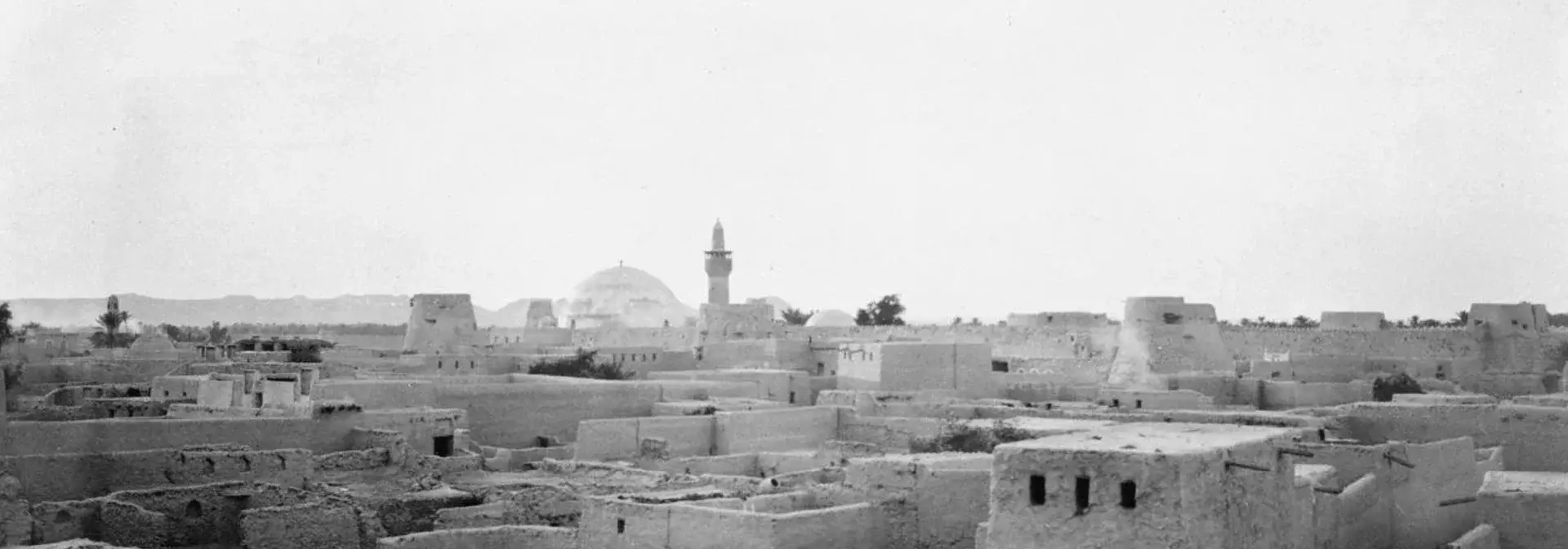
Overview
Hofuf City is a city in Al-Ahsa Governorate, in the Eastern Province of Saudi Arabia; at its centre stand historic palaces, markets and schools that form part of the heritage of its oasis. [2][5][11]
Hofuf holds Ibrahim Palace, the Bay'ah House, the Amiriya School and Al-Qaisariya Market, alongside the Al-Ahsa Oasis, a site inscribed on the UNESCO World Heritage List. [1][3][4][6][11]
Ibrahim Palace
Ibrahim Palace, known as Ibrahim Fort, stands out in Hofuf City. It was built in 963 AH, corresponding to 1555 CE, and ranks among the historical landmarks of Al-Ahsa. It occupies an area of 16,500 square metres, with architecture that combines the Islamic and military styles; its structure was renewed in 1216 AH, corresponding to 1801 CE, by Ibrahim bin Ufaisan, after whom it takes its name. [1]
The palace lies in the northern part of Al-Kut district, one of the oldest quarters of Hofuf City, and forms part of the city's northern wall; a military garrison was permanently stationed there, and it served as the administrative seat of the governor. It is one of the largest palaces of the Al-Ahsa Oasis, covering 18,200 square metres, surrounded by a high wall and eight towers, and it contains a mosque, a steam bath, a cellar, a stable for horses and a communications room. [2]
The palace came under the rule of King Abdulaziz Al Saud after he took control of it and of the soldiers and equipment within it on the day of the opening of Al-Ahsa, on the fifth of Jumada al-Awwal 1331 AH, corresponding to 1913 CE. It is registered with the Heritage Commission as part of the architectural heritage of Al-Ahsa and is one of the elements of the oasis inscribed on the World Heritage List. [2]
The Bay'ah House
The Bay'ah House lies in Hofuf City, in Al-Kut district, one of the best-known ancient quarters of Al-Ahsa Governorate. The house, whose construction dates back to the year 1203 AH, has an estimated area of more than 705 square metres. It was built by Sheikh Abdulrahman bin Omar bin Mohammed Al-Mulla, the judge of Al-Ahsa, and was turned into a museum that tells the story of the pledge of allegiance. [3]
There the founder King Abdulaziz bin Abdulrahman Al Saud arrived in Al-Ahsa on Sunday, the eve of Monday, 28 Jumada al-Awwal 1331 AH, and the people of Al-Ahsa pledged allegiance to him in it; this is recalled every year on the occasion of National Day. The house embodies one of the milestones in the course of the unification of Saudi Arabia. [3]
The Amiriya School
The Amiriya School opened on the eleventh of Muharram 1360 AH, and it is the oldest formal government school in Al-Ahsa Governorate. It carried several names in succession: it began as the Amiriya School, then the First Al-Ahsa School, then the Hofuf School, and finally the House of Culture; it contributed to the entry of Al-Ahsa onto the UNESCO list, alongside other sites in the Kingdom. [4]
King Abdulaziz bin Abdulrahman Al Saud visited the school in 1931 to inspect it, admired it, and ordered his son Prince Faisal bin Abdulaziz to open it as a starting point for education in the Eastern Province. It was built in 1937 and opened in February 1941, and it was erected in the centre of Hofuf City on an area of 1200 square metres; traditional markets surround it, most notably the vegetable market, the Qassabiya market, the meat market, the gold market and the historic Al-Qusairiya market. [5]
Al-Qaisariya Market
Al-Qaisariya Market stands out among the traditional markets of Al-Ahsa, and it is one of the Kingdom's ancient historic popular markets. It lies in Al-Rifaa district of Hofuf City and was built in 1822 CE, corresponding to 1238 AH; it contains about 422 shops along covered, enclosed passages, and it saw a renewal of its structure during the reign of King Abdulaziz in 1334 AH. [6]
The market lies in the centre of Hofuf City, on the western side of Al-Rifaa district. Its area is seven thousand square metres, it has 14 entrances, and it holds more than 422 commercial shops. UNESCO inscribed it on the World Heritage List in 2018, and it has become one of the best-known traditional markets in the Arabian Peninsula and one of the most prominent landmarks and tourist destinations. [7]
Development of Central Hofuf and Services
The Al-Ahsa Municipality has completed 55% of the works of the project to develop the central Hofuf historic axis, the internal ring road, 1.5 kilometres long and at a total cost estimated at 8 million and 750,000 riyals. The road encircles the historic area from Ibrahim Palace in the north to the Riyadh road in the south, 6 kilometres long with four lanes in each direction. [8]
The Al-Ahsa Municipality is carrying out 73 projects under the initiatives of the National Transformation Program, at a total value of 928,006,229 riyals. These include 20 projects to raise the efficiency and rehabilitation of roads, 24 projects to address visual distortion and improve the urban landscape, 7 projects for rainwater drainage, 12 projects for the construction of buildings and service facilities, and 10 projects for the humanisation of cities. [9]
Al-Ahsa International Airport
On 15 Muharram 1447 AH, corresponding to 10 July 2025, the first direct seasonal flights were launched between Al-Ahsa International Airport and Rize–Artvin International Airport in Turkey, as part of plans to expand seasonal destinations and the efforts of the Al-Ahsa Development Authority to support the airport. [10]
The Al-Ahsa Oasis and World Heritage
It was announced on 15 Shawwal 1439 AH, corresponding to 29 June 2018, that the Al-Ahsa Oasis site in the Eastern Province had been inscribed on the UNESCO World Heritage List, as the fifth Saudi site to join the list. The oasis is among the best known palm oases; it holds more than 1.5 million palms producing dates, and the earliest date of human settlement there goes back to the fifth millennium BCE. This ancient agricultural heritage represents what is known as date palm cultivation in Saudi Arabia. [11]
The Oasis in the Guinness World Records
The Al-Ahsa Oasis entered the Guinness World Records as the largest self-contained oasis in the world: it holds 2.5 million palms fed by a vast groundwater layer through 280 artesian wells, over an area exceeding 85.4 square kilometres, and the Heritage Commission introduced the encyclopedia to it. [12]
Frequently Asked Questions
Q: Where is Hofuf City located? A: In Al-Ahsa Governorate in the Eastern Province of Saudi Arabia, and at its centre it holds historic palaces, markets and schools. [2][5]
Q: What are the most prominent archaeological and heritage landmarks in Hofuf? A: Ibrahim Palace, the Bay'ah House, the Amiriya School and Al-Qaisariya Market, alongside the Al-Ahsa Oasis inscribed on the World Heritage List. [1][3][4][6][11]
Q: When was Ibrahim Palace built and what is its area? A: It was built in 963 AH, corresponding to 1555 CE, on an area of 16,500 square metres, and it lies in the northern part of Al-Kut district on an area of 18,200 square metres, surrounded by eight towers. [1][2]
Q: What is the significance of Al-Qaisariya Market? A: A historic popular market built in 1822 CE in Al-Rifaa district; it holds more than 422 shops and 14 entrances, and UNESCO inscribed it on the World Heritage List in 2018. [6][7]
Q: What is most notable about the Al-Ahsa Oasis? A: It was inscribed on the World Heritage List in 2018, and it entered the Guinness World Records as the largest self-contained oasis in the world. [11][12]
Conclusion
Hofuf City combines Ibrahim Palace, the Bay'ah House, the Amiriya School and Al-Qaisariya Market [1][3][4][6], the projects to develop its historic centre and its services [8][9], its international airport [10], and the Al-Ahsa Oasis inscribed on the World Heritage List. [11][12] Related topics on the platform include Qatif City and Dammam City.
Related topics
- RegionEastern ProvinceA large eastern Saudi region administered from Dammam, combining Gulf cities, the oases of Al Ahsa and Qatif, desert areas, energy industries and maritime commerce.
- RegionQatif CityQatif City is a Saudi city in the Eastern Province, on the shore of the Arabian Gulf, known for its palm oases, date farms, fish market, Tarout Island and the town of Darin. Its development is reinforced by the approved development direction for Darin and Tarout Island, waterfront projects and health and leisure services.
- RegionDammam CityDammam City is a Saudi city in the Eastern Province on the coast of the Arabian Gulf. Its metropolitan area takes in Dammam City together with the governorates of Al-Khobar and Al-Bayda and the Dhahran centre; within it stand King Abdulaziz Port and King Fahd International Airport, and the King Fahd Causeway links the Kingdom of Saudi Arabia with the Kingdom of Bahrain. In 2026 the Dammam metropolitan area joined the Global Quality of Life Initiative.
- HistoricAl-Ahsa OasisThe world's largest self-contained oasis according to Guinness World Records, inscribed on the UNESCO World Heritage List in 2018 as a cultural landscape of human interaction with the environment.
- Agricultural heritage and traditional knowledgeDate Palm Cultivation in Saudi ArabiaDate palm cultivation in Saudi Arabia combines food production with knowledge of irrigation, pollination and fruit care. Al-Ahsa illustrates its links to farming heritage.
- EventUnification of Saudi ArabiaKing Abdulaziz's path from the recovery of Riyadh in 1902 to the proclamation of the Kingdom of Saudi Arabia on 23 September 1932, now National Day.
- HistoricAflajAflaj is a traditional irrigation system in the Kingdom of Saudi Arabia that conveys water from springs, wellsprings and channels to agricultural land, and one of its most prominent models is known locally as the buried channels (Al-Kharaz) in Aflaj Governorate in the Riyadh region. The Al-Ahsa Oasis offers a broad model of spring and channel networks that have developed through modern projects to convert them and raise their efficiency.
- Saudi statesThe Third Saudi StateThe Third Saudi State began with Abdulaziz bin Abdulrahman Al Saud's recovery of Riyadh in 1902. Regional unification led to the Kingdom of Saudi Arabia proclaimed in 1932 and continuing thereafter.
Sources & references
- Saudi Press Agency (SPA) — Report: Ibrahim Palace in Hofuf, a 463-year-old archaeological landmark
- Saudi Press Agency (SPA) — National Day: 'Ibrahim Palace', a historic imprint of the story of time and place in the Al-Ahsa Oasis
- Saudi Press Agency (SPA) — National Day: 'the Bay'ah House', a witness to a historic course and the pledge of the people of Al-Ahsa to King Abdulaziz
- Saudi Press Agency (SPA) — Report: the Amiriya School in Al-Ahsa, the first icon of education in the region
- Saudi Press Agency (SPA) — Report: 'the Amiriya School' in Al-Ahsa, the first icon of education in the Eastern Province
- Saudi Press Agency (SPA) — Report: Al-Qaisariya Market tells stories 196 years old woven by the people of Al-Ahsa
- Saudi Press Agency (SPA) — Culture: 'Al-Qaisariya', a heritage market blending the present and the past
- Saudi Press Agency (SPA) — General: the Al-Ahsa Municipality completes 55% of the works of the 'central Hofuf historic axis' project
- Saudi Press Agency (SPA) — Economic: the Al-Ahsa Municipality carries out 73 projects in the Al-Ahsa conurbation
- Saudi Press Agency (SPA) — Tourism and entertainment: the Governor of Al-Ahsa inaugurates the first direct flights between Al-Ahsa International Airport and Rize – Artvin International Airport in Turkey
- Saudi Press Agency (SPA) — Culture: Prince Sultan bin Salman announces: the Al-Ahsa Oasis is a world heritage site
- Saudi Press Agency (SPA) — Culture: 'Guinness' records the Al-Ahsa Oasis as the largest oasis in the world