
Family, upbringing and residence in Kuwait
Abdulaziz grew up in Riyadh in the Al Saud family. His parents were Imam Abdulrahman bin Faisal, the last imam of the Second Saudi State, and Sara bint Ahmed Al Sudairi. He studied the Quran, reading and writing, and learned horsemanship. After the second state ended, his family left Riyadh and moved between locations before settling in Kuwait, where he followed developments in Najd and regional politics. The consulted references differ between 1876 and 1877 for his birth year, so this article does not assign an exact birthday. [1][2]
Recovering Riyadh and beginning the third state
Abdulaziz returned from Kuwait with a group of followers and recovered Riyadh in 1902, making it his base for rebuilding Saudi rule. The recovery marks the beginning of the Third Saudi State, not the proclamation of a kingdom with its later name and borders. Campaigns, agreements and negotiations followed over roughly three decades. The beginning of that process must therefore be distinguished from the establishment of the Kingdom of Saudi Arabia in 1932. [1][2]
Unification and the proclamation of the Kingdom
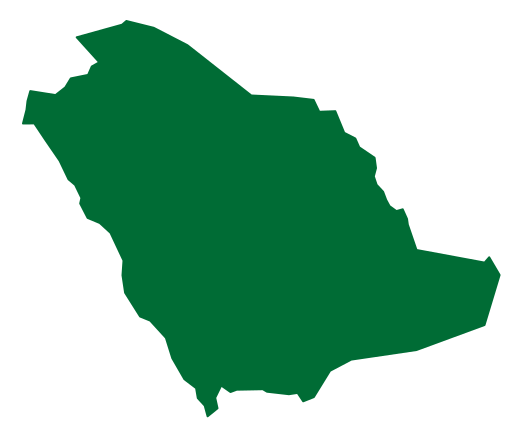
Saudi rule extended to Al Ahsa in 1913, Hail in 1921, and the Hejaz during 1924–1925. This process also involved conflict: Abdulaziz faced a rebellion by Ikhwan leaders, with the Battle of Sabilla in 1929 forming part of the consolidation of state authority. An order issued in September 1932 unified the country under the name Kingdom of Saudi Arabia, effective on 23 September. His reign as its first king is dated from this proclamation rather than from the recovery of Riyadh. [1][2]
Administration and state institutions
Unification was accompanied by the organisation of the judiciary, public finance, foreign affairs and services, alongside regional administrative structures. The Ministry of Foreign Affairs was established in 1930 under Prince Faisal, and government institutions expanded during the Kingdom’s early years. In 1953, before Abdulaziz’s death, an order established the Council of Ministers under Prince Saud. Its meetings began during King Saud’s reign. This sequence illustrates how institutional development continued across successive reigns. [1]
Oil and foreign relations
The government granted an oil exploration concession in 1933, and oil was discovered in commercial quantities in 1938. This opened a long period of economic change rather than producing all its effects immediately; output and revenues expanded in subsequent years. In foreign relations, Abdulaziz met U.S. President Franklin Roosevelt on 14 February 1945 aboard USS Quincy on Egypt’s Great Bitter Lake, a notable meeting in the development of Saudi–American relations. [1][2]
Death and succession
King Abdulaziz died in Taif on 9 November 1953 and was buried in Al Oud Cemetery in Riyadh. Crown Prince Saud succeeded him. Studying Abdulaziz’s reign brings military and political unification together with administrative and economic history. It also requires reading sources in context and distinguishing dated events from the assessments that writers make of his character and legacy. [1][2]


