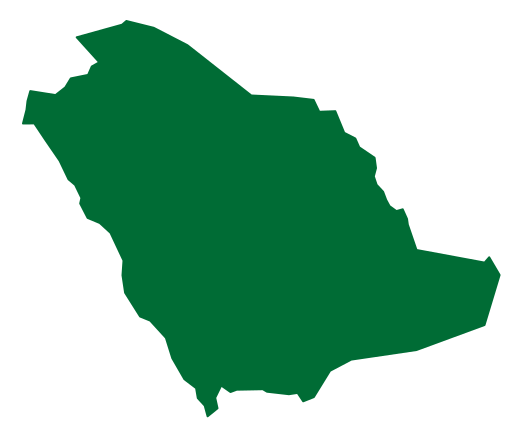

Overview
The Hejaz Railway is a railway line ordered to be built by the Ottoman Sultan Abdulhamid II, with work beginning in 1900 to serve as a link connecting the Muslims of the northern Arabian Peninsula with the Holy Places. [3] The line runs from Damascus station through stations including Tabuk, Madain Saleh, AlUla and Hadiyah, ending at Madinah station. [1] The first train reached Madinah on 22 Rajab 1326 AH, corresponding to 23 August 1908, when the official celebration for the opening of the railway was held. [1]
The Building and Financing of the Line
Sultan Abdulhamid II issued a decree for the construction of the Hejaz railway in March 1900, corresponding to 1313 AH, on the condition that it be funded entirely by donations from the Muslim world, with no foreign involvement in its supply or administration. [2]
Between 5,000 and 7,000 workers took part in the project, most of them from the Ottoman army, and a school was founded in Istanbul to train railway engineers. [2] The cost of building the line was estimated at around five million Ottoman gold liras in 1908. [4]
The Route and Stations of the Line
The line begins at Damascus station and passes through a number of stations on its way, among them Qatranah, Ma'an, Al-Mudawwarah, Tabuk, Al-Akhdar, Al-Mu'azzam, Ad-Dar Al-Hamra, Madain Saleh, Al-Hijr, AlUla and Hadiyah, ending at Madinah station. [1]
The railway reached AlUla in September 1907, corresponding to 1320 AH, when a celebration was held to mark the arrival of the line there. [2] Within the Kingdom of Saudi Arabia the line falls in the Tabuk Region and the Madinah Region; among its most prominent stations in them are Tabuk, Madain Saleh and Madinah, alongside bridges built over valleys, wells and fortifications. [2]
The Arrival of the Train in Madinah
The Years of the Line's Operation
Madinah Station, Al-Istasyon
The Hejaz Railway station known as Al-Istasyon in Madinah is the terminus of the line that began in Damascus; it lies one kilometre west of the Prophet's Mosque and overlooks Al-Anbariyyah Square, and the station with its annexes stands on an area estimated at about 90,000 square metres. [5]
Restoration of the Station and the Hejaz Railway Museum
The restoration and rehabilitation of the Hejaz Railway station in Madinah was entrusted to the Al-Turath Charitable Foundation and took five years, from 2001 to 2006, covering the main building, the supporting buildings, the railway track, the locomotives, the surrounding wall and the site as a whole. [3]
The Hejaz Railway Museum in Madinah comprises the restored buildings of the station and a museum of the locomotive repair workshop, and the components of its first phase include 14 exhibition halls, among them the museum lobby and halls for the environment and natural history of Madinah. [6] The Hejaz Railway bridge over Wadi al-Aqiq was rebuilt and restored after the collapses caused by floods that swept Madinah in December 2004, corresponding to 1425 AH, bringing down two spans of the bridge. [7]
Its Heritage Status Today
The Hejaz Railway has been on the UNESCO World Heritage Tentative List under the name of the Kingdom of Saudi Arabia since the list was submitted on 8 April 2015; it covers the Tabuk and Madinah regions, and the file carries reference 6026. [2]
The Heritage Commission organised sound and light shows on the facade of the Hejaz Railway station in the Madinah Region on 1 Jumada al-Akhirah 1443 AH, corresponding to 4 January 2022, in celebration of the inscription of the art of Arabic calligraphy on UNESCO's Intangible Cultural Heritage List, on the initiative and under the leadership of the Kingdom and in cooperation with 15 Arab states. [8]
Frequently Asked Questions
Q: What is the Hejaz Railway? A: A railway line ordered to be built in March 1900, with work beginning in 1900, to link the Muslims of the northern Arabian Peninsula with the Holy Places; it runs from Damascus to Madinah. [1][2][3]
Q: What is the route of the Hejaz Railway and its stations? A: It begins at Damascus station and passes through stations including Qatranah, Ma'an, Al-Mudawwarah, Tabuk, Al-Akhdar, Al-Mu'azzam, Ad-Dar Al-Hamra, Madain Saleh, Al-Hijr, AlUla and Hadiyah, and ends at Madinah station. [1]
Q: When did the first train reach Madinah? A: On 22 Rajab 1326 AH, corresponding to 23 August 1908, when the official celebration for the opening of the railway was held and the Prophet's Mosque was lit for the first time on the day of the opening. [1]
Q: How many years did the line operate? A: About nine years between Damascus and Madinah, carrying pilgrims and traders, after which the train ceased operating in late 1334 AH. [1]
Q: What are the most prominent features of the Hejaz Railway in Madinah today? A: The Al-Istasyon station, one kilometre west of the Prophet's Mosque on an area estimated at about 90,000 square metres; the Hejaz Railway Museum with 14 exhibition halls; and the rebuilt Wadi al-Aqiq bridge. [5][6][7]
Conclusion
The Kingdom of Saudi Arabia preserves the antiquities of the Hejaz Railway, its station and its museum, after the restoration of the station between 2001 and 2006 and the rehabilitation of its site, and the line is inscribed on the UNESCO World Heritage Tentative List in the Tabuk and Madinah regions. [2][3]
Related topics on the platform include Darb Zubaydah, the history of Al-Hijr, the geography of AlUla, the Tabuk Region and the Madinah Region.
Related topics
- HistoricDarb ZubaydahThe Kufa pilgrimage road linking Iraq to Makkah through five Saudi regions, used since before Islam and named after the spring dug by Zubaydah bint Ja'far.
- Archaeological sitesHistory of HegraHegra, also called Mada'in Salih, is an archaeological site in AlUla Governorate whose tombs, wells and inscriptions illuminate Nabataean life and caravan routes.
- Governorate and oasis geographyGeography of AlUlaAlUla is a governorate in Madinah Region in northwestern Saudi Arabia, where cultivated oases and settlements lie among wadis and desert escarpments.
- RegionTabuk RegionA northwestern Saudi region administered from Tabuk city, combining Red Sea and Gulf of Aqaba coasts with inland centres such as Tayma and a history of trade and pilgrimage routes.
- RegionMadinah RegionA western Saudi region combining Madinah, Yanbu, AlUla and other governorates, with Islamic landmarks, oases, archaeological sites and a Red Sea coastline.
- HistoricThe Grand Mosque (Al-Masjid Al-Haram)The Grand Mosque (Al-Masjid Al-Haram) is the mosque at the centre of which stands the Kaaba in Makkah, and successive states and restorations followed upon its construction across the ages. In the Saudi era it witnessed major expansions and construction works, most notably the Third Saudi Expansion and the raising of the capacity of the Mataf and the courtyards.
Sources & references
- Saudi Press Agency (SPA) — The Hejaz Railway.. A Story of Travel and the Remains of a Journey
- UNESCO — World Heritage Centre, World Heritage Tentative List (Ref. 6026) — Hejaz Railway
- Saudi Press Agency (SPA) — A Photo Gallery of the Restoration Project of the Historic Hejaz Railway Station
- Saudi Press Agency (SPA) — The Hejaz Railway Marks Its Centenary
- Saudi Press Agency (SPA) — The Hejaz Railway Station Al-Istasyon in Madinah
- Saudi Press Agency (SPA) — The Madinah Museum at the Hejaz Railway Station
- Saudi Press Agency (SPA) — The Rebuilding of the Hejaz Railway Bridge over Wadi al-Aqiq
- Saudi Press Agency (SPA) — Sound and Light Shows on the Facade of the Hejaz Railway Station in Madinah