

Overview
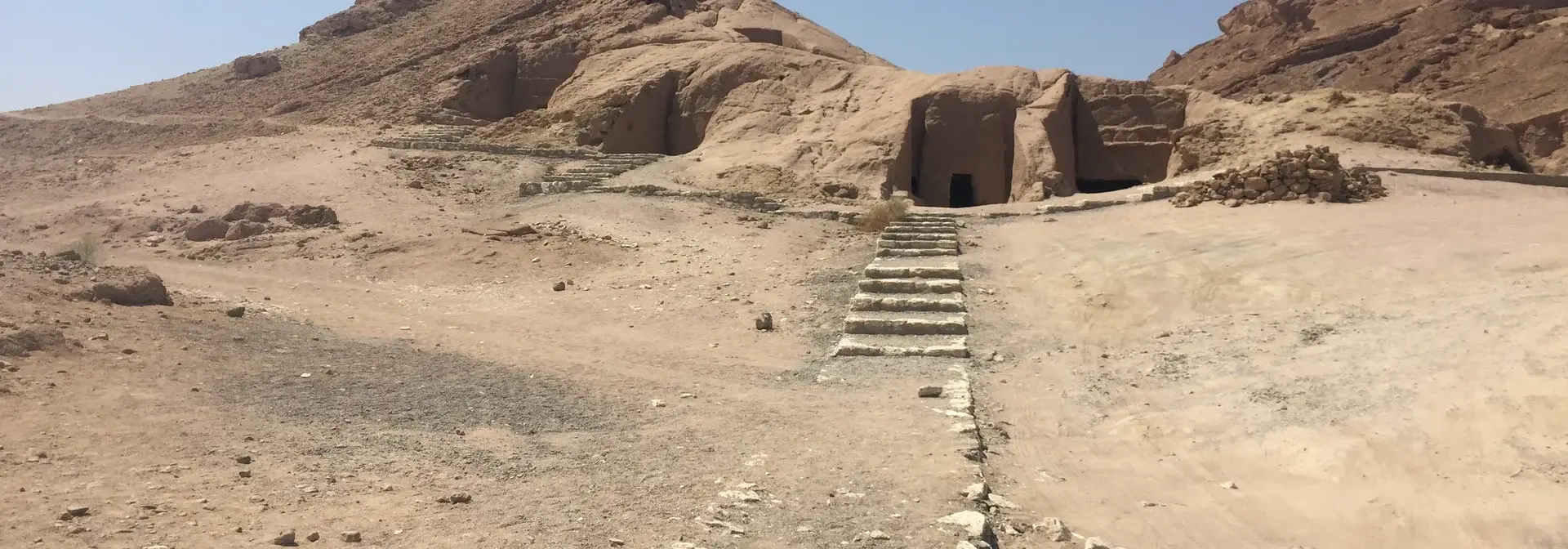
Mada'in Shuayb (Madyan), also known as Magha'ir Shuayb, is an archaeological site in Al-Bad' governorate in the Tabuk region; it is one of the most prominent archaeological landmarks in the governorate and is among the sites of Al-Bad' that date back to several eras.[2]
The Tabuk region holds about 200 archaeological sites distributed across Al-Bad', the village of Rawafah, Aynunah, Al-Khuraybah, Al-Daysah, Al-Muwaylih, Al-Azlam and Al-Akhdar.[1] Mada'in Shuayb lies alongside the two banks of Wadi Afal, which are among the most famous archaeological sites of Al-Bad' governorate.[2]
Location of Mada'in Shuayb and its Surroundings
Mada'in Shuayb lies in Al-Bad' governorate, the sixth governorate of the Tabuk region, about 220 kilometres from the city of Tabuk, where archaeological sites dating back to several eras are spread across the governorate.[2]
The two banks of Wadi Afal are among the most famous archaeological sites in Al-Bad' governorate, and Magha'ir Shuayb is one of its most prominent archaeological landmarks.[2]
Mada'in Shuayb Carved into the Rock
Mada'in Shuayb, or Magha'ir Shuayb, is a civilisation that existed in pre-Islamic times, with houses carved into the mountains and engravings of aesthetic forms on their entrances.[4]
In the Tabuk region, in Madyan, stands the fortress of the Companions of the Thicket (Ashab al-Aykah), which is mentioned in the Holy Quran and dates back to 3,500 years BCE, and it contains an archaeological museum.[1]
Tombs of the People of Shuayb in Madyan
Mada'in Shuayb on the Egyptian Hajj Route
Madyan, which is Mada'in Shuayb in Al-Bad', was a station on the Egyptian Hajj route that came after Ayla, Haql and Al-Sharaf.[3]
In the Mamluk and Ottoman eras, pilgrim caravans reached Mada'in Shuayb on their journey and then travelled southwest until they reached Aynunah.[3] On the same route, Madyan, Aynuna, Al-Awnid, Al-Hawra, Al-Jar, Al-Juhfah, Shaghab and Bada were among the towns that were thriving.[3]
After Madyan, the Egyptian Hajj route branched into two paths: an inland one heading to Shaghab, then Bada, then the Wadi al-Qura area, joining at As-Suqya "Al-Khushaybah" the Levantine Hajj route to continue with it to Madinah; and a coastal one passing through Aynuna, Al-Muwaylih, Duba, Al-Wajh, Yanbu and Al-Jar, and from there to Makkah.[3]
In the era of the Mamluk Sultan Al-Zahir Baybars, pilgrim traffic returned to the overland coastal route, beginning with the Hajj of 667 AH.[3] This route continued to serve the caravans of Egyptian pilgrims until 1310 AH, after which the Egyptian pilgrims returned to travelling by sea from Suez to Jeddah aboard steamships and sailing vessels.[3] Among the surviving architectural remains on the route is the Al-Bad' pool, "Mada'in Shuayb", whose construction dates back to the Mamluk era, alongside the Madyan pool and the Al-Jar pool on the coastal stretch.[3]
Mada'in Shuayb in Tourism
Frequently Asked Questions
Q: Where is Mada'in Shuayb located? A: In Al-Bad' governorate in the Tabuk region, the sixth governorate of the region, about 220 kilometres from the city of Tabuk.[2]
Q: What else is Mada'in Shuayb known as? A: It is known as Magha'ir Shuayb, a civilisation that existed in pre-Islamic times, with houses carved into the mountains and engravings of aesthetic forms on their entrances.[4]
Q: What is the place of Mada'in Shuayb among the archaeological sites of Al-Bad'? A: It is one of the most prominent archaeological landmarks of Al-Bad' governorate, alongside the two banks of Wadi Afal, among sites that date back to several eras.[2]
Q: What is the connection of Mada'in Shuayb to the Egyptian Hajj route? A: It was a station on the route after Ayla, Haql and Al-Sharaf, and from it the route branched into an inland path towards Wadi al-Qura and a coastal path towards the Red Sea coast; it also holds the Al-Bad' pool, whose construction dates back to the Mamluk era.[3]
Q: What tombs are found in Madyan? A: The Tabuk region holds the tombs of the people of Shuayb, peace be upon him, in Madyan.[1]
Conclusion
The Mada'in Shuayb site combines being an archaeological landmark of a pre-Islamic civilisation, a station on the Egyptian Hajj route, and the site of the tombs of the people of Shuayb in Madyan.[4][3][1]
On the platform, the topic connects to Tabuk Region, Egyptian Hajj Route, Tabuk Castle, Kingdom of Lihyan, and History of Hegra.
Related topics
- RegionTabuk RegionA northwestern Saudi region administered from Tabuk city, combining Red Sea and Gulf of Aqaba coasts with inland centres such as Tayma and a history of trade and pilgrimage routes.
- EventEgyptian Hajj RouteThe Egyptian Hajj Route is one of the seven most important pilgrimage and trade routes that linked the Islamic world to the Arabian Peninsula, and was taken by pilgrims from Egypt, the Maghreb, Al-Andalus and West Africa from the beginning of the Islamic era. It combines a coastal land path across Sinai with stations as far as Makkah and a sea route through the port of Aydhab.
- HistoricTabuk CastleTabuk Castle is a historic landmark in the city of Tabuk in the Tabuk region of northwestern Saudi Arabia, and one of the stations of the Syrian Hajj route that links the Levant to Madinah. The present castle dates to 976 AH, corresponding to 1559 CE, and it was renovated and rehabilitated in 1434 AH to become the Tabuk Castle Museum.
- EventKingdom of LihyanThe Kingdom of Lihyan is an ancient Arab kingdom that flourished in the northwest of the Arabian Peninsula, specifically in the AlUla region, and it followed the Kingdom of Dadan in ruling the area. Its influence extended from the sixth century to the second century BC. Its inscriptions documented its religious thought, its offerings, its civilisational standing and its school of sculpture, and among the most prominent sites connected with it are the Umm Daraj site and the Al-Khuraybah site.
- Archaeological sitesHistory of HegraHegra, also called Mada'in Salih, is an archaeological site in AlUla Governorate whose tombs, wells and inscriptions illuminate Nabataean life and caravan routes.