
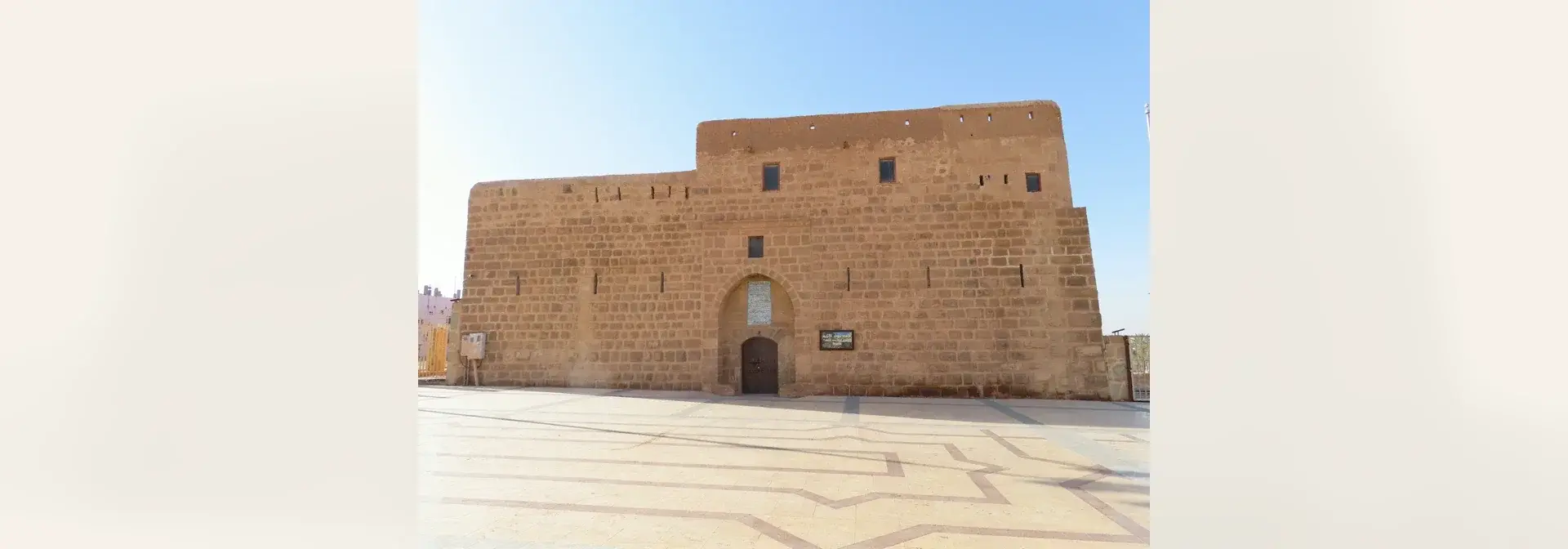
Overview
Tabuk Castle is a historic landmark in the heart of the city of Tabuk in the Tabuk region of northwestern Saudi Arabia, and its site is linked to the place where the Prophet, peace be upon him, stayed during the Expedition of Tabuk. [1]
The Tabuk region holds antiquities, landmarks, forts, castles and palaces that stand witness to the depth of the historic eras and the civilizations that succeeded one another there, and Tabuk Castle is among its most prominent witnesses. [3]
Location and the Syrian Hajj Route
The castle is one of the stations of the Syrian Hajj route that links the Levant to Madinah, and which consists of castles and stations running from the borders of the Jordanian Kingdom to Madinah. [1]
The route extends from the city of Damascus through Bosra al-Sham (Daraa), then Adhri'at, Ma'an and Al-Mudawwarah, before entering the Kingdom's territory through Halat Ammar, heading to Dhat al-Hajj in the Tabuk region, then Al-Aqra' and Al-Akhdar, reaching Al-Mu'azzam station on its way to Madinah. [4]
History
Architecture and Elements of the Castle
The castle was built of stone and wood, and is distinguished by a group of inscriptions. [2] It consists of two floors: a ground floor with an open courtyard, a number of rooms, a mosque and a well; and an upper floor reached by staircases, with an open summer mosque and rooms. [1]
Other staircases lead to the towers that were used for guarding and observation. [1] Behind the castle stand the Sultani cisterns, distinguished by the precision of their construction and made up of two cisterns, one square and the other rectangular in build. [1]
Modern Restorations
Tabuk Castle Museum
The Saudi Commission for Tourism and National Heritage, now the Ministry of Tourism, played a role in renovating and rehabilitating the castle in 1434 AH, so that it became the Tabuk Castle Museum. [1]
The museum houses many archaeological and heritage pieces on display, and receives visitors throughout the week. [1]
The Castle on National Occasions
On 22 September 2023, Tabuk Castle was adorned with a number of visual and audio shows prepared by the Heritage Commission to mark the Kingdom's 93rd National Day under the slogan "We Dream and We Achieve". [2]
Frequently Asked Questions
Q: What is Tabuk Castle? A: It is an archaeological castle in the city of Tabuk in the Tabuk region, and one of the stations of the Syrian Hajj route that links the Levant to Madinah. [1]
Q: When was the castle built? A: The present castle dates to 976 AH, corresponding to 1559 CE. [2]
Q: What does the Tabuk Castle Museum contain? A: Archaeological and heritage pieces on display, and it receives visitors throughout the week. [1]
Q: What are the Sultani cisterns? A: Two cisterns located behind the castle, one square and the other rectangular in build, distinguished by the precision of their construction. [1]
Related topics
- RegionTabuk RegionA northwestern Saudi region administered from Tabuk city, combining Red Sea and Gulf of Aqaba coasts with inland centres such as Tayma and a history of trade and pilgrimage routes.
- RegionTabuk CityTabuk City is a Saudi city whose presence dates back to more than 500 years before the Common Era. Al-Tawbah Mosque formed the nucleus from which it grew, with its neighbourhoods and markets, and it was there that the Battle of Tabuk, the last of the Prophet's battles, took place in Rajab 9 AH.
- EventShami Hajj RouteThe Shami Hajj Route is a historic course taken by pilgrims coming from the Levant to Makkah and Madinah, which for long centuries served as a main artery for the passage of caravans and a civilisational route linking the parts of the Islamic world. It runs from Damascus through archaeological forts and stations until Madinah, and the Kingdom of Saudi Arabia continues to develop it with modern roads and integrated services for pilgrims and Umrah performers.
- EventEgyptian Hajj RouteThe Egyptian Hajj Route is one of the seven most important pilgrimage and trade routes that linked the Islamic world to the Arabian Peninsula, and was taken by pilgrims from Egypt, the Maghreb, Al-Andalus and West Africa from the beginning of the Islamic era. It combines a coastal land path across Sinai with stations as far as Makkah and a sea route through the port of Aydhab.
- EventHejaz RailwayThe Hejaz Railway is a railway line ordered to be built in March 1900, with work beginning in 1900, to link the Muslims of the northern Arabian Peninsula with the Holy Places; it runs from Damascus station to Madinah station. The first train reached Madinah on 22 Rajab 1326 AH, corresponding to 23 August 1908, and the line operated for about nine years. The Kingdom of Saudi Arabia today preserves its station, its museum and its antiquities in the Tabuk and Madinah regions.
- HistoricMasmak PalaceA historic earthen fortress in Al-Thumairi, central Riyadh, linked to King Abdulaziz's recovery of Riyadh in 1319 AH/1902 CE, now a museum of the Kingdom's founding.
- HistoricHejazi ArchitectureHejazi architecture is a Saudi architectural style associated with the coastal areas on the Red Sea, known for its wooden rawasheen and historic houses. It is included in the Saudi Architecture Map, which comprises 19 architectural styles, and efforts to protect and develop it continue.
- MuseumSaudi National Museum: Reading History through ObjectsAn introduction to Riyadh's National Museum, its setting within the King Abdulaziz Historical Center, and the use of objects and multimedia to explore the Arabian Peninsula's past.
- RegionMadinah RegionA western Saudi region combining Madinah, Yanbu, AlUla and other governorates, with Islamic landmarks, oases, archaeological sites and a Red Sea coastline.
- HistoricAt-Turaif DistrictA historic district at the heart of Diriyah, built in the mid-eighteenth century CE, seat of the First Saudi State and a UNESCO World Heritage site since 2010.
- HistoricMarid CastleMarid Castle is an archaeological castle at the southern edge of the old town of Dumat al-Jandal in the Al-Jouf region, standing on a high hill overlooking the city. Its construction goes back to the first and second centuries CE, and the earliest mention of it is in the third century CE.
- EventMada'in Shuayb (Madyan)Mada'in Shuayb (Madyan), also known as Magha'ir Shuayb, is an archaeological site in Al-Bad' governorate in the Tabuk region, containing houses carved into the mountains and engravings on their entrances from a civilisation that existed in pre-Islamic times. It is one of the most prominent archaeological landmarks of Al-Bad' and a station on the Egyptian Hajj route, and the Tabuk region holds within it the tombs of the people of Shuayb in Madyan.
- HistoricMadyan MountainsThe Madyan Mountains are a mountain range in the Tabuk region of northwestern Saudi Arabia, and they form the northern part of the western highlands. They contain towering peaks, foremost among them Jabal Al-Lawz, alongside heritage and archaeological landmarks including Alqan Heritage Village.