
Overview
The discovery of oil in Saudi Arabia is a historic event that changed the course of the Kingdom. It began with the signing of the oil exploration concession on the fourth of Safar 1352 AH, corresponding to 29 May 1933, between King Abdulaziz ibn Abdulrahman Al Saud and the Standard Oil Company of California (Socal).[1][6]
Following the signing, geologists arrived in Dhahran and its surroundings on 23 September 1933, and drilling continued in the Dammam wells until the discovery was realised in Dammam Well No. 7; the phase culminated in the export of the first shipment of Saudi oil on 1 May 1939.[1][4][5]
The Concession Agreement and the Signing at Khuzam Palace
The oil exploration concession was signed on the fourth of Safar 1352 AH, corresponding to 29 May 1933, between King Abdulaziz and the Standard Oil Company of California (Socal), after the discovery of oil in Bahrain had revived the prospects of exploration in the region.[1]
The signing took place at Khuzam Palace in Jeddah, where Sheikh Abdullah Al-Sulaiman represented the Saudi government on behalf of King Abdulaziz, and Mr Lloyd Hamilton represented the company.[6]
After the signing, geologists arrived on 23 September 1933 and landed at the coastal village of Jubail, about 105 kilometres north of Dammam, from where the field exploration work set out.[1]
Drilling the First Dammam Wells
On 30 April 1935, it was decided to begin drilling Dammam Well No. 1; after seven months of drilling the well produced a strong burst of gas and some shows of oil at a depth of about 700 metres, before its flow was stopped and it was plugged with cement because of equipment failure.[1]
Drilling Dammam Well No. 2 began on 8 February 1936; when it was tested in June 1936 oil flowed from it at a rate of 335 barrels per day, and its output reached 3,840 barrels per day after acid treatment.[1]
As the wells followed one another, the results were mixed: Dammam Well No. 1 failed after being drilled to a depth of more than 975 metres; Dammam Well No. 2 proved to produce water at 8 or 9 times its oil output; Dammam Well No. 3 produced no more than 100 barrels of heavy oil per day, while wells 4, 5 and 6 were dry, so the team continued its work on the deep test well.[2]
The First Sign and the Oil Discovery at Dammam Well No. 7
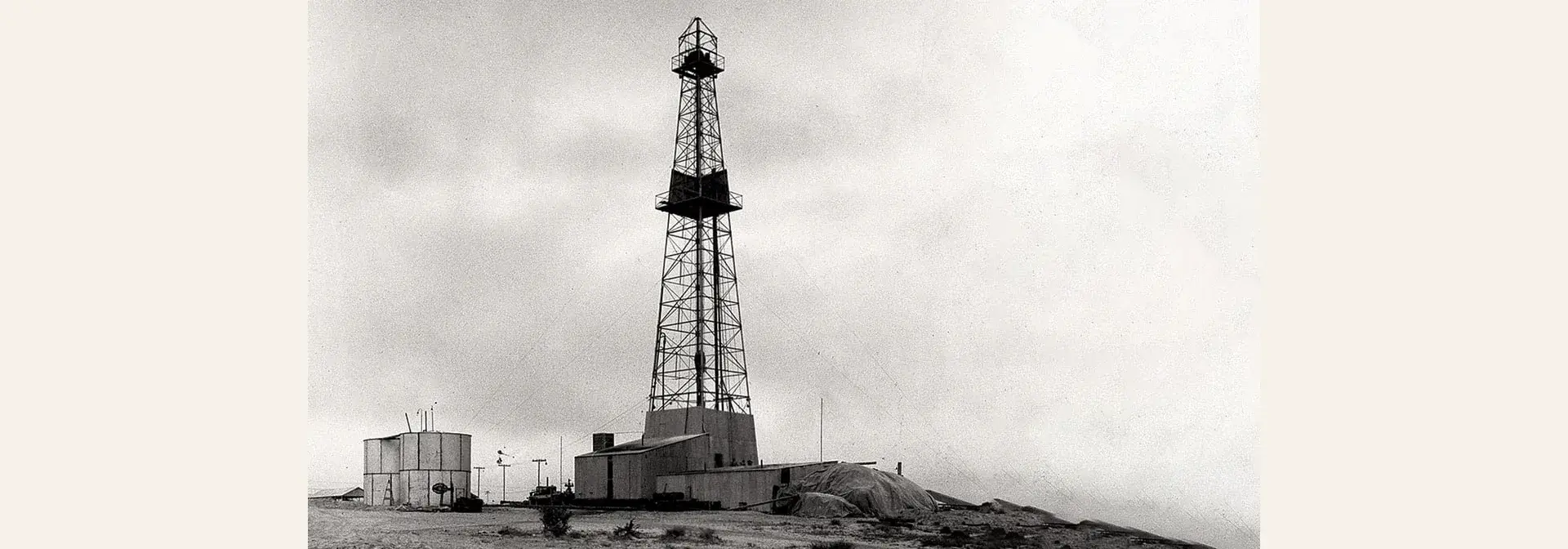
On the seventh of December 1936, the specialists in drilling exploration wells began drilling deep test well No. 7, after the result of the earlier wells had remained the same on reaching the Bahrain geological layer: that there was no oil.[3][2]
Ten months later, specifically on 16 October 1937 and at a depth of 1,097 metres, the drillers saw the first sign: 5.7 litres of oil in the diluted drilling mud returning from the well, with some gas.[4]
On the last day of 1937, the control equipment failed to bring the well under control and it blew out, ejecting the liquids and gases it held, and after drilling to a depth of 1,382 metres the drilling team found no appreciable amount of oil.[4]
Then in the first week of March 1938, Dammam Well No. 7 fulfilled the hoped-for result at a distance of 1,440 metres below the surface of the earth, and on the fourth of March 1938 it produced about 1,585 barrels per day.[5]
The well's output rose to 3,690 barrels on the seventh of March 1938; it recorded 2,130 barrels nine days later, then 3,732 barrels after five more days, then 3,810 barrels the following day.[3][4]
Workers on the Oil Project
By the end of 1936, the number of Saudi workers on the oil project had risen to 1,076, alongside 62 non-Saudi workers, an indication of the expansion of field work and the employment of national talent in the project.[2]
The Royal Visit and the First Oil Shipment
In the spring of 1939, King Abdulaziz travelled with a delegation to Dhahran, crossing the Ad-Dahna desert, where a city of 350 tents was set up as the centre for celebrations that included visiting the wells, holding banquets and receiving delegations of well-wishers.[1]
This coincided with the completion of the pipeline extending from the Dammam field to the port of Ras Tanura, 69 kilometres long, where King Abdulaziz turned the valve with his own hand to load the first shipment of Saudi oil, the first shipment of crude oil exported by the Kingdom on 11 Rabi' al-Awwal 1358 AH, corresponding to the first of May 1939.[4]
Related people
Frequently Asked Questions
Q: When was the oil exploration concession signed in Saudi Arabia? A: On the fourth of Safar 1352 AH, corresponding to 29 May 1933, between King Abdulaziz and the Standard Oil Company of California (Socal).
Q: Where was the agreement signed? A: At Khuzam Palace in Jeddah, where Sheikh Abdullah Al-Sulaiman represented the Saudi government on behalf of King Abdulaziz, and Mr Lloyd Hamilton represented the company.
Q: In which well was the oil discovery realised? A: In Dammam Well No. 7, which produced oil on the fourth of March 1938 at a distance of 1,440 metres below the surface of the earth at a rate of 1,585 barrels per day, and its output rose to 3,690 barrels on the seventh of March 1938.
Q: When did the Kingdom export its first shipment of oil? A: On 11 Rabi' al-Awwal 1358 AH, corresponding to the first of May 1939, through a pipeline 69 kilometres long from the Dammam field to the port of Ras Tanura.
Q: How many Saudi workers were there on the project? A: 1,076 by the end of 1936, alongside 62 non-Saudi workers.
Conclusion
The discovery of oil in Saudi Arabia began with the concession agreement of 1933, then passed through successive drilling stages in the Dammam wells until the discovery was realised at Dammam Well No. 7 on 4 March 1938, and it culminated in the export of the first shipment of Saudi oil on 1 May 1939, marking a turning point in the Kingdom's economic course.[1][4][5]
Related topics
- RegionEastern ProvinceA large eastern Saudi region administered from Dammam, combining Gulf cities, the oases of Al Ahsa and Qatif, desert areas, energy industries and maritime commerce.
- RegionDammam CityDammam City is a Saudi city in the Eastern Province on the coast of the Arabian Gulf. Its metropolitan area takes in Dammam City together with the governorates of Al-Khobar and Al-Bayda and the Dhahran centre; within it stand King Abdulaziz Port and King Fahd International Airport, and the King Fahd Causeway links the Kingdom of Saudi Arabia with the Kingdom of Bahrain. In 2026 the Dammam metropolitan area joined the Global Quality of Life Initiative.
- RegionDhahran CityDhahran City is a city in the Eastern Province of the Kingdom of Saudi Arabia. Its name is bound up with the story of oil discovery in the Kingdom and with its hosting of the world's largest oil company, and it is home to the headquarters of Saudi Aramco, King Fahd University of Petroleum and Minerals and the King Abdulaziz Center for World Culture (Ithra).
- MuseumKhuzam Palace MuseumKhuzam Palace Museum is a Saudi museum housed in the historic Khuzam Palace in the Al-Nuzlah Al-Yamaniyah district, southeast of the city of Jeddah in the Makkah Region. King Abdulaziz ordered the construction of the palace in 1928 and it was completed in 1932; it witnessed the signing of the first oil exploration agreement in 1933, and it was later converted into a museum that opened in March 1995.
- TopicSaudi AramcoSaudi Aramco is the Saudi Arabian Oil Company, a national oil and gas company whose roots go back to a concession agreement concluded in 1933 CE, and which achieved its first commercial oil production in 1938 CE. The Kingdom completed its ownership of the company in 1980 CE, and it was formally established under its current name in 1988 CE; its net income for the 2025 fiscal year reached about SAR 392.5 billion.
- National visions and programmesSaudi Vision 2030: A Framework for TransformationAn introduction to Saudi Vision 2030, its social, economic and institutional themes, and the relationship between implementation programmes, long-term targets and measured results.
- EventUnification of Saudi ArabiaKing Abdulaziz's path from the recovery of Riyadh in 1902 to the proclamation of the Kingdom of Saudi Arabia on 23 September 1932, now National Day.
- RegionJubail CityJubail City is a Saudi city on the coast of the Arabian Gulf that brings together a maritime history from which its name was derived and a modern industrial present led by the Royal Commission for Jubail and Yanbu. It contains Jubail Commercial Port and King Fahd Industrial Port, seven beaches, and the UNESCO Award for Best Learning City.