
Overview
The Shami Hajj Route is a historic course taken by pilgrims coming from the Levant to Makkah and Madinah, and for long centuries it served as a main artery for the passage of caravans and a civilisational route reflecting the depth of connection between the parts of the Islamic world. [1]
The route links Damascus to the holy places through a series of forts, stations and stopping places, some of which still stand today, and these stations are spread from the Kingdom's borders up to Madinah. [1][4]
The Course and the Stopping Places
The route runs from the city of Damascus, passing through Bosra al-Sham (Daraa), then Adhri'at, Ma'an and Al-Mudawwarah, before entering the territory of the Kingdom through Halat Ammar. [1] From Halat Ammar the route heads to Dhat al-Hajj in the Tabuk region, then Al-Aqra', then Al-Akhdar, on to the Al-Mu'azzam station, which holds the Al-Mu'azzam pool, one of the most prominent watering points for pilgrims and Umrah performers, then AlUla passing through Al-Hijr, then Qa' al-Hajj and Qurh, until Madinah. [1]
These stopping places connect to one another: they begin from Damascus, Bosra al-Sham (Daraa), Adhri'at, Ma'an and Al-Mudawwarah (Saragh), then Halat Ammar, Dhat al-Hajj in Tabuk, Al-Aqra', then Al-Akhdar, where the Al-Muhdathah station lies, then the Al-Mu'azzam station, and AlUla passing through Al-Hijr, then Qa' al-Hajj and Qurh, reaching Madinah. [4]
Dhat al-Hajj Fort
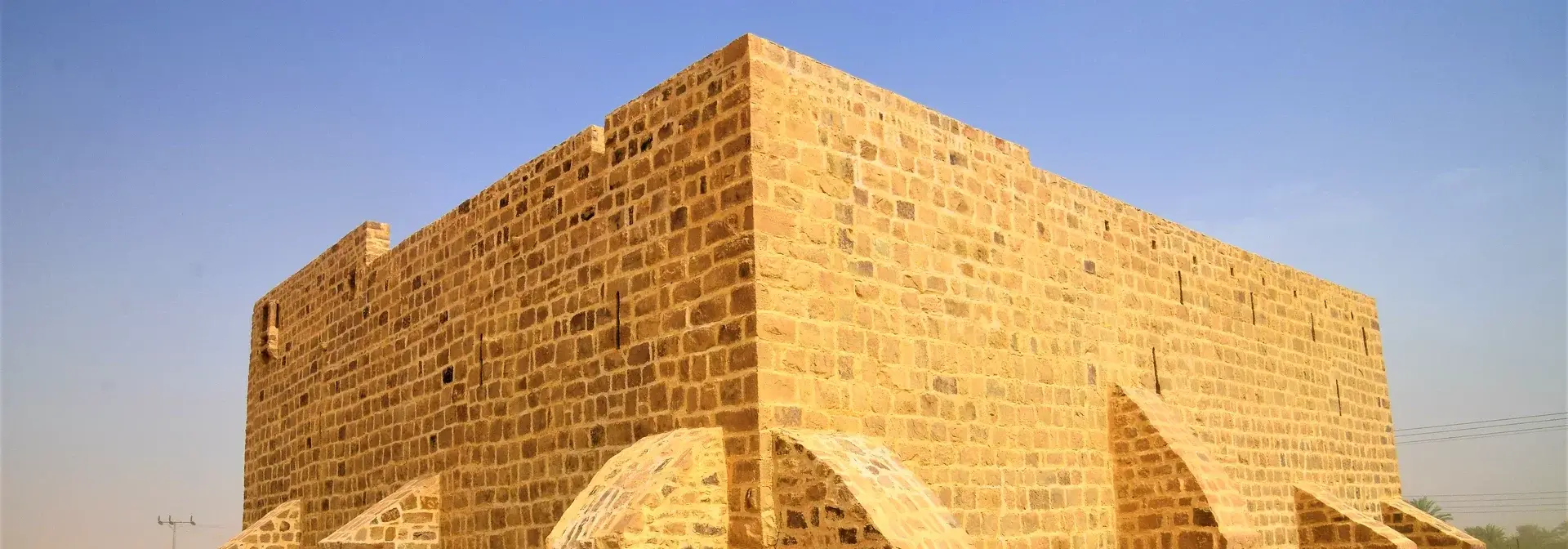
Dhat al-Hajj Fort lies between Halat Ammar Centre and the city of Tabuk, and served as a resting place for the pilgrims of the Shami route and a meeting point of caravans, from which they set out towards Madinah and Makkah going and returning. [2] Its construction dates back to the year 971 AH. [2]
It was named "Dhat Hajj" after a type of plant that grew there, and it was a thriving village in earlier ages through which pilgrim caravans passed to rest and take on water, and its importance grew with the arrival of the Hejaz Railway to it in the early twentieth century AD. [2]
Tabuk Fort
Tabuk Fort is one of the stations of the Shami Hajj Route that links the Levant to Madinah, and it consists of forts and stations beginning from the borders of the Kingdom up to Madinah. [3] The fort was built in 976 AH, then restored in 1064 AH, and in 1259 AH it was restored and entirely renewed, with a special inscription commemorating this placed in the mihrab of the mosque, and it was then renovated in 1370 AH. [3]
The Saudi Commission for Tourism and National Heritage contributed to the renovation and rehabilitation of the fort in 1434 AH, so that it became the "Tabuk Fort Museum". [3] Behind the fort lie the Sultanic pools, distinguished by the precision of their construction, made up of two pools, one square and the other of rectangular construction. [3]
Water Supply Stations
Throughout its history the route faced multiple challenges, foremost among them water scarcity and the difficulty of travel across varied terrain, as the pilgrims crossed mountains, plains and deserts. [1] This required the establishment of resting stations, the digging of wells and the construction of pools to collect water, to secure the caravans' needs for drinking and provisions. [1]
Qa' al-Hajj and AlUla
The village of Qa' al-Hajj lies in the north-east of AlUla Governorate and is distinguished by its terrain, which made it an important destination and a route for pilgrims coming along the Shami Hajj Route that links the Levant to the holy places, Makkah and Madinah. [4]
The route passes through AlUla Governorate at Al-Hijr before Qa' al-Hajj and Qurh, a course associated with the location of Al-Hijr on the caravan route between the south of the Arabian Peninsula and its north. [1][4]
The Route in the Era of the Saudi State
In the era of the Saudi state the pilgrimage routes witnessed a full qualitative leap, represented in the development of infrastructure and the creation of modern road networks to the highest standards, alongside an integrated system of services for pilgrims and Umrah performers. [1]
This system includes equipped stations and advanced health, guidance and logistical services, ensuring the performance of the rites with ease and facility from arrival until departure. [1]
The Overland Pilgrimage Route from Jordan
The overland pilgrimage routes coming from Jordan comprise two main courses: the first via Halat Ammar, Tabuk, Madinah and Makkah, with a distance of 1,219 km, and the second via Al-Hadithah, Al-Qurayyat, Sakaka, Madinah and Makkah, with a distance of 1,545 km. [5]
Frequently Asked Questions
Q: What is the Shami Hajj Route? A: A historic course taken by pilgrims coming from the Levant to Makkah and Madinah, which served as a main artery for the passage of caravans and a civilisational route linking the parts of the Islamic world. [1]
Q: Where does the route begin and where does it end? A: It begins from Damascus and passes through Bosra al-Sham, Adhri'at, Ma'an and Al-Mudawwarah, then enters the territory of the Kingdom through Halat Ammar, Dhat al-Hajj, Tabuk, Al-Aqra', Al-Akhdar and the Al-Mu'azzam station, then AlUla passing through Al-Hijr, then Qa' al-Hajj and Qurh, reaching Madinah. [1][4]
Q: What are the most prominent forts and stations along the route? A: Dhat al-Hajj Fort between Halat Ammar and Tabuk, and Tabuk Fort, which became a museum, in addition to the Sultanic pools, the Al-Mu'azzam station and the village of Qa' al-Hajj. [2][3][4]
Q: How was water secured for the pilgrims along the route? A: By establishing resting stations, digging wells and building pools to collect water, to secure the caravans' needs for drinking and provisions. [1]
Q: What are the distances from Jordan to Makkah along the overland routes? A: 1,219 km via Halat Ammar, Tabuk and Madinah, and 1,545 km via Al-Hadithah, Al-Qurayyat, Sakaka and Madinah. [5]
Conclusion
The Shami Hajj Route brings together a historic course that linked the Levant to the holy places over long centuries, and archaeological stations and forts that still stand today, foremost among them Dhat al-Hajj Fort and Tabuk Fort. The Kingdom of Saudi Arabia continues to develop the pilgrimage routes and their services within an integrated system that facilitates the performance of the rites. [1][2][3] Related topics on the platform include Darb Zubaydah, Madinah Region and the Prophet's Mosque.
Related topics
- HistoricDarb ZubaydahThe Kufa pilgrimage road linking Iraq to Makkah through five Saudi regions, used since before Islam and named after the spring dug by Zubaydah bint Ja'far.
- EventHejaz RailwayThe Hejaz Railway is a railway line ordered to be built in March 1900, with work beginning in 1900, to link the Muslims of the northern Arabian Peninsula with the Holy Places; it runs from Damascus station to Madinah station. The first train reached Madinah on 22 Rajab 1326 AH, corresponding to 23 August 1908, and the line operated for about nine years. The Kingdom of Saudi Arabia today preserves its station, its museum and its antiquities in the Tabuk and Madinah regions.
- Archaeological sitesHistory of HegraHegra, also called Mada'in Salih, is an archaeological site in AlUla Governorate whose tombs, wells and inscriptions illuminate Nabataean life and caravan routes.
- Governorate and oasis geographyGeography of AlUlaAlUla is a governorate in Madinah Region in northwestern Saudi Arabia, where cultivated oases and settlements lie among wadis and desert escarpments.
- RegionMadinah RegionA western Saudi region combining Madinah, Yanbu, AlUla and other governorates, with Islamic landmarks, oases, archaeological sites and a Red Sea coastline.
- HistoricThe Prophet's MosqueThe Prophet's Mosque is the mosque of the Prophet Muhammad ﷺ in Madinah, built in the first year of the Hijrah over an area of 1,050 square meters. Several constructions followed across the Islamic eras, and the mosque saw its widest expansions in the Saudi era.
Sources & references
- Saudi Press Agency (SPA) — General / The Shami Hajj Route, a historic course for pilgrims from the Levant to Makkah and Madinah
- Saudi Press Agency (SPA) — General / Dhat al-Hajj Fort, a station on the Shami Hajj Route
- Saudi Press Agency (SPA) — General / Tabuk Fort, one of the stations of the Shami Hajj Route
- Saudi Press Agency (SPA) — General / The village of Qa' al-Hajj and the stopping places of the Shami Hajj Route
- Saudi Press Agency (SPA) — General / Road guide for the overland pilgrimage route from Jordan for the Hajj season 1447 AH