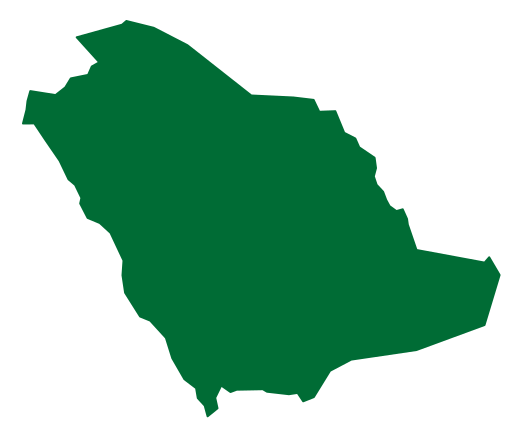

What does the Third Saudi State mean?
The Third Saudi State is a historical term for the phase begun by Abdulaziz bin Abdulrahman Al Saud with his recovery of Riyadh in 1902, following the second state's end in 1891. This phase developed into the Kingdom of Saudi Arabia; it does not describe a state that ceased to exist in 1932. Wikipedia presents the third state as the current Saudi state, while Saudipedia covers its origins in articles on unification and the founder's biography. Distinguishing the political beginning from the official name is essential to understanding the sequence.
1902: Riyadh as the starting point
After his period of residence in Kuwait, Abdulaziz returned to recover Riyadh from Al Rashid rule in January 1902, an event associated with Masmak Fort and its garrison. Riyadh became the base for rebuilding and extending his rule. His father Abdulrahman bin Faisal, the second state's last ruler, supported the transition of leadership to his son. Control of Riyadh, however, did not mean that all the Kingdom's regions were unified that year; the process continued through subsequent political and military stages.
1913–1925: the east, Ha'il and the Hejaz
The incorporation of Al-Ahsa and Qatif in 1913 was an important step towards the eastern coast, its resources and ports. Ha'il followed in 1921 with the end of Al Rashid rule there. In the Hejaz, Makkah came under Saudi control in 1924, followed by the completion of control over Jeddah and Madinah in 1925. These milestones trace the expansion of rule from a base in Najd into several regions; they do not reduce every unification campaign or boundary settlement to a single list.
How did the state's names and ruler's titles change?
Wikipedia uses Emirate of Riyadh for the initial phase and Emirate of Najd and Hasa after expansion eastwards. Abdulaziz adopted the title Sultan of Najd in 1921, King of the Hejaz and Sultan of Najd and its Dependencies in 1926, and King of the Hejaz and Najd and its Dependencies in 1927, following the title sequence in his Saudipedia biography. These names concern the expansion of his rule and the changing status of its regions. Each should not be treated as a separately numbered Saudi state or confused with the first and second states.
23 September 1932: proclaiming the Kingdom of Saudi Arabia
The country took the name Kingdom of Saudi Arabia from 23 September 1932, after its regions had been brought under Abdulaziz's rule. This is the date associated with National Day, confirmed by Saudipedia, Wikipedia and the official Founding Day website. Riyadh retained its position as capital, and the ruler's title became King of Saudi Arabia. The effective naming and proclamation date differs from the earlier issuance of the order, so the naming process should not be compressed into one day or 1932 interpreted as the third state's endpoint.
After proclamation: institutions, economy and continuing rule
Institution-building had begun before the name was proclaimed, including the establishment of the Ministry of Foreign Affairs in 1930, and continued within the Kingdom. The discovery of oil in commercial quantities in 1938 introduced a new resource that affected the economy and state finances. Abdulaziz remained ruler until his death in 1953 and was succeeded by his son Saud, demonstrating the Kingdom's continuity after unification. The period 1902–1932 is therefore a useful frame for studying origins and unification, not the entire lifespan of the Third Saudi State.
Dates and landmarks: how do 1727, 1902 and 1932 differ?
The year 1727 concerns the First Saudi State's founding under Muhammad bin Saud in official Saudi chronology; 1902 marks Abdulaziz's recovery of Riyadh and the third phase's beginning; and 1932 marks the Kingdom's proclamation under its current name. Masmak was not built for the unification announcement: it was a nineteenth-century fort that predated Riyadh's recovery and was later restored and turned into a museum. The 2010 photograph shows the landmark at a later time, not the events of 1902, and does not establish Masmak as the venue of the 1932 announcement.
Sources & references
- Saudipedia: Unification of the Kingdom of Saudi Arabia (Arabic)
- English Wikipedia: Third Saudi state
- Saudipedia: Abdulaziz bin Abdulrahman Al Saud (Arabic)
- Official Founding Day website: Founding Day and National Day distinction
- Saudipedia: Masmak Palace (Arabic)
- English Wikipedia: Al Masmak Palace
- Royal Commission for Riyadh City: Qasr al-Hukm District Development Programme (Arabic)


