
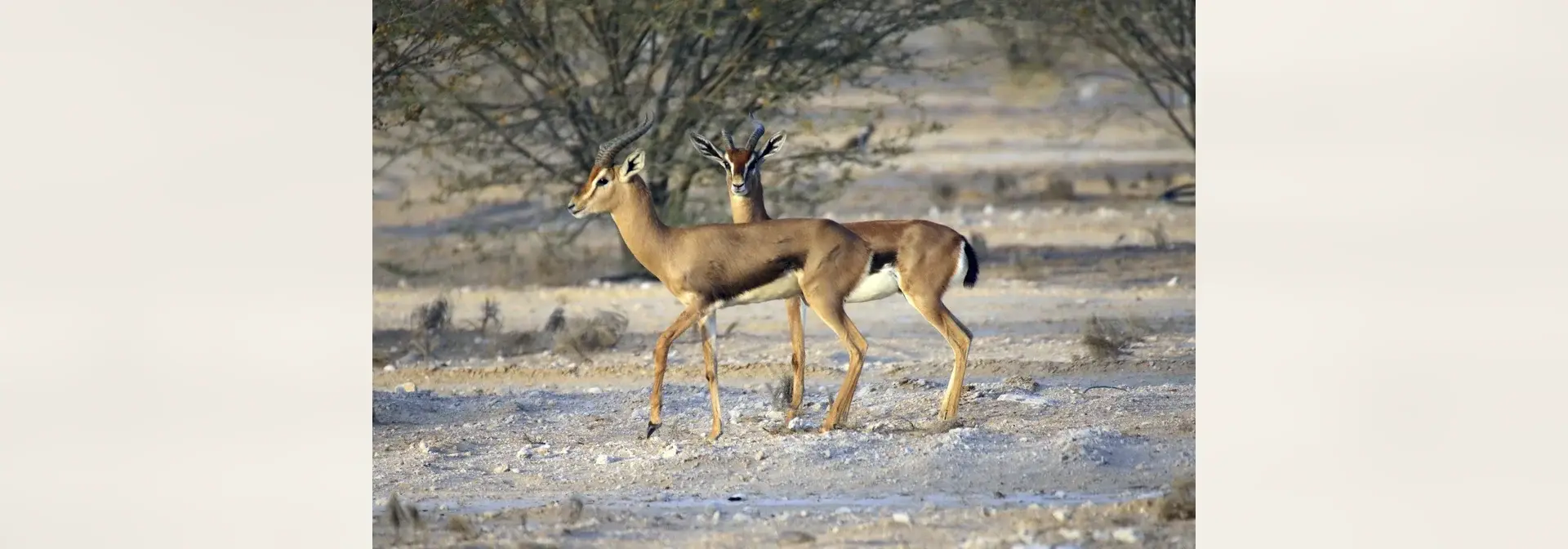
Overview
The Arabian Gazelle is among the wildlife species that receive continuous efforts in the Kingdom of Saudi Arabia for their protection, breeding and reintroduction into their natural habitats.[2] These efforts belong to a broader concern for biological diversity and the restoration of ecosystems across the royal reserves.[1][3]
National reserves continue to record tangible results along this path, including three newborn Arabian Gazelles at Imam Turki bin Abdullah Royal Reserve during the second quarter of 2026.[1]
The Arabian Gazelle in Nature Reserves
The Arabian Gazelle finds in the Kingdom's nature reserves suitable environments for grazing and reproduction, as gazelle species feed on grasses and wild plants and live in open desert environments.[2] These reserves prepare and protect habitats in a way that supports the stability of the species within them.[2]
Imam Turki bin Abdullah Royal Reserve holds more than 265 species of wildlife, including 28 species of mammals, 184 species of birds, 30 species of reptiles and 23 orders of invertebrates.[2] Among its most prominent wildlife are the Reem Gazelle, the Arabian Oryx, the red-necked ostrich and the houbara bustard.[2]
Breeding and Reintroduction Efforts
Conservation efforts for the Arabian Gazelle rest on an integrated system that begins with breeding and the growth of herds and is linked to the protection and preparation of habitats, leading to reintroduction into natural environments, which supports the formation of stable groups in their habitats and their long-term sustainability.[2]
This system has contributed to a marked increase in the numbers of rare species and to the release of endangered species into their natural environments, within the national objectives for the protection of biological diversity.[2]
Imam Turki bin Abdullah Royal Reserve
Imam Turki bin Abdullah Royal Reserve recorded three newborn Arabian Gazelles in the At-Taysiyah area during the second quarter of 2026, an indicator that reflects the progress of programmes for the conservation of endangered wildlife and the success of breeding efforts in growing the numbers of the Arabian Gazelle.[1]
The registration of these newborns falls within a path that supports the reintroduction of the Arabian Gazelle into its natural habitats and the enhancement of the sustainability of biological diversity within the reserve, by linking the growth of herds to the protection and preparation of habitats.[1][2]
Sharaan Nature Reserve
Sharaan Nature Reserve in AlUla aims to protect and regenerate the rich biological diversity of its canyons, valleys and deserts, and to conserve local animal species such as the gazelle, the Arabian Oryx and acacia forests, while promoting sustainable coexistence.[4]
The reserve hosts rare animals such as the red-necked ostrich, the Nubian ibex, the Idmi gazelle, the slender-limbed hare and the rock hyrax, and it provides a suitable environment for endangered wild species such as Arabian wolves, gazelles and the large-eared red foxes.[5]
Uruq Bani Maarid Reserve
Reintroduction efforts in the country advance by returning distinctive desert animals to their natural habitats in Uruq Bani Maarid Reserve, among them the Arabian Oryx (Oryx leucoryx) and the Reem Gazelle (Gazella marica).[6]
The Northern Reserve for Sustainable Hunting
The Northern Reserve for Sustainable Hunting is the first reserve in the Kingdom dedicated to sustainable hunting, in an approach that balances the enjoyment of hunting with the conservation of wildlife.[3]
The reserve holds a variety of quarry, such as the houbara bustard, gazelles and the Wudhayhi oryx, in a safe environment that maintains ecological balance.[3]
Wildlife Protection and National Objectives
The reserves continue to expand the impact of their programmes in wildlife conservation and ecosystem restoration, through an approach that links the protection of species to the development and sustainability of their habitats, which strengthens their contribution to achieving the national objectives for the protection of biological diversity and the restoration of ecosystems.[3]
This approach is in line with the objectives of Saudi Vision 2030 and the Saudi Green Initiative for environmental protection and sustainable development.[3]
Frequently Asked Questions
Q: How does the Kingdom protect the Arabian Gazelle? A: Through nature reserves that provide suitable environments for it, and through programmes for breeding, growing herds and reintroduction into natural habitats.[2]
Q: What is the latest news on the Arabian Gazelle in the Kingdom's reserves? A: Three newborn Arabian Gazelles were recorded at Imam Turki bin Abdullah Royal Reserve during the second quarter of 2026.[1]
Q: What are the most prominent wildlife species in Imam Turki bin Abdullah Royal Reserve? A: The Reem Gazelle, the Arabian Oryx, the red-necked ostrich and the houbara bustard, among more than 265 species of wildlife.[2]
Q: Which reserves are concerned with protecting the gazelle and reintroducing it? A: Imam Turki bin Abdullah Royal Reserve, Sharaan Nature Reserve, Uruq Bani Maarid Reserve and the Northern Reserve for Sustainable Hunting.[1][3][4][6]
Q: How do these efforts relate to the national objectives? A: They are tied to the protection of biological diversity and the restoration of ecosystems, in line with Saudi Vision 2030 and the Saudi Green Initiative.[3]
Conclusion
Interest in the Arabian Gazelle in the Kingdom combines habitat protection, the growth of herds and reintroduction [1][2][3], the role of nature reserves that host gazelles and other rare species [4][5][6], and consistency with the national objectives for biological diversity.[3]
Related topics on the platform include Arabian Oryx, Arabian Leopard and AlUla Geography.
Related topics
- HistoricArabian OryxThe Arabian Oryx, also known as the wadhi oryx, is a species of wild mammal and the largest wild mammal in the Arabian Peninsula. It was absent from its natural habitat in northern Saudi Arabia for about ninety years, then was resettled in protected reserves and released in Uruq Bani Ma'arid Reserve and King Salman bin Abdulaziz Royal Reserve.
- HistoricArabian LeopardThe Arabian Leopard is a subspecies of the endangered leopard, known scientifically as Panthera pardus nimr, and is one of the smallest and rarest leopard subspecies. The International Union for Conservation of Nature has classified it as Critically Endangered since 1996, and efforts to conserve it in the Kingdom of Saudi Arabia are tied to the Sharaan Nature Reserve and the Arabian Leopard Breeding and Conservation Centre in AlUla.
- Reserves and biodiversityUruq Bani Maarid: Conserving Life in the Empty QuarterExplore the dunes and habitats of Uruq Bani Maarid, its wildlife reintroduction programmes, and the significance of its inscription as a natural World Heritage property in 2023.
- Governorate and oasis geographyGeography of AlUlaAlUla is a governorate in Madinah Region in northwestern Saudi Arabia, where cultivated oases and settlements lie among wadis and desert escarpments.
- National visions and programmesSaudi Vision 2030: A Framework for TransformationAn introduction to Saudi Vision 2030, its social, economic and institutional themes, and the relationship between implementation programmes, long-term targets and measured results.
- TopicSaudi Green InitiativeThe Saudi Green Initiative is a national initiative announced by His Royal Highness the Crown Prince and Prime Minister on 27 March 2021, charting the Kingdom's direction in protecting land and nature along a clear and ambitious roadmap. It targets the planting of 10 billion trees, the raising of protected areas to more than 30 percent, and the supply of 50 percent of electricity generation from renewable energy by 2030.
Sources & references
- Imam Turki bin Abdullah Royal Reserve Development Authority — Recording of new Arabian Gazelle births
- Imam Turki bin Abdullah Royal Reserve Development Authority — Species restoration system and wildlife diversity
- Imam Turki bin Abdullah Royal Reserve Development Authority — The Northern Reserve for Sustainable Hunting and national objectives
- Royal Commission for AlUla — Sharaan Nature Reserve
- Royal Commission for AlUla — Rare animals in Sharaan Nature Reserve
- UNESCO — World Heritage Centre, Uruq Bani Maarid Reserve