
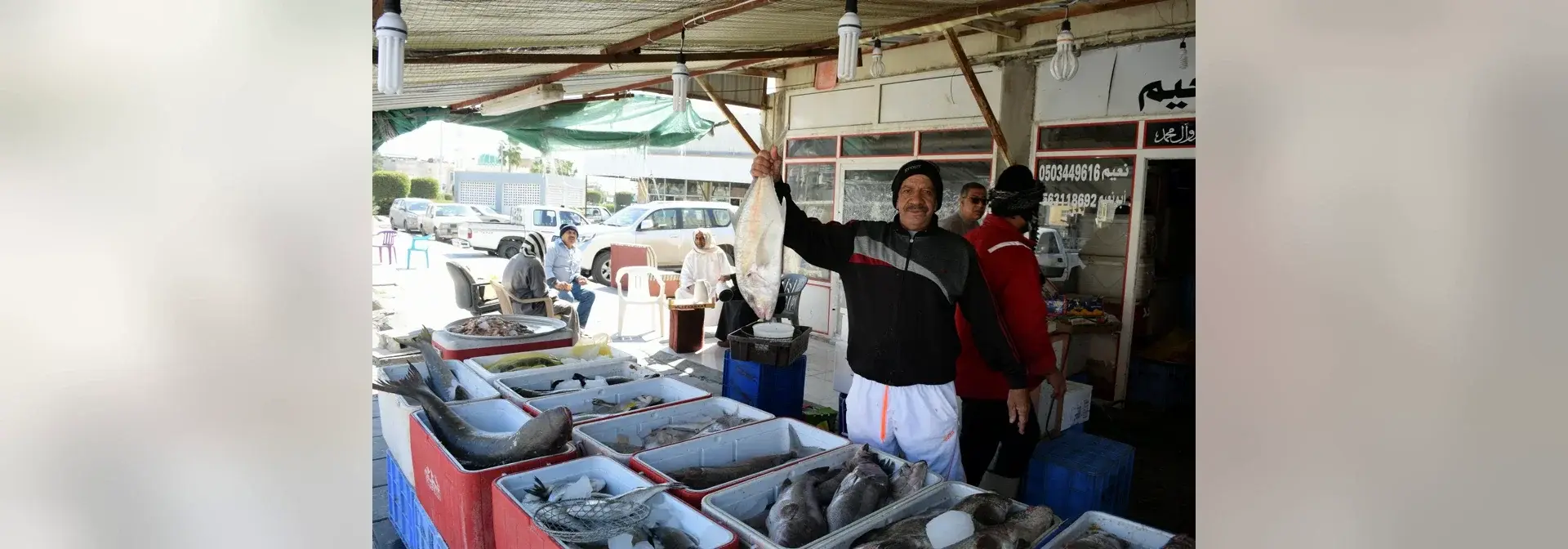

Overview
Fisheries in Saudi Arabia are a national sector concerned with managing marine fisheries and aquaculture. The Kingdom continues to develop its national marine fisheries management system, strengthening governance, oversight and compliance frameworks, raising inspection efficiency, improving data quality and drawing on modern technologies for tracking and monitoring. These efforts reinforce the sustainable management of marine resources, consolidate supply-chain transparency and advance the growth of the blue economy.[1]
The Red Sea
The Red Sea holds a special place in the Kingdom's efforts, given its unique biological diversity and the environmental, economic and developmental importance of its ecosystems. It includes Coral reefs in Saudi Arabia and Farasan Islands Reserve.[1]
The Kingdom's approach establishes a balanced model between development ambitions and sustainability requirements. It protects sensitive marine habitats, regulates fishing activities, strengthens oversight and tracking, improves the management of landing operations and encourages responsible, sustainable fishing practices, including The Red Sea Project.[1]
The Kingdom also stresses the importance of strengthening regional partnership among the states bordering the Red Sea, exchanging information and data, integrating oversight and inspection work and building capacity. This helps protect its resources and sustain them for future generations.[1]
Tourism and nature
International Cooperation
The Kingdom took part in the thirty-seventh session of the Committee on Fisheries (COFI37) at the headquarters of the Food and Agriculture Organization of the United Nations (FAO) in Rome. Its delegation was led by the Assistant Undersecretary for Livestock and Fisheries, Dr. Ali bin Mohammed Al-Sheikh.[1]
The Kingdom affirmed its commitment to continuing its international and regional efforts to strengthen the sustainability of marine resources, to combat illegal, unreported and unregulated fishing and to support good fisheries governance. This contributes to protecting global food security and the sustainability of marine ecosystems.[1]
The participation also included the high-level event marking ten years since the entry into force of the Port State Measures Agreement, held at the FAO headquarters in Rome.[1]
Regional Center for Sustainable Fisheries Development
The Ministry of Environment, Water and Agriculture received the Regional Center for Sustainable Fisheries Development, Arabian Gulf Branch, from Saudi Aramco. This strategic step aims to strengthen domestic fish production and develop the fisheries sector in line with Saudi Vision 2030's drive to enable the sector and reinforce the food security system.[2]
The initiative comes within the Ministry's efforts, represented by the National Program for the Development of the Livestock and Fisheries Sector. It aims to strengthen marine sustainability and raise the efficiency of the aquaculture system through the latest technologies and scientific standards.[2]
The Regional Center launched a distinctive initiative by releasing 100,000 sobaity bream larvae into the waters of the Arabian Gulf in several batches. The step affirms the Kingdom's commitment to protecting the marine environment and developing its natural resources, and extends the development efforts of Eastern Province.[2]
Production Capacity and Development Impact
The project's production capacity reaches 10 million marine fish larvae a year, and its facilities extend over 243,000 square meters. It also includes a mangrove lagoon of 300,000 square meters that supports ecological balance.[2]
The facility is one of the strategic initiatives that contribute to strengthening fish stocks in the waters of the Arabian Gulf, preserving biodiversity and supporting the sustainability of local fisheries.[2]
The project also contributes to strengthening food security and reducing dependence on external imports, and to raising the efficiency of the fishing sector. This reflects positively on fishers' income and on the economy of coastal regions.[2]
Aquaculture Agreement
On 29 September 2026, Deputy Minister of Environment, Water and Agriculture Eng. Mansour bin Hilal Al-Mushaiti sponsored the signing of the bilateral agreement between the Saudi Tharawat Al-Bihar Fish Company and Alfa Water Company at the Ministry's headquarters in Riyadh.[3]
Frequently Asked Questions
Q: What are the fisheries in Saudi Arabia? A: A national sector concerned with managing marine fisheries and aquaculture and with strengthening food security and the sustainability of marine resources.
Q: What are the most prominent initiatives for developing the sector? A: The National Program for the Development of the Livestock and Fisheries Sector and the Regional Center for Sustainable Fisheries Development, Arabian Gulf Branch.
Q: What is the production capacity of the Regional Center? A: 10 million marine fish larvae a year.
Q: What is the Kingdom's role in the sustainability of marine resources? A: Developing the fisheries management, oversight and tracking system, combating illegal, unreported and unregulated fishing and strengthening regional partnership in the Red Sea.
Related topics
- HistoricCoral Reefs of Saudi ArabiaCoral reefs of Saudi Arabia are marine ecosystems that extend along the Kingdom's coasts on the Red Sea, and the Red Sea holds the world's second-longest coral reef system, stretching 2,000 kilometres.[1] The General Organization for the Conservation of Coral Reefs and Sea Turtles in the Red Sea "Shams" is responsible for their protection and sustainability.[2]
- RegionEastern ProvinceA large eastern Saudi region administered from Dammam, combining Gulf cities, the oases of Al Ahsa and Qatif, desert areas, energy industries and maritime commerce.
- HistoricThe Red Sea ProjectThe Red Sea Project is a global tourism destination on the Red Sea coast in northwestern Saudi Arabia, developed by Red Sea Global within the Public Investment Fund's giga-projects. It spans more than 28,000 square kilometres, includes the world's fourth-largest flourishing coral reef, and aims to welcome one million visitors by 2030.