
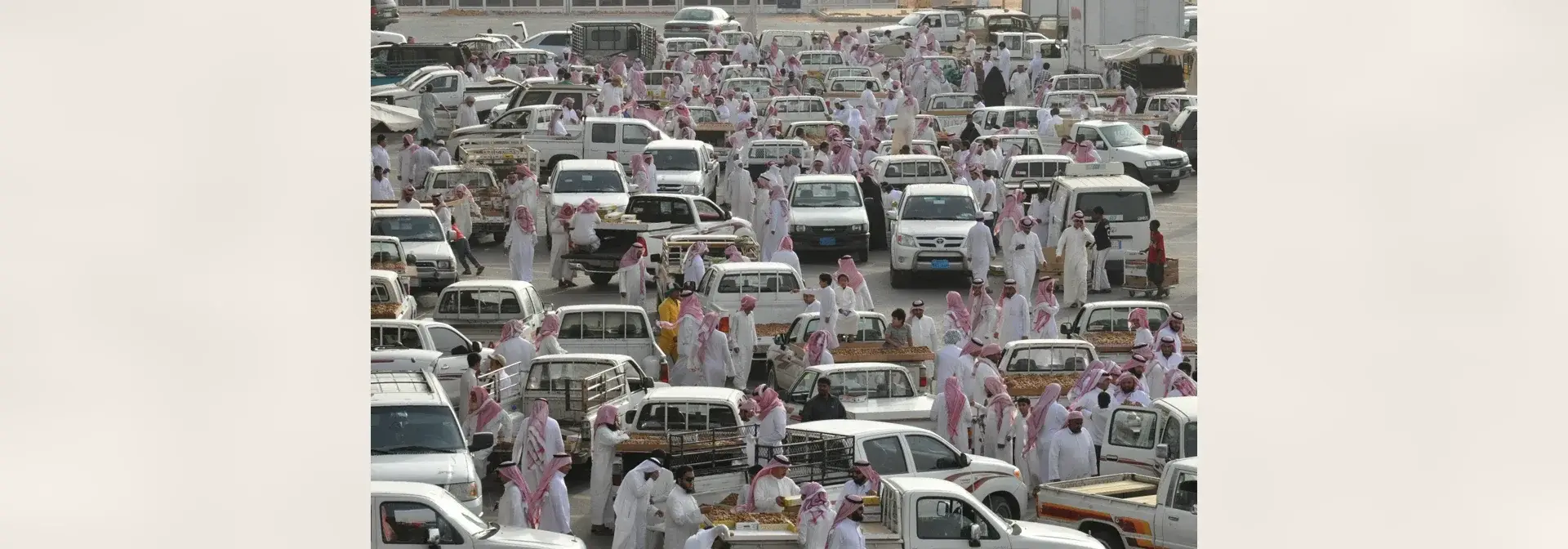

Overview
The Buraidah Dates Festival is an annual economic, agricultural and tourism event held in Buraidah in Al-Qassim Region of the Kingdom of Saudi Arabia, and it is the most prominent economic and agricultural event in the dates sector.[3]
The festival is registered in the Guinness World Records as the largest dates festival in the world, and it brings together more than 30 varieties of dates, most notably Sukkari, Saq'i and Medjool.[3]
Organisation and Administration
The festival is organised by the Al-Qassim Region Emirate and the Ministry of Environment, Water and Agriculture, under the supervision of the National Center for Palms and Dates, with the support of the Al-Qassim Municipality and the region's police.[1] His Royal Highness Prince Dr. Faisal bin Mishal bin Saud bin Abdulaziz, Governor of Al-Qassim Region, directed that the name "Buraidah Dates Carnival" be adopted from the year following his directive.[4]
In the 1445 AH/2023 CE edition, activities began in early August at Dates City in central Buraidah, organised by the regional branch of the Ministry of Environment, Water and Agriculture under the supervision of the region's emirate and in partnership with the Al-Qassim Municipality, to market the produce of more than 11 million palm trees.[7]
Event Venues and Duration
The festival's activities are held at a number of venues, including Dates City (Al-Nakhlah Centre), which forms the hub of daily commercial activity for the sale and purchase of dates, alongside the accompanying exhibitions.[2] The venues also include the "Rifiyyah" farm, which offers a tourism experience showcasing the agricultural heritage and rural identity of Al-Qassim Region, and King Khalid Civilisation Centre, which hosts cultural activities.[2]
The 1448 AH/2026 CE edition runs for 75 days, beginning on the first of August and continuing until 14 October.[2] In the 1446 AH/2024 CE edition, the festival ran for 51 days across morning and evening sessions.[1]
Dates, Production and Economic Returns
The Kingdom of Saudi Arabia has more than 34 million palm trees distributed across all regions, with Al-Qassim Region accounting for 11.2 million palm trees.[1] Date production in Al-Qassim across all its governorates exceeds 528,000 tonnes, representing about 35% of the Kingdom's production of 1.6 million tonnes.[1]
In the 1448 AH/2026 CE edition, date production reached 587,000 tonnes and the number of palm trees reached 12 million, with an annual contribution of about SAR 4 billion in economic returns and more than 4,000 direct and indirect job opportunities for young men and women.[2]
In 2023 CE, the number of farmers' vehicles entering the Buraidah market exceeded 60,000, carrying more than 7 million packages equivalent to about 300,000 tonnes, and the festival's visitors exceeded 400,000.[1] The festival prepares daily to receive more than two thousand vehicles laden with hundreds of tonnes at Dates City in Buraidah, and more than 4,300 young men and women take part across various fields.[1]
The festival's objectives align with the targets of Saudi Vision 2030, which set out for the Kingdom to be the world's largest exporter of dates.[7]
Cultural and Heritage Activities
In the 1447 AH/2025 CE edition, the Culinary Arts Commission announced its participation as a strategic partner, through live events highlighting the use of dates in modern recipes and interactive activities spanning five days.[6] In the 1448 AH/2026 CE edition, the Commission took part by displaying a selection of its publications, most notably the book "Buraidah", as part of its efforts to present Saudi culinary heritage.[3]
In the 1447 AH/2025 CE edition, the Productive Families Corner was held at King Khalid Civilisation Centre in Buraidah and continued until 9 September, with participants displaying products that accompany dates such as molasses, ma'moul and coffee, along with handicrafts and traditional textiles.[5] Buraidah holds the distinction of being the first Gulf city to join the UNESCO Creative Cities Network in gastronomy.[3]
Frequently Asked Questions
Q: Where is the Buraidah Dates Festival held? A: In Buraidah in Al-Qassim Region of the Kingdom of Saudi Arabia, with its activities distributed between Dates City (Al-Nakhlah Centre), King Khalid Civilisation Centre, the "Rifiyyah" farm and the accompanying exhibitions.[2]
Q: What is the official name of the festival? A: The Governor of Al-Qassim Region directed that the name "Buraidah Dates Carnival" be adopted from the year following his directive.[4]
Q: How long does the festival last? A: The 1446 AH/2024 CE edition ran for 51 days across morning and evening sessions, while the 1448 AH/2026 CE edition spans 75 days from the first of August to 14 October.[1][2]
Q: How many date varieties are at the festival? A: More than 30 varieties, most notably Sukkari, Saq'i and Medjool.[3]
Q: What are the economic returns of the festival? A: It contributes annually about SAR 4 billion in economic returns and provides more than 4,000 direct and indirect job opportunities.[2]
Conclusion
The festival continues its role in marketing the dates of Al-Qassim Region and welcoming farmers and visitors, through Dates City and the accompanying event venues. It combines daily commercial activity with the cultural and heritage events overseen by the government agencies in the region.
Related topics
- RegionBuraydah CityBuraydah is a Saudi city in Qassim Province, known for a dates economy in which Qassim's production reaches more than 390,000 tons annually and its dates are exported to more than 100 countries. The city is home to the water tower registered in the National Register of Modern Urban Heritage and to the Aqilat Museum, and it has been included in the UNESCO Creative Cities Network for gastronomy.
- RegionQassim RegionAn inland Najdi region administered from Buraydah, associated with trading towns, date cultivation and markets, and the geographical corridor of Wadi Al Rummah.
- RegionUnaizah CityUnaizah City is one of the historic towns of Qassim Province, and its history is bound up with commercial, agricultural, and scholarly activity that helped shape its local identity. It holds prominent heritage and scholarly landmarks, among them the Al-Bassam Heritage House, the Al-Musawkaf traditional market, and the Sheikh Muhammad ibn Salih al-Uthaymeen Mosque.
- HistoricSaudi DatesSaudi Dates is a national product and a leading agricultural crop in the Kingdom of Saudi Arabia. Its sector holds more than 37 million palm trees with a production exceeding 1.9 million tons annually, and the value of its exports reached about SAR 1.938 billion in 2025, extending to more than 125 countries.
- Agricultural heritage and traditional knowledgeDate Palm Cultivation in Saudi ArabiaDate palm cultivation in Saudi Arabia combines food production with knowledge of irrigation, pollination and fruit care. Al-Ahsa illustrates its links to farming heritage.
- National visions and programmesSaudi Vision 2030: A Framework for TransformationAn introduction to Saudi Vision 2030, its social, economic and institutional themes, and the relationship between implementation programmes, long-term targets and measured results.
- HistoricKing Abdulaziz Camel FestivalKing Abdulaziz Camel Festival is a Saudi event held in the southern As-Sayahid of the Ad-Dahna desert, north-east of Riyadh, devoted to the heritage of camels, their beauty contests, their races and the accompanying activities. The King Abdulaziz Foundation for Research and Archives (Darah) has organised and supervised it from 1438 AH/2017.
- HistoricAl-Janadriyah FestivalAl-Janadriyah Festival is the National Festival for Heritage and Culture in the Kingdom of Saudi Arabia. Its beginnings go back to 1405 AH, corresponding to 1985, and it is held at the Heritage Village in Al-Janadriyah to showcase heritage, culture and the arts with international participation. The Ministry of the National Guard organised it over the past decades, and the task of holding and organising it later passed to the Ministry of Culture.
- TopicNational Tourism StrategyThe National Tourism Strategy is a national strategy launched in 2019 to develop the tourism sector in the Kingdom of Saudi Arabia and raise its contribution to the national economy. It aims to receive 150 million tourists annually and provide one million jobs linked to the sector by 2030, after achieving the target of 100 million tourists in 2023.
- TopicAgricultural Development FundThe Agricultural Development Fund is a Saudi government institution with an independent legal personality and financial and administrative autonomy. It is organizationally affiliated with the National Development Fund and headquartered in Riyadh. The Fund supports sustainable agricultural development and food security through concessional loans and credit facilities, and it originated from the Saudi Arabian Agricultural Bank, established in 1382 AH (1963).
- RegionAl-Rass CityAl-Rass City is a city in the western part of the Qassim Region, about 90 kilometres from Buraydah City, and it contains historic urban landmarks, foremost among them the Al-Rass Trench, Shinanah Tower and Adhla Palace.
Sources & references
- Saudi Press Agency (SPA) — launch of the Buraidah Dates Carnival
- Saudi Press Agency (SPA) — Buraidah International Dates Carnival 1448 AH/2026 CE
- Saudi Press Agency (SPA) — Buraidah Dates Carnival and the UNESCO Creative Cities Network
- Saudi Press Agency (SPA) — directive to adopt the name Buraidah Dates Carnival
- Saudi Press Agency (SPA) — Productive Families Corner at the Buraidah Dates Carnival
- Saudi Press Agency (SPA) — Culinary Arts Commission participation in the Buraidah Dates Carnival
- Saudi Press Agency (SPA) — launch of the Buraidah Dates Carnival 1445 AH/2023 CE