
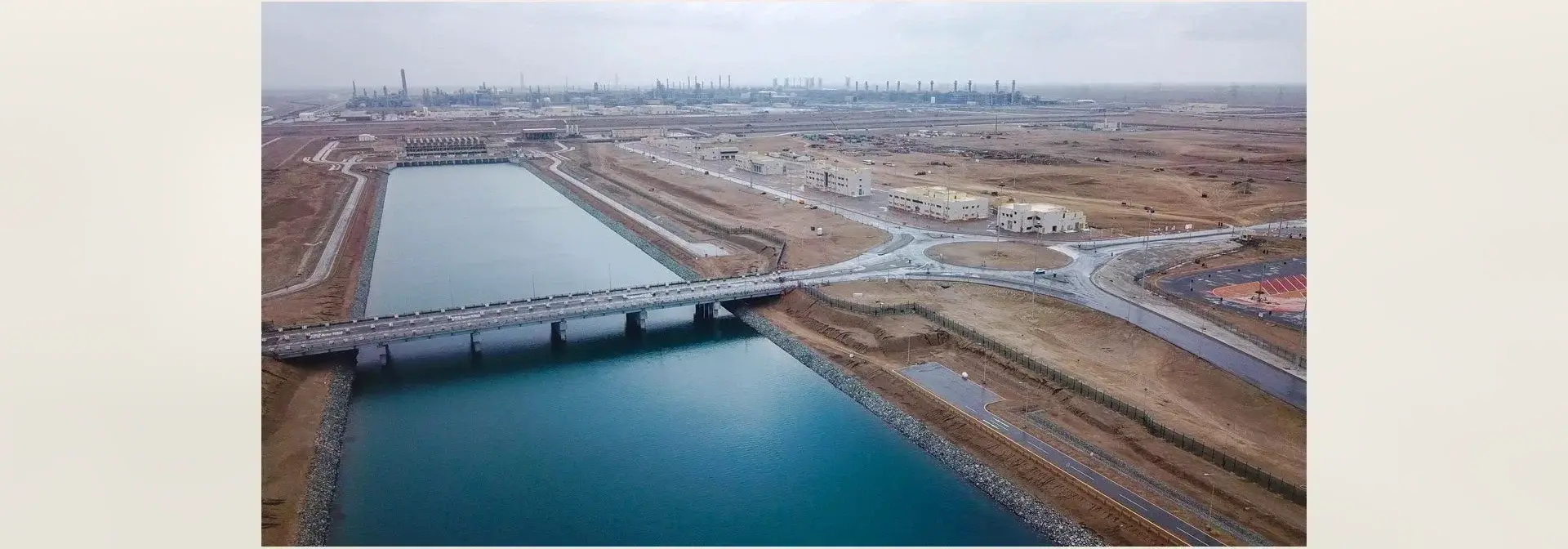
Overview
Special economic zones in Saudi Arabia are zones that form one of the paths of national economic diversification and offer competitive incentives; they are supervised by the Economic Cities and Special Zones Authority in its capacity as the parent regulatory body and the trusted national reference for economic cities and special economic zones in the Kingdom.[1]
The Authority was established by Royal Order No. (A/19). It was founded in 2010 as the Economic Cities Authority, and its organization was amended in 2019, when it was tasked with supervising special economic zones and its name was changed to the Economic Cities and Special Zones Authority.[1] The Authority contributes to achieving strategic objective (3.1.7) of the third level of Saudi Vision 2030 within the National Industrial Development and Logistics Program.[1]
Launch of the Special Economic Zones and Their Incentives
The Kingdom officially launched four new special economic zones within the strategy of Saudi Vision 2030 to diversify the national economy.[2]
The incentives offered in these zones include a 0% rate of withholding tax and value-added tax, a 5% corporate income tax, a 0% deferral of customs duties, and full 100% flexibility in workforce requirements.[3]
King Abdullah Economic City Special Economic Zone
The special economic zone at King Abdullah Economic City covers an area of 60 km² and includes King Abdullah Port, which has a capacity of up to 30 million tons of cargo annually; the zone targets the manufacture of 600,000 vehicles annually by 2035.[4]
Ras Al Khair Special Economic Zone
The Ras Al Khair Special Economic Zone extends over an area of 20 km² and includes 14 berths at Ras Al Khair Port, which has a capacity of 35 million tons of cargo annually and a depth of up to 16.2 meters, and serves more than 100 industrial projects.[5] The expected contribution of marine industries to the gross domestic product is estimated at SAR 82 billion by 2030.[3]
Jazan Special Economic Zone
The special economic zone in the Jazan region covers an area of 24.6 km², and Jazan Port accommodates more than one million standard containers annually, with a berth depth of 16.5 meters.[6] The expected contribution of the food industries and agribusiness sector to the gross domestic product is estimated at SAR 83 billion.[3]
Cloud Computing and Information Technology Special Economic Zone
Frequently Asked Questions
Q: What is the Economic Cities and Special Zones Authority? A: It is the parent regulatory body and the trusted national reference for economic cities and special economic zones in the Kingdom.[1]
Q: When was the Authority founded and how did its organization develop? A: It was founded in 2010 as the Economic Cities Authority, and its organization was amended in 2019, when it was tasked with supervising special economic zones and its name was changed to the Economic Cities and Special Zones Authority.[1]
Q: What incentives do the special economic zones offer? A: A 0% rate of withholding tax and value-added tax, a 5% corporate income tax, a 0% deferral of customs duties, and full 100% flexibility in workforce requirements.[3]
Q: How many new special economic zones did the Kingdom launch? A: Four new special economic zones within the strategy of Saudi Vision 2030 to diversify the national economy.[2]
Conclusion
Special economic zones in Saudi Arabia combine a regulatory framework supervised by the Authority, competitive incentives and logistics and industrial infrastructure, distributed across King Abdullah Economic City, Ras Al Khair, Jazan and the virtual Cloud Computing and Information Technology zone.[1][4][5][6][7]
Related topics
- National visions and programmesSaudi Vision 2030: A Framework for TransformationAn introduction to Saudi Vision 2030, its social, economic and institutional themes, and the relationship between implementation programmes, long-term targets and measured results.
- TopicNational Industrial Development and Logistics Program (NIDLP)The National Industrial Development and Logistics Program (NIDLP) is one of the most important and largest programs realizing Saudi Vision 2030, launched on 28 January 2019. It aims to transform the Kingdom into a leading industrial power and a global logistics platform through four main sectors: energy, industry, mining and logistics services.
- TopicNational Industrial StrategyThe National Industrial Strategy is a sectoral strategy launched under the vision of His Royal Highness Prince Mohammed bin Salman bin Abdulaziz, Crown Prince and Prime Minister, to build a resilient national industrial economy and transform the Kingdom into a global industrial power. It targets SAR 895 billion in manufacturing gross domestic product, 2.1 million jobs and SAR 557 billion in non-oil exports by 2030.
- TopicNational Investment StrategyThe National Investment Strategy is a national strategy whose launch was announced on 5 Rabi' al-Awwal 1443 AH, corresponding to 11 October 2021, and it is one of the key enablers for achieving the objectives of Saudi Vision 2030. It aims to inject investments exceeding 12 trillion riyals into the domestic economy through 2030, raise the private sector's contribution to gross domestic product to 65%, and reduce the unemployment rate to 7%.
- CityRiyadh (city)Capital of Saudi Arabia and seat of the Riyadh Region emirate, beside Diriyah, home to Qasr Al-Hukm and Masmak Palace.
- RegionJazan RegionA southwestern Saudi region administered from Jazan city, combining the Red Sea coast, Farasan Islands, plains and mountains with farming, fishing, commerce and industry.
Sources & references
- Economic Cities and Special Zones Authority (ECZA) — About the Authority
- Economic Cities and Special Zones Authority (ECZA) — Media Center
- Economic Cities and Special Zones Authority (ECZA) — Special Economic Zones
- Economic Cities and Special Zones Authority (ECZA) — King Abdullah Economic City Special Economic Zone
- Economic Cities and Special Zones Authority (ECZA) — Ras Al Khair Special Economic Zone
- Economic Cities and Special Zones Authority (ECZA) — Jazan Special Economic Zone
- Economic Cities and Special Zones Authority (ECZA) — Cloud Computing and Information Technology Special Economic Zone