
Overview
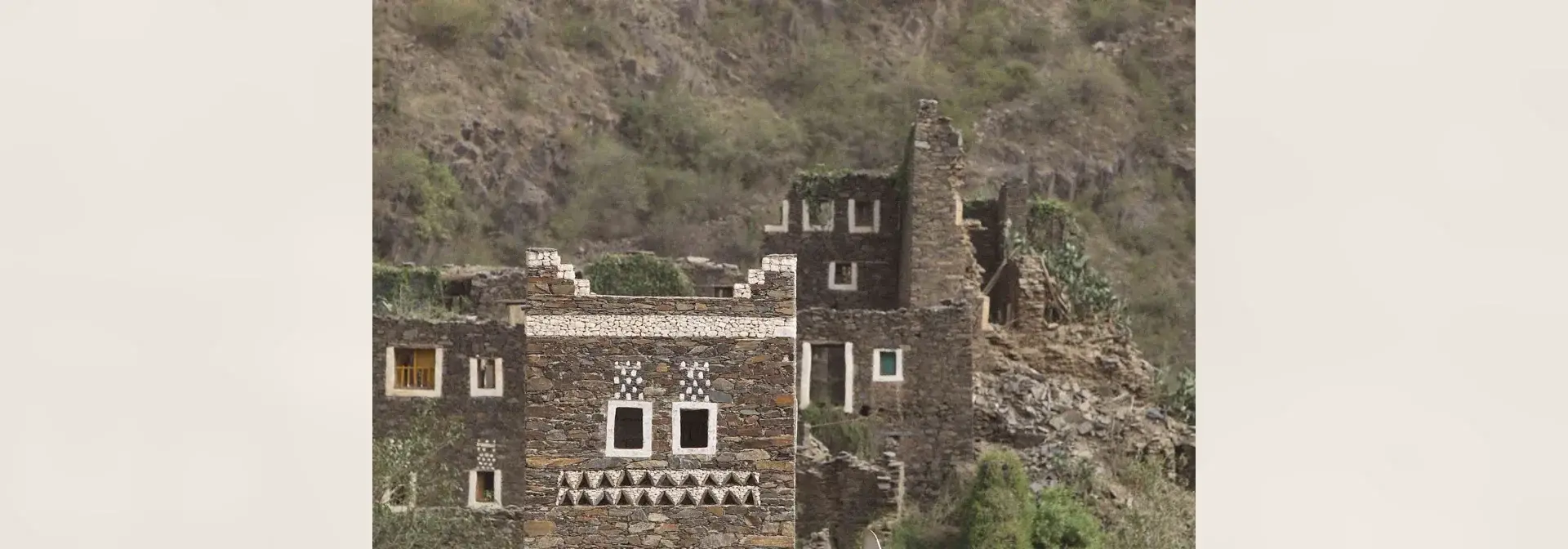
Asiri architecture is a local architectural style in the Asir region, based on building with stone, clay and wood, distinguished by towering stone palaces and facades clad in white quartz stones.[7]
These buildings are spread across the villages, palaces and forts of the region, and some of them rise beyond a single storey to several storeys.[7]
Building Materials and Architectural Features
Building in Asir relies on materials available locally in the mountain highlands: natural stone, clay and wood; these materials suit the nature of the mountain environment in the region.[7]
White quartz stones appear on the facades, lending the old buildings a decorative touch alongside their structural function.[7]
Ornamentation and Colour in Asiri Houses
Among the most prominent features of the Asiri style is the colouring and ornamentation of house facades, a tradition associated with ornamentation and colour in the local architecture of the region.[2] That attention covered seven different houses in the villages of Al Muslim and Wadi Janab in Al-Harajah Governorate, coloured as part of the 'Coloured Asir Houses' competition.[1]
The French researcher Thierry Muguet documented the coloured houses of Al-Harajah Governorate in photographs on two visits, the first in 1980 and the second as a researcher in 1994, and concluded that the land of Qahtan, including Al-Harajah, is distinguished by a constant mark that outlines the windows in blue and surrounds them in red on three sides.[3]
This legacy also appears on national occasions: Rijal Almaa Heritage Village hosted folk and artistic events marking the 93rd National Day of the Kingdom, including a mural about 'Al-Qatt Al-Asiri'.[6]
Stone Villages and Palaces
Rijal Almaa Heritage Village contains dozens of stone palaces in a single architectural composition, and some of its buildings rise beyond a single storey to several storeys.[7] Stone forts and houses are spread among the mountains of the governorate, testifying to a long experience of adapting to the mountain environment.[7]
In Al-Namas Governorate, the old houses of 'Al-Madanah' village are spread across Wadi Zaid centre in a coordinated urban composition that highlights the features of traditional architecture.[8]
The activities of 'Saudi Summer' 2021 activated five heritage villages in Asir: Al-Najad Heritage Village, Al Yanfa Heritage Village, Zabna Heritage Village, Al-Makhad Heritage Village, and the Al Abunqatah Al-Mutahami palaces.[4]
Sadr Eid Historical Mosque
Sadr Eid Historical Mosque is located in the town of Sadr Eid in Al-Namas Governorate on an area of about 138 square metres, and its founding dates back to the ninth century CE; it was built in the era of the Abbasid Caliph Harun al-Rashid in 786 CE (170 AH).[9]
Traditional building materials of stone and clay were used in its construction, following the local style prevalent in the towns of Al-Namas Governorate in harmony with the nature of the mountain environment, and it was roofed with juniper tree trunks.[9]
Preserving Asiri Architecture and Developing It for Tourism
The Ministry of Culture, represented by the Heritage Commission, launched the project 'Colouring Heritage Houses from the Outside', whose first phase began with the colouring of seven heritage houses in Al-Harajah Governorate, about 140 kilometres south of Abha city.[3]
The Heritage Commission organised the 'Coloured Asir Houses' competition from 30 October to 5 November 2022, under the patronage of His Royal Highness Prince Turki bin Talal bin Abdulaziz, Governor of Asir region and Chairman of the Asir Region Development Authority.[1] The Ministry of Culture, represented by the Heritage Commission, concluded the organisation of the competition in celebration of ornamentation and colour in local architecture.[2] Within the revival of archaeological sites, the parades of the 'Qimam International' Festival for Mountain Performing Arts were held in seven archaeological villages distributed between Abha city and Khamis Mushait and their outskirts.[5]
Al-Muftaha Village in Abha city, a village whose life extends over hundreds of years, is among the most beautiful tourist villages in the Kingdom.[10] It is sought by followers of heritage and plastic arts, crafts and handicrafts.[10]
Tourism and nature
Frequently Asked Questions
Q: What is meant by Asiri architecture? A: A local architectural style in the Asir region based on building with stone, clay and wood, distinguished by facades clad in white quartz stones.[7]
Q: Which villages most notably preserve this style? A: 'Rijal' Heritage Village in Rijal Almaa Governorate with its dozens of stone palaces, and 'Al-Madanah' village in Wadi Zaid centre in Al-Namas Governorate.[7][8]
Q: How does ornamentation appear in Asiri houses? A: In the colouring and engraving of the facades, and among its most prominent marks is outlining the windows in blue and surrounding them in red on three sides in the land of Qahtan, including Al-Harajah.[3]
Q: What is the standing of Sadr Eid Mosque in the local architecture? A: The mosque is located in the town of Sadr Eid in Al-Namas Governorate and is one of the oldest mosques in the region, as its founding dates back to the ninth century CE in the era of the Abbasid Caliph Harun al-Rashid in 786 CE (170 AH).[9]
Q: Are initiatives organised to preserve these houses? A: Yes, the Ministry of Culture, represented by the Heritage Commission, launched the project 'Colouring Heritage Houses from the Outside' and its first phase began with the colouring of seven heritage houses in Al-Harajah Governorate, and it then organised the 'Coloured Asir Houses' competition from 30 October to 5 November 2022.[3][1]
Conclusion
Care for Asiri architecture continues in the region through urban heritage projects, among them the project 'Colouring Heritage Houses from the Outside' in Al-Harajah Governorate.[3] Related topics on the platform include Najdi architecture and Hejazi architecture.
Related topics
- TopicAl-Qatt Al-AsiriA traditional art of painted wall decoration in Asir homes, practised by women, added to UNESCO's Representative List of the Intangible Cultural Heritage in 2017.
- HistoricRijal Almaa VillageRijal Almaa Village (also known as Rijal) is a heritage village 45 km west of the city of Abha in the mountainous Asir Region of southwestern Saudi Arabia, with a cultural heritage and history spanning nearly 900 years. It has been on the UNESCO Tentative List since 2015 and was chosen in 2021 as one of the world's best tourism villages.
- HistoricNajdi ArchitectureNajdi Architecture is a Saudi architectural style that expresses the urban identity of the Najd region, and it draws on local construction materials in a design adapted to the desert climate. Its applications continue in modern urban projects, competitions and cultural events inside the Kingdom and abroad.
- RegionAsir RegionA southwestern Saudi region administered from Abha, combining Sarawat highlands, Tihamah and the coast, with agricultural terraces, historic villages and distinctive local cultural traditions.
- HistoricHejazi ArchitectureHejazi architecture is a Saudi architectural style associated with the coastal areas on the Red Sea, known for its wooden rawasheen and historic houses. It is included in the Saudi Architecture Map, which comprises 19 architectural styles, and efforts to protect and develop it continue.
- RegionAbha CityAbha City is a Saudi city in the Asir region of south-western Saudi Arabia, combining a mountainous setting with the cultural and social heritage expressed in its traditional markets, heritage villages and historic houses. It was chosen as the Arab Tourism Capital for 2017, and it holds the Tuesday Market and Al-Muftaha Village alongside its mountain parks and seasonal festivals.
- RegionKhamis Mushait CityKhamis Mushait City is a Saudi city in the Asir Region, known since ancient times for its substantial commercial activity, and its janbiya souq ranks among the oldest specialised souqs in the Kingdom. The city is seeing projects in roads, water networks, investment sites and car showrooms.
- HistoricAl-Habala ParkAl-Habala Park is a tourist site in Al-Wadiyayn Center of Ahad Rufaydah Governorate in Asir Region, about 55 kilometers from the city of Abha. It includes waterfalls descending from a deep rocky cliff at more than 2,000 meters above sea level, and Al-Wadiyayn Heritage Village with its market for productive families, heritage palace and museum.
- HistoricAsir National ParkAsir National Park is a mountain park at Al-Soudah in Asir Region, standing 3100 m above the Red Sea. It is among the largest and most visited parks in the Kingdom of Saudi Arabia and the highest park in the Middle East, and its Al-Soudah site was opened on 4 Sha'ban 1432 AH, corresponding to 5 July 2011.
Sources & references
- Saudi Press Agency (SPA) — The 'Coloured Asir Houses' Competition
- Saudi Press Agency (SPA) — Conclusion of the 'Coloured Asir Houses' Competition
- Saudi Press Agency (SPA) — The Coloured Houses of Al-Harajah and the Heritage House Colouring Project
- Saudi Press Agency (SPA) — 'Saudi Summer' Activities in the Heritage Villages of Asir
- Saudi Press Agency (SPA) — The 'Qimam International' Festival for Mountain Performing Arts
- Saudi Press Agency (SPA) — 93rd National Day Events in Rijal Almaa Heritage Village
- Saudi Press Agency (SPA) — 'Rijal' Heritage Village and Stone Architecture in Rijal Almaa
- Saudi Press Agency (SPA) — 'Al-Madanah' Village in Al-Namas Governorate
- Saudi Press Agency (SPA) — Sadr Eid Historical Mosque in Al-Namas Governorate
- Saudi Press Agency (SPA) — Al-Muftaha Village in Abha