

Overview
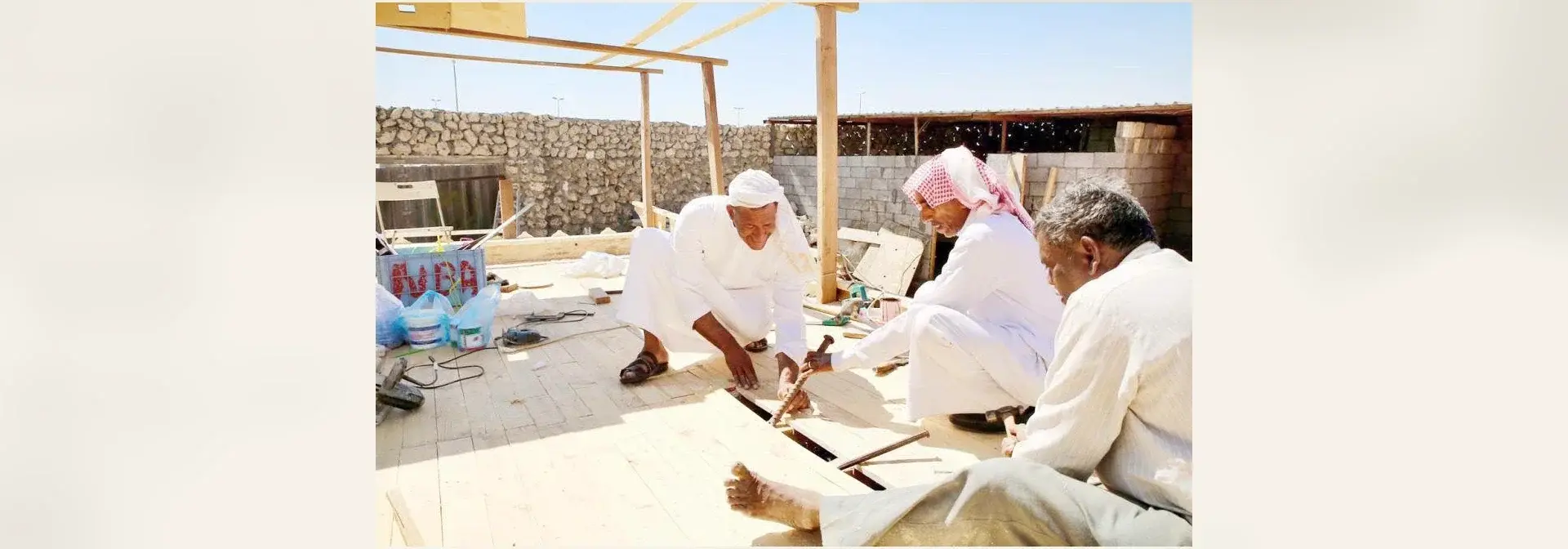
Al-Qallafah is the craft of building wooden sailing vessels and boats, and it belongs to the authentic traditional handicrafts known to the Arabian Gulf.[1] It is among the most precise and important handicrafts, requiring special tools, timbers and nails that let the vessel put to sea and withstand the force of its waves and the storms its sailors face.[4]
The craft is practised by the qallaf, the builder and engineer of old boats and ships, who carries out the carpentry and determines the dimensions required for the boat.[2] Qallafs inherit the trade from their fathers, among them Abdulaziz Halwani, who learned it from his father and has practised it for about 30 years.[1]
The Qallaf and His Tools
The qallaf begins by determining the type, size and purpose of the boat, then chooses its timbers and nails and supervises the carpentry until the hull is complete, assisted by a number of qallafs who take part in building the base and preparing the hull.[2]
The qallaf uses specific hand tools, among them the saw, the randa (the plane), the bariya, the whetstone, the mijdaah (the drill) in its types, chalk for marking, the sail-stitching needle and the hammer, alongside other supporting tools.[3]
Stages of Building the Boat
Construction begins with the base, in which a group of qallafs takes part, and then the front and rear posts of the vessel are prepared.[2] Seven wooden planks are then fitted on the two sides together with the ribs, and the planks are joined firmly to the ribs so that the hull of the boat is complete.[2]
Once the hull is complete, the "kalfat" pieces are placed between the planks to seal the joints, and the boat is then coated with sill.[2] The time of the work varies with the type and size of the vessel: a large one takes about a year or more, and some are completed in six months, while a small one takes between three and four months, and the number of workers in building a ship ranges between 5 and 10.[4]
Timbers and Materials
Wooden ships are made from selected timbers, foremost among them teak, which the people of the Gulf used to bring from India to build ships, alongside other types such as camphor, sidr and neem.[3]
The lower part of the ship is coated with "al-shawnah", made from a mixture of lime and fat, so that the wood resists salinity.[3] The boat is coated with sill oil extracted from fish, while cloth is used in making the sails of ships.[2][3]
Types of Gulf Ships
Qallafs in the Gulf built various types of ships, among them the boom, the jalbut, the baghla, the baqarah, the shu'i, the huri, the sanbuk, the baitil and the ghirb, in addition to the sam'a, a wooden boat used in searching for oysters and carrying passengers.[4]
In the Eastern Province, craftsmen continue to work on models of these ships: Idris Khalifa Al-Buainain began by designing a model of the boom ship, which took 30 days to make, and then made models of the jalbut, the dumi, the banoush and the shu'i.[8]
Ships in Transport, the Hajj and Trade
Reviving the Craft
With the shift of boatbuilding to modern materials instead of wood, reliance on wooden ships in maritime transport declined.[1] The craft returned to the fore at national events, as the activities of Souq Okaz displayed the trade of al-qallafah among its crafts, and the trade drew the visitors of the market.[1]
In its seventh edition, the Eastern Coast Festival announced the revival of the craft of building the traditional wooden ships for which the Eastern Province is known, after an interruption lasting nearly 50 years, with the participation of a number of craftsmen, at King Abdullah Environmental Park on the waterfront in Dammam.[4]
The Heritage Commission organised the first edition of the "Shira" festival for wooden ships on the Al-Hamra corniche in Jeddah from 12 to 16 January 2026, with the participation of the Jeddah Governorate Municipality and a number of partner bodies.[5][6]
The zones of the festival bore names from the maritime heritage: the exhibition zone "al-Qallafah", the theatre "al-Qaffal", the arts "al-Danah" and the market "al-Tawwashin", in reference to the culture of the coast and the trades of its people.[5] The participation of Historic Jeddah in the festival revived the pivotal role played by Al-Bant port in the movement of trade and the reception of pilgrims.[7]
Frequently Asked Questions
Q: What is the craft of al-qallafah? A: The craft of building wooden sailing vessels and boats, practised by the qallaf, who does its carpentry and determines its dimensions.[1][2]
Q: What timbers are ships made from? A: Teak, which used to be brought from India, and camphor, sidr and neem.[3]
Q: How long does building a ship take? A: A large ship takes about a year or more, some of them six months, and a small one between three and four months, and between 5 and 10 workers take part in building it.[4]
Q: How is the ship protected from the salinity of the sea? A: Its lower part is coated with "al-shawnah", made from a mixture of lime and fat.[3]
Q: Where is the craft of al-qallafah shown today? A: At national events and festivals, among them Souq Okaz, the Eastern Coast Festival in Dammam, and the "Shira" festival for wooden ships in Jeddah.[1][4][5]
Related topics
- HistoricPearl DivingPearl diving is an ancient maritime profession known to the coasts and islands of the Kingdom of Saudi Arabia, linked in the Farasan Islands of the Jazan region and on the Arabian Gulf coast at Jubail; it formed a main source of livelihood and a social and economic pillar, and today it is part of the national heritage.
- HistoricSaudi Traditional HandicraftsSaudi traditional handicrafts are a productive activity based primarily on manual work that draws its designs and artistic elements from the cultural heritage inherited across the regions of the Kingdom. The Law of Crafts and Handicrafts was issued by Royal Decree No. (M/49) dated 1447/03/02 AH to regulate the activity, develop it and protect it from extinction. [1][3]
- HistoricSouq OkazAn archaeological site in Taif, one of the oldest Arab markets before and after Islam and a meeting place for trade, poetry and alliances, dating to about 501 CE.
- RegionEastern ProvinceA large eastern Saudi region administered from Dammam, combining Gulf cities, the oases of Al Ahsa and Qatif, desert areas, energy industries and maritime commerce.
- RegionDammam CityDammam City is a Saudi city in the Eastern Province on the coast of the Arabian Gulf. Its metropolitan area takes in Dammam City together with the governorates of Al-Khobar and Al-Bayda and the Dhahran centre; within it stand King Abdulaziz Port and King Fahd International Airport, and the King Fahd Causeway links the Kingdom of Saudi Arabia with the Kingdom of Bahrain. In 2026 the Dammam metropolitan area joined the Global Quality of Life Initiative.
- RegionJeddah CityJeddah City is a Saudi city that is a gateway to the Two Holy Mosques and a station through which cultures have passed. Its history spans more than 1,400 years, and it is home to Historic Jeddah, inscribed on the World Heritage List in 2014, alongside modern development projects, most notably the Jeddah Central Project.
- HistoricHistoric JeddahHistoric Jeddah, or Al-Balad, is an urban core on the Red Sea shaped by maritime trade and pilgrimage, with houses distinguished by projecting wooden windows.
Sources & references
- Saudi Press Agency (SPA) — the craft of al-qallafah at Souq Okaz
- Saudi Press Agency (SPA) — the trade of al-jallaf or al-qallaf
- Saudi Press Agency (SPA) — the materials and tools of building old ships
- Saudi Press Agency (SPA) — the craft of wooden shipbuilding and the Eastern Coast Festival
- Saudi Press Agency (SPA) — the "Shira" festival for wooden ships in Jeddah
- Saudi Press Agency (SPA) — the conclusion of the first edition of the wooden ships festival
- Saudi Press Agency (SPA) — the participation of Historic Jeddah in the wooden ships festival
- Saudi Press Agency (SPA) — models of eastern ships at a craftsman