
Overview
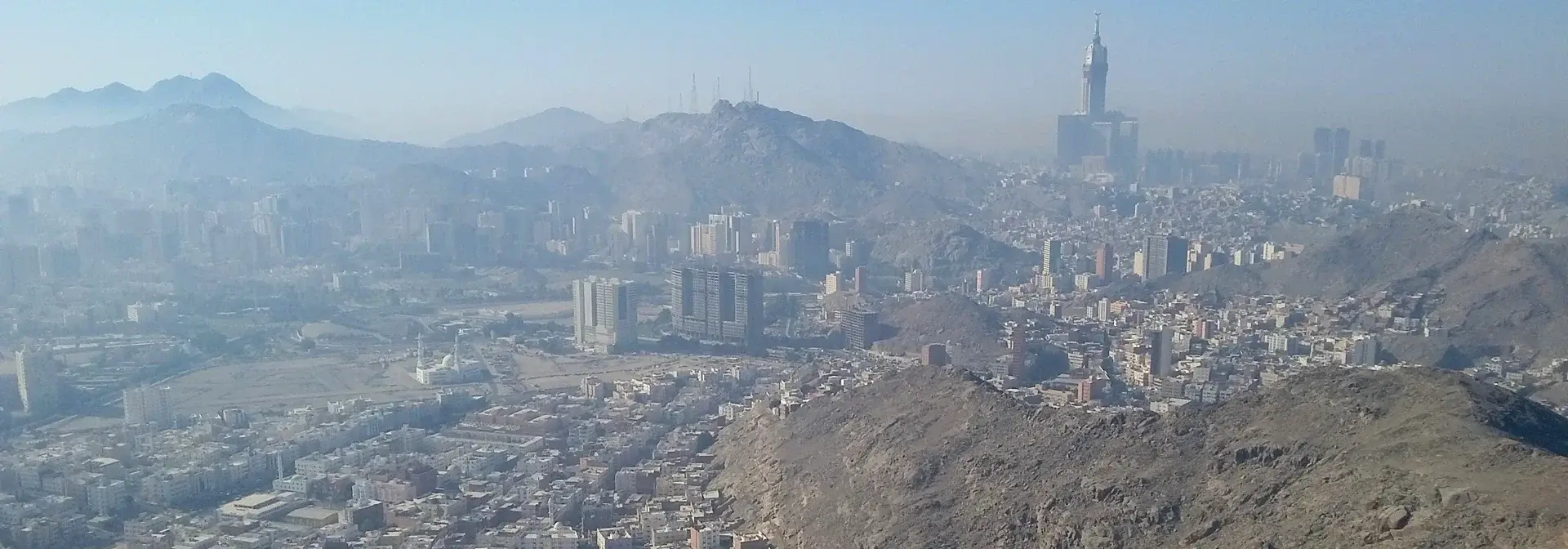
Makkah City is a Saudi city in the west of the Kingdom of Saudi Arabia, home to the Grand Mosque and the qibla of Muslims, towards which pilgrims and Umrah performers from around the world turn. [1] Its existence is bound up with the Well of Zamzam and with the arrival of Ibrahim (peace be upon him) with his son Isma'il, which means that its age exceeds four thousand years. [1]
Location, Area and Climate
Makkah City lies in the west of the Kingdom of Saudi Arabia, 280 metres above sea level, with an area exceeding 480 hectares, confined within a group of valleys surrounded by two mountain ranges. [1] It lies about 73 kilometres from Jeddah, 87 kilometres from Taif, 450 kilometres from Madinah and 990 kilometres from the capital, Riyadh. [1]
A hot, dry climate prevails in Makkah City: temperatures in winter range between 15 and 20 degrees Celsius, and in summer they reach 45 degrees Celsius. [1]
The Antiquity of the City and Its Name in Ancient Sources
The history of Makkah City reaches far back into antiquity, and it is among the oldest cities in the world; its name appears in ancient Greek, Syriac and Roman sources under the forms Makrabo, Makka and Makraba, all of which mean 'the Holy City'. [1] Researchers agree that Ibrahim (peace be upon him) brought his son Isma'il to Makkah City in 1910 BC, the same year in which the Well of Zamzam appeared, which means that Makkah existed more than four thousand years ago. [1]
Related people
The Three Historic Walls
Makkah City was once surrounded by three walls that protected it: Bab al-Ma'la on the eastern side, Bab al-Shubayka on the western side and Bab al-Yaman on the southern side. [1]
Jabal An-Noor and the Cave of Hira
Jabal An-Noor is one of the historic and Islamic sites of Makkah City; it lies north-east of the Grand Mosque, four kilometres from it, at a height of about 634 metres, and covers an area of 55 square kilometres. [8] Within it is the Cave of Hira, where the revelation descended upon the Prophet Muhammad (peace be upon him), and the cave accommodates five people seated. [8]
The mountain is the place where the Prophet (peace be upon him) worshipped before the start of the mission, and its steep slope begins at a height of 380 metres and continues up to 500 metres, then goes on to the summit. [8]
Care for Makkah's History and Its Cultural Standing
An order was issued to establish the Makkah History Centre as a research centre aimed at highlighting the importance of the history of Makkah City, the qibla of Muslims and the focus of their hearts, and the King Abdulaziz Foundation (Darah) was tasked with supervising it. [4]
Makkah City was chosen as the Capital of Islamic Culture for 2005 by a decision of the Conference of Ministers of Culture in Islamic Countries, in coordination with the Islamic Educational, Scientific and Cultural Organization (ISESCO). [7]
The Royal Commission for Makkah City and the Holy Sites
A decision by the Custodian of the Two Holy Mosques, King Salman bin Abdulaziz Al Saud, issued on 17 Ramadan 1439 AH, established the Royal Commission for Makkah City and the Holy Sites to raise the standard of services provided in Makkah City and the Holy Sites in keeping with their sanctity and standing, and to facilitate service to the guests of the Sacred House, pilgrims and Umrah performers. [2] The Commission enjoys a public legal personality and financial and administrative independence, and it is organisationally linked to the Prime Minister; its scope covers Makkah City and the Holy Sites and such places beyond them as its board of directors determines. [2]
The Commission has a board of directors chaired by the Deputy Prime Minister, with the Governor of Makkah Region, the Minister of Interior, the Deputy Governor of Makkah Region, the Minister of Hajj and Umrah, the Minister of Economy and Planning and a number of members among its members. [2] Development plans in Makkah Region and the Holy Sites aim to host 30 million Umrah performers and about 5 million pilgrims in 2030, within diverse development programmes under Saudi Vision 2030. [2]
Kadana Company and the Development of the Holy Sites
The Royal Commission for Makkah City and the Holy Sites announced the launch of the Kadana Development Company to be the body specialised in developing and growing the Holy Sites and their surroundings, with its headquarters in Mina. [3] It is the first closed joint-stock company owned by the Royal Commission, with an authorised capital of one billion riyals. [3]
The Third Saudi Expansion of the Grand Mosque
The Custodian of the Two Holy Mosques, King Salman bin Abdulaziz, inaugurated the third Saudi expansion of the Grand Mosque during Ramadan. It continues the historic expansions that began by order of the founding King Abdulaziz and were completed by Kings Saud and Faisal, followed by the expansion of the eastern courtyards in the reign of King Khalid, the expansion of the mosque on the western side in the reign of King Fahd, the expansion of the Mas'a in the reign of King Abdullah, and then the major expansion ordered by King Abdullah and being completed in the reign of King Salman. [5]
The expansion comprises the main expansion building, the expansion of the Mas'a, the expansion of the Mataf and the outer courtyards, the bridges and the terraces, the central services buildings complex, the services tunnel, the security buildings, the hospital, the pedestrian tunnels, the transport stations and the bridges leading to the sanctuary, the First Ring Road surrounding the Grand Mosque area, and the power stations, water tanks and flood drainage. [5]
The Mashair Train and Transport
Frequently Asked Questions
Q: Where is Makkah City located and what is its climate like? A: It lies in the west of the Kingdom of Saudi Arabia, 280 metres above sea level, and a hot, dry climate prevails, with temperatures in winter ranging between 15 and 20 degrees Celsius and reaching 45 degrees Celsius in summer. [1]
Q: What indicates the antiquity of Makkah City? A: Its name appears in ancient sources under forms that mean 'the Holy City', and researchers agree that Ibrahim (peace be upon him) brought his son Isma'il to it in 1910 BC, the same year in which the Well of Zamzam appeared, which means that it existed more than four thousand years ago. [1]
Q: What is the Royal Commission for Makkah City and the Holy Sites? A: A commission established by a decision of the Custodian of the Two Holy Mosques, King Salman bin Abdulaziz, on 17 Ramadan 1439 AH, enjoying a public legal personality and financial and administrative independence, and organisationally linked to the Prime Minister. [2]
Q: When did the Mashair Train set off and what does its wristband cost? A: It set off on its first journeys to carry those wishing to move between the Holy Sites, with boarding and alighting at all stations around the clock, and the wristband costs 250 riyals for all journeys and 50 riyals during the days of Tashriq. [6]
Q: What most distinguishes Jabal An-Noor? A: It lies north-east of the Grand Mosque, four kilometres from it, its height is about 634 metres, and within it is the Cave of Hira, where the revelation descended, and it accommodates five people seated. [8]
Conclusion
Makkah City combines its religious standing as the qibla of Muslims, with the Grand Mosque within it, and continuous care for its history and for the development of its services and its Holy Sites in keeping with their sanctity and standing. [1][2][5] Related topics on the platform include Makkah Region, Jeddah City, Madinah Region and Taif City.
Related topics
- RegionMakkah RegionA western Saudi region administered from Makkah, encompassing Jeddah, Taif and other governorates, where pilgrimage, maritime trade, coastal landscapes and uplands meet.
- HistoricThe Grand Mosque (Al-Masjid Al-Haram)The Grand Mosque (Al-Masjid Al-Haram) is the mosque at the centre of which stands the Kaaba in Makkah, and successive states and restorations followed upon its construction across the ages. In the Saudi era it witnessed major expansions and construction works, most notably the Third Saudi Expansion and the raising of the capacity of the Mataf and the courtyards.
- RegionJeddah CityJeddah City is a Saudi city that is a gateway to the Two Holy Mosques and a station through which cultures have passed. Its history spans more than 1,400 years, and it is home to Historic Jeddah, inscribed on the World Heritage List in 2014, alongside modern development projects, most notably the Jeddah Central Project.
- RegionMadinah RegionA western Saudi region combining Madinah, Yanbu, AlUla and other governorates, with Islamic landmarks, oases, archaeological sites and a Red Sea coastline.
- RegionTaif CityTaif City is a Saudi city in the west of the Kingdom, known as the “City of Roses and Bride of Saudi Summer Resorts” for its moderate summer climate and its natural views in Al-Shafa and Al-Hada. It contains more than 700 rose farms, farms of seasonal fruits, and cultural and historical landmarks including Souq Okaz and Shubra Palace.
- National visions and programmesSaudi Vision 2030: A Framework for TransformationAn introduction to Saudi Vision 2030, its social, economic and institutional themes, and the relationship between implementation programmes, long-term targets and measured results.
- HistoricCave of HiraThe Cave of Hira is a rock cavity at the top of Jabal An-Noor in Makkah, northeast of the Grand Mosque, and the place where Prophet Muhammad (peace be upon him) used to retreat in worship before the Revelation, where the first verse of the Holy Quran was revealed: "Read in the name of your Lord who created."
Sources & references
- Saudi Press Agency (SPA) — General / Makkah: history and religious standing
- Saudi Press Agency (SPA) — General / The Royal Commission for Makkah City and the Holy Sites: a new building block for developing Makkah in keeping with its sanctity
- Saudi Press Agency (SPA) — Economic / The Royal Commission for Makkah City and the Holy Sites launches the Kadana Company to develop the Holy Sites
- Saudi Press Agency (SPA) — General / The Makkah History Centre: a beacon of knowledge and an accurate reference for history and historians
- Saudi Press Agency (SPA) — Hajj / The third Saudi expansion of the Grand Mosque
- Saudi Press Agency (SPA) — Hajj / The Mashair Train sets off on its first journeys for those wishing to move between the Holy Sites
- Saudi Press Agency (SPA) — Cultural / Saudi Aramco takes part in the activities of Makkah, Capital of Islamic Culture
- Saudi Press Agency (SPA) — General / Jabal An-Noor: the mountain of the Qur'an and the place where the revelation descended