
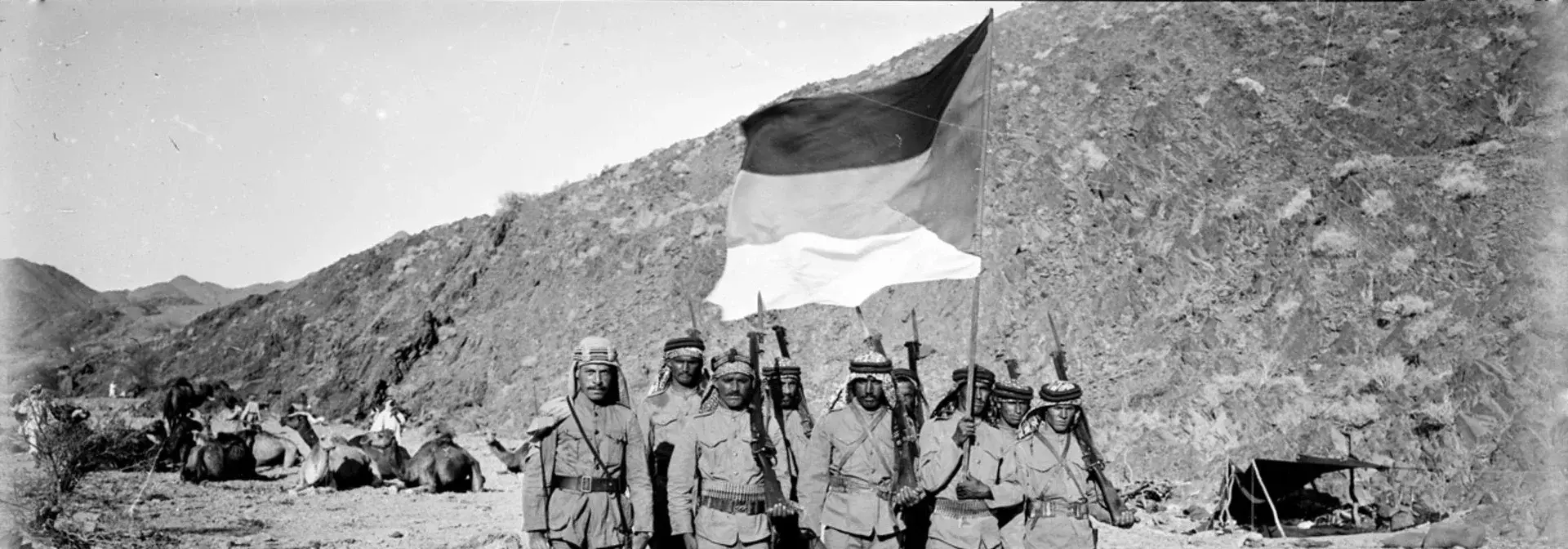
Overview
The Arab Revolt was a movement that began in the Hejaz during World War I, coinciding with the end of the Turkish era in the Hejaz in 1916 and the beginning of the Hashemite era, which continued until King Abdulaziz entered the Hejaz in 1924. [5]
The revolt was accompanied by transformations in the conditions of the Hejaz and the Arabian Peninsula, as its men destroyed part of the Hejaz Railway line, disrupting it. [3][4] King Abdulaziz, for his part, sought during it to bring about a change in Ottoman policy reflecting the common interest of Arabs and Turks, and he took on responsibility for the rule of Makkah and Madinah to preserve the holy places of Muslims in them. [9]
The Context before World War I
Sharif Hussein in the Hejaz was, before World War I, subject to the Ottoman state, which doubted his loyalty to it. [1] British strategy in World War I in the Arabian Peninsula and the Red Sea aimed at occupying the head of the Arabian Gulf and securing the protection of the oil sources and the trade routes to India, then keeping the lines of communication across the Suez Canal and the Red Sea open to its movements. [1]
The Emirate of Ha'il was loyal to the Ottoman state before the outbreak of the war, and the Ottoman authorities planned in October 1914 for Prince Saud Al Rashid, in cooperation with the Ruwallah, Huwaitat, Bani Sakhr and Shararat tribes and the rest of the tribes neighbouring the Hejaz Railway, to advance on Sinai and Egypt; the plan was not put into effect. [10]
The Impact of the Revolt on the Hejaz Railway
The men of the Arab Revolt destroyed part of the Hejaz Railway line extending from Damascus to Madinah and blew it up at many points, and the line was disrupted. [3][4]
The Hejaz Railway: Its Origins and Efforts to Revive It
The construction of the Hejaz Railway was first proposed in 1864, and Sultan Abdulhamid announced in 1318 AH the necessity of building the line to ease the performance of the Hajj; the line served pilgrims and the transport of goods, and was also a means of supporting the rule's control over the land of the Two Holy Mosques and the Muslim world. [3] A German company carried out the construction, which was completed in 1908 with a length of one thousand three hundred and three kilometres, and the station was opened in Sha'ban 1326 AH / September 1908. [3]
After the line was disrupted during the Arab Revolt, the efforts of the Saudi state to revive the Hejaz Railway continued from the era of King Abdulaziz until those attempts stopped in the era of King Khalid, over the period 1344–1402 AH / 1925–1982. [4]
King Abdulaziz's Position and His Care for the Holy Places
It is evident from King Abdulaziz's views that he neither worked nor considered taking part in the elimination of the Ottoman Empire, but rather, amid the prevailing international circumstances, he sought to bring about a change in Ottoman policy reflecting the common interest of Arabs and Turks alike. [9] He took the necessary measures to preserve the holy lands of Muslims in the Hejaz from fragmentation and loss, taking on responsibility for the rule of Makkah and Madinah and joining them with Najd. [9]
King Abdulaziz concluded the Treaty of Darin in 1334 AH / 1915, by which Britain recognised him as Emir of Najd and Al-Ahsa and pledged to provide him with financial and military assistance, on condition that he not communicate with any other state or conclude treaties without its consent. [2] In 1338 AH / 1920, a British mission was sent to Najd and the Hejaz in an attempt to ease the tension between King Abdulaziz and Sharif Hussein after the disputes between them worsened following the restrictions Sharif placed on the arrival of Najdi pilgrims for Hajj. [6]
The End of the Hashemite Era and the Entry of the Hejaz into Saudi Rule
In 1924, Sharif Hussein announced his assumption of the Islamic Caliphate that had been abolished in Turkey, and sent a telegram to the Soviet government informing it of that. [8]
With King Abdulaziz's entry into the Hejaz in 1924, the Hashemite era ended and the Saudi era began. [5] In the autumn of 1925, in the Bahra negotiations, King Abdulaziz set out to Gilbert Clayton, the British Ambassador Extraordinary, his views on the northern borders of Najd and expressed his wish to review British-Saudi relations. [7] King Abdulaziz abolished the Treaty of Darin in the Treaty of Jeddah of 1927, by which Britain recognised him as King of the Hejaz and Najd and his right to conclude treaties with other states. [2]
Related people
The End of Foreign Privileges and International Recognition of the Saudi State
King Abdulaziz ended the foreign privileges in the Hejaz over the period 1926–1927, and neither the efforts of the Ottomans nor those of their Hashemite successors succeeded in abolishing them in the Hejaz before him. [7]
On 16 February 1926, the Soviet Union recognised the Saudi state and recognised King Abdulaziz as King of the Hejaz and Sultan of Najd and its dependencies, and considered itself bound by normal diplomatic relations with the Saudi government; thus the Kingdom of Saudi Arabia was the first Arab state with which the Soviet Union established diplomatic relations. [8]
Frequently Asked Questions
Q: What is the Arab Revolt and where did it begin? A: A movement that began in the Hejaz during World War I, coinciding with the end of the Turkish era in the Hejaz in 1916 and the beginning of the Hashemite era. [5]
Q: When did the Turkish era in the Hejaz end, and when did King Abdulaziz enter the Hejaz? A: The Turkish era ended in 1916, and the Hashemite era began in 1916 and lasted until King Abdulaziz entered the Hejaz in 1924. [5]
Q: What was the impact of the Arab Revolt on the Hejaz Railway? A: The men of the revolt destroyed part of the line and blew it up at many points, disrupting it, and then the efforts of the Saudi state to revive it continued from the era of King Abdulaziz until the era of King Khalid over the period 1344–1402 AH / 1925–1982. [3][4]
Q: What was King Abdulaziz's position on the Ottoman Empire? A: He neither worked nor considered taking part in its elimination, and amid the international circumstances he sought to bring about a change in Ottoman policy reflecting the common interest of Arabs and Turks. [9]
Q: When did the Soviet Union recognise the Saudi state, and when were the foreign privileges in the Hejaz ended? A: The Soviet Union recognised the Saudi state on 16 February 1926, and the foreign privileges in the Hejaz were ended over the period 1926–1927. [8][7]
Conclusion
The Turkish era in the Hejaz ended in 1916 with the Arab Revolt, and the Hashemite era began, and then King Abdulaziz entered the Hejaz in 1924. [5] Related topics on the platform include the Hejaz Railway, the Treaty of Darin, the Treaty of Jeddah of 1927, the Kingdom of Hejaz, the unification of Saudi Arabia and King Abdulaziz.
Related topics
- EventHejaz RailwayThe Hejaz Railway is a railway line ordered to be built in March 1900, with work beginning in 1900, to link the Muslims of the northern Arabian Peninsula with the Holy Places; it runs from Damascus station to Madinah station. The first train reached Madinah on 22 Rajab 1326 AH, corresponding to 23 August 1908, and the line operated for about nine years. The Kingdom of Saudi Arabia today preserves its station, its museum and its antiquities in the Tabuk and Madinah regions.
- EventTreaty of DarinThe Treaty of Darin is a treaty signed by King Abdulaziz bin Abdulrahman bin Faisal Al Saud with Britain, in which Britain recognised Abdulaziz as Emir of Najd and Al-Ahsa. It is also known as the Treaty of Qatif and the Treaty of Al-Uqair, and it was annulled in the Treaty of Jeddah of 1927.
- EventTreaty of Jeddah (1927)The Treaty of Jeddah is an agreement signed in 1927 between King Abdulaziz bin Abdulrahman Al Saud and Britain. In it Britain recognized Abdulaziz as King of the Hijaz and Najd, affirmed his right to conclude treaties with other states, and brought the Treaty of Darin to an end.
- EventKingdom of HejazThe Kingdom of Hejaz is an official name borne by the Saudi State at a stage of its formation after the annexation of the Hejaz, and it is associated with the successive titles of King Abdulaziz bin Abdulrahman bin Faisal Al Saud up to the naming of the Kingdom of Saudi Arabia in 1351 AH/1932.
- EventUnification of Saudi ArabiaKing Abdulaziz's path from the recovery of Riyadh in 1902 to the proclamation of the Kingdom of Saudi Arabia on 23 September 1932, now National Day.
- EventEmirate of Jabal ShammarThe Emirate of Jabal Shammar is an emirate that arose in the Hail region, and it came to govern the region after the Emirate of Al Ali that preceded it. In its last years it was linked to its position towards the Ottoman State during the First World War, and then its era ended with the annexation of Hail to the Saudi State in the reign of King Abdulaziz in 1340 AH.
Sources & references
- Al-Darah Journal — King Abdulaziz Foundation (vol. 6, no. 2, 1401 AH) — "Britain's Position in the Red Sea in World War I" (Muhammad Mahmoud Al-Saruji)
- Al-Darah Journal — King Abdulaziz Foundation (vol. 11, no. 4, 1406 AH) — "Britain's Relations with King Abdulaziz Al Saud" (Turki bin Mohammed bin Saud Al Kabeer Al Saud)
- Al-Darah Journal — King Abdulaziz Foundation (vol. 13, no. 2, 1408 AH) — "The Hejaz Railway: A Journey through Time and Place" (Ahmed Abdulqader Al-Muhandis)
- Al-Darah Journal — King Abdulaziz Foundation (vol. 47, no. 4, 2021) — "The Efforts of the Kingdom of Saudi Arabia to Revive the Hejaz Railway 1344–1402 AH / 1925–1982" (Dr. Mohammed bin Abdulrahman Al-Salama)
- Al-Darah Journal — King Abdulaziz Foundation (vol. 5, no. 3, 1400 AH) — "Arab Travels in the Arabian Peninsula: (Saudi Arabia, 1901–1972)" (Mansour Ibrahim Al-Hazmi)
- Al-Darah Journal — King Abdulaziz Foundation (vol. 49, no. 4, 2023) — "Farhan Al-Rahma's Report on His Journey from Makkah to Bahrain via Riyadh in 1338 AH / 1920" (Prof. Khalid bin Hamoud Al-Saadoun)
- Al-Darah Journal — King Abdulaziz Foundation (vol. 10, no. 1, 1404 AH) — "King Abdulaziz's Ending of the Foreign Privileges in the Hejaz, 1926–1927" (Jamal Mahmoud Hajar)
- Al-Darah Journal — King Abdulaziz Foundation (vol. 23, no. 4, 1418 AH) — "Soviet Diplomacy in the Hejaz" (Vitaly Naumkin)
- Al-Darah Journal — King Abdulaziz Foundation (vol. 1, no. 2, 1395 AH) — "Lawrence in the Secret Documents" (Zuhdi Al-Fateh)
- Al-Darah Journal — King Abdulaziz Foundation (vol. 9, no. 2, 1404 AH) — "The Position of the Emirate of Ha'il on World War I as Portrayed by British Documents" (Khalid Hamoud Al-Saadoun)