
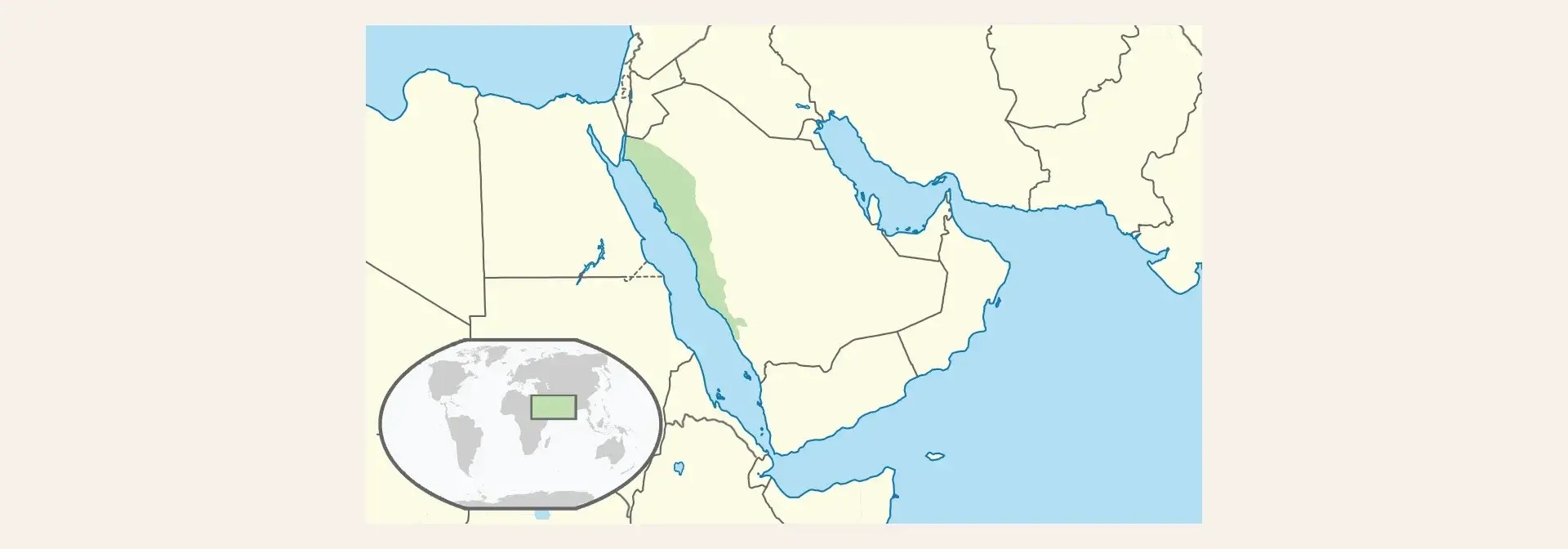

Overview
The Kingdom of Hejaz is an official name borne by the Saudi State at a stage of its formation after the annexation of the Hejaz, and it is associated with the successive titles of King Abdulaziz bin Abdulrahman bin Faisal Al Saud as the state was built. [1]
From “Emir of Najd and chief of its tribes” in 1319 AH/1902 to “King of the Hejaz and Sultan of Najd and its dependencies” in 1344 AH/1926, then “King of the Kingdom of Saudi Arabia” in 1351 AH/1932. [1]
The official name of the state on its diplomatic passport was “the Kingdom of Hejaz and Sultanate of Najd and its dependencies” before it became “the Kingdom of Saudi Arabia”. [2]
The Titles of King Abdulaziz and the Naming of the State
The titles of King Abdulaziz bin Abdulrahman bin Faisal Al Saud advanced with the stages of the formation of the Saudi State. He was “Emir of Najd and chief of its tribes” in 1319 AH/1902, then became “Sultan of Najd and its dependencies” in 1339 AH/1920. [1]
After the annexation of the Hejaz the title “King of the Hejaz” was added to the Sultanate of Najd, so that the title became “King of the Hejaz and Sultan of Najd and its dependencies” in 1344 AH/1926, and then “King of the Hejaz and Najd and its dependencies” in 1345 AH/1927. [1]
The official name of the state was recorded on its diplomatic passport as “the Kingdom of Hejaz and Sultanate of Najd and its dependencies” before it was replaced by the name “the Kingdom of Saudi Arabia”. [2] This stage closed with the title “King of the Kingdom of Saudi Arabia” in 1351 AH/1932. [1]
Abraq Al-Raghama and the Entry into Jeddah
Before the unification of the Kingdom, the Abraq Al-Raghama area was bare land used as a passage for the trade caravans reaching the Hejaz region. [3]
King Abdulaziz bin Abdulrahman bin Faisal Al Saud encamped with his men on the land of Abraq Al-Raghama in preparation for entering Jeddah, and he announced there in the month of Jumada al-Akhirah of 1344 AH that “the Sacred City of God is in progress, goodness, security and comfort, and the day of speech has passed .. and we have reached the day of beginning work”. [3]
The Deputyship in the Hejaz
The administration of the Hejaz in the era of King Abdulaziz was entrusted to Prince Faisal bin Abdulaziz as a general deputyship, the stage recorded by the book “The Deputyship of Prince Faisal in the Hejaz in the Era of King Abdulaziz 1344-1373 AH”, issued among the publications of the King Salman Chair for the Study of the History of Makkah at Umm Al-Qura University. [8]
The book sets out the reasons that led King Abdulaziz to appoint Prince Faisal over the Hejaz, his leadership qualities, and the origin of the general deputyship, its duties and its administrative structure, together with his role in addressing domestic and international positions towards the annexation of the Hejaz. [8]
The exhibition “King Faisal in the Hejaz as King and Deputy to the King” at Umm Al-Qura University addressed the stages of King Faisal’s life and his service as deputy to the King in the Hejaz, Makkah, Jeddah and Taif. [11]
The Press in the Hejaz
The first issue of the newspaper Umm Al-Qura appeared on 15 Jumada al-Ula 1343 AH, corresponding to 12 December 1924; it is the official newspaper of the Kingdom, tied since its founding to royal decrees and official announcements and to the course of the state in the era of King Abdulaziz. [4]
The newspaper Sawt Al-Hijaz first appeared on 17/11/1350 AH, corresponding to 4/4/1932; it was the first private newspaper in the Kingdom, founded by Mohammed Salih Nassif. [5]
Sawt Al-Hijaz continued to appear until 1360 AH, when it was suspended for about five years owing to a shortage of paper, and it resumed publication in 1365 AH under the name Bilad Al-Saud. [5] The King Abdulaziz Foundation entered the archives of Umm Al-Qura and Sawt Al-Hijaz into its digital portal, with search by date, title, keywords, persons and subjects and access to photographed copies of the original issues, and it issued an analytical index of Sawt Al-Hijaz holding 4758 entries and a digital database of 4765 records. [4][5]
The Hejaz Railway Station in Madinah
The Hejaz Railway station in Madinah was built in 1900 by Sultan Abdulhamid II to link the railway line with the Muslims in the countries of the north of the Arabian Peninsula and with the Holy Places, and work on its final stage was completed in 1906. [10]
The station was restored and rehabilitated over five years, from 2001 to 2006. [10]
Documenting the History of the Hejaz in Publications
The book “Journeys of King Abdulaziz Al Saud between Najd and the Hejaz from 1346 AH/1928 to 1364 AH/1945” covered 34 journeys made by King Abdulaziz by car between Najd and the Hejaz, half of them outbound from Najd to the Hejaz and half of them returning, most of which were published in Umm Al-Qura newspaper. [6]
The book “Kutiba Ilayna min Jazirat al-Arab min Akhbar al-Hijaz wa Najd (1924-1931)”, in two volumes running to 1358 pages, documented the news of the Hejaz and Najd and their dependencies before the unification of the Kingdom, as published in the Cairo-based Al-Shura newspaper. [7]
Treaties and Relations
The marking of a century of diplomatic relations between the Kingdom of Saudi Arabia and the United Kingdom followed the signing of the Treaty of Darin on 26 December 1915 and its ratification in June 1916. [9]
The archive of the Kingdom holds a group of the most important treaties of King Abdulaziz bin Abdulrahman before and after the unification of the Kingdom, some of them dating to 1350 AH and some signed before the unification of the Kingdom of Saudi Arabia. [2]
Related people
- Kings of Saudi ArabiaKing Abdulaziz bin Abdulrahman Al SaudFounder and first king of Saudi Arabia, Abdulaziz recovered Riyadh in 1902 and led the unification proclaimed in 1932. His reign saw the development of state institutions and the beginnings of the oil industry.
- Kings of Saudi ArabiaKing Faisal bin Abdulaziz Al SaudThe third Saudi king, Faisal brought extensive experience in foreign affairs and government. His reign included educational expansion, development planning and Saudi participation in the 1973 oil crisis.
Frequently Asked Questions
Q: What is meant by the Kingdom of Hejaz? A: An official name borne by the Saudi State at a stage of its formation, linked to the title of King Abdulaziz “King of the Hejaz and Sultan of Najd and its dependencies” in 1344 AH/1926. [1]
Q: How did the titles of King Abdulaziz advance? A: From “Emir of Najd and chief of its tribes” in 1319 AH/1902 to “Sultan of Najd and its dependencies” in 1339 AH/1920, then “King of the Hejaz and Sultan of Najd and its dependencies” in 1344 AH/1926, then “King of the Hejaz and Najd and its dependencies” in 1345 AH/1927, and finally “King of the Kingdom of Saudi Arabia” in 1351 AH/1932. [1]
Q: What was the official name of the state before “the Kingdom of Saudi Arabia”? A: “The Kingdom of Hejaz and Sultanate of Najd and its dependencies”, as set out on the diplomatic passport. [2]
Q: What was the first private newspaper in the Kingdom? A: The newspaper Sawt Al-Hijaz, which appeared on 17/11/1350 AH, corresponding to 4/4/1932, and was founded by Mohammed Salih Nassif. [5]
Q: When was the Hejaz Railway station in Madinah built? A: It was built in 1900, work on its final stage was completed in 1906, and it was then restored and rehabilitated between 2001 and 2006. [10]
Conclusion
The Kingdom of Hejaz represented a stage in the course of the Saudi State in the era of King Abdulaziz bin Abdulrahman bin Faisal Al Saud: the annexation of the Hejaz went together with the title “King of the Hejaz and Sultan of Najd and its dependencies” in 1344 AH/1926, then “King of the Hejaz and Najd and its dependencies” in 1345 AH/1927, up to “King of the Kingdom of Saudi Arabia” in 1351 AH/1932. [1]
In that stage Umm Al-Qura newspaper appeared in 1343 AH/1924 and then Sawt Al-Hijaz in 1350 AH/1932, and publications documented the history of the Hejaz and the journeys of King Abdulaziz between Najd and the Hejaz. [4][5][6]
Related topics on the platform are the unification of the Kingdom of Saudi Arabia, King Abdulaziz bin Abdulrahman Al Saud, King Faisal bin Abdulaziz Al Saud, the Hejaz Railway, Makkah Region, Madinah Region, the Prophet’s Mosque and the Treaty of Darin.
Related topics
- EventUnification of Saudi ArabiaKing Abdulaziz's path from the recovery of Riyadh in 1902 to the proclamation of the Kingdom of Saudi Arabia on 23 September 1932, now National Day.
- EventHejaz RailwayThe Hejaz Railway is a railway line ordered to be built in March 1900, with work beginning in 1900, to link the Muslims of the northern Arabian Peninsula with the Holy Places; it runs from Damascus station to Madinah station. The first train reached Madinah on 22 Rajab 1326 AH, corresponding to 23 August 1908, and the line operated for about nine years. The Kingdom of Saudi Arabia today preserves its station, its museum and its antiquities in the Tabuk and Madinah regions.
- RegionMakkah RegionA western Saudi region administered from Makkah, encompassing Jeddah, Taif and other governorates, where pilgrimage, maritime trade, coastal landscapes and uplands meet.
- RegionMadinah RegionA western Saudi region combining Madinah, Yanbu, AlUla and other governorates, with Islamic landmarks, oases, archaeological sites and a Red Sea coastline.
- HistoricThe Prophet's MosqueThe Prophet's Mosque is the mosque of the Prophet Muhammad ﷺ in Madinah, built in the first year of the Hijrah over an area of 1,050 square meters. Several constructions followed across the Islamic eras, and the mosque saw its widest expansions in the Saudi era.
- EventTreaty of DarinThe Treaty of Darin is a treaty signed by King Abdulaziz bin Abdulrahman bin Faisal Al Saud with Britain, in which Britain recognised Abdulaziz as Emir of Najd and Al-Ahsa. It is also known as the Treaty of Qatif and the Treaty of Al-Uqair, and it was annulled in the Treaty of Jeddah of 1927.
Sources & references
- Saudi Press Agency (SPA) — the titles of King Abdulaziz and the stages of naming the state
- Saudi Press Agency (SPA) — the Ministry of Foreign Affairs pavilion displays the documents and treaties of the Kingdom
- Saudi Press Agency (SPA) — Abraq Al-Raghama and the entry into Jeddah
- Saudi Press Agency (SPA) — Umm Al-Qura newspaper and the digitisation of the press archive
- Saudi Press Agency (SPA) — the newspaper Sawt Al-Hijaz
- Saudi Press Agency (SPA) — the book on the journeys of King Abdulaziz between Najd and the Hejaz
- Saudi Press Agency (SPA) — the book “Kutiba Ilayna min Jazirat al-Arab min Akhbar al-Hijaz wa Najd”
- Saudi Press Agency (SPA) — the book on the deputyship of Prince Faisal in the Hejaz
- Saudi Press Agency (SPA) — a century of Saudi-British relations
- Saudi Press Agency (SPA) — the Hejaz Railway station in Madinah
- Saudi Press Agency (SPA) — the exhibition “King Faisal in the Hejaz as King and Deputy to the King”