
Overview
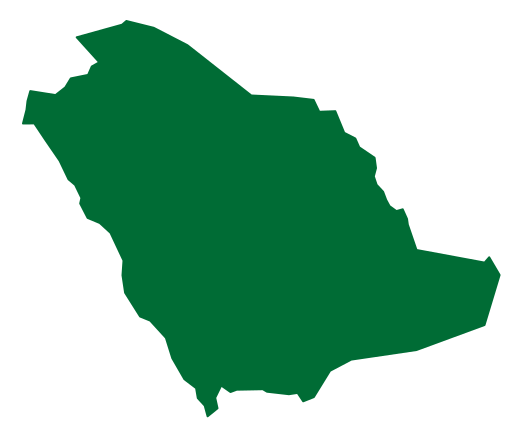
The Battle of Sabilla was a confrontation that took place during the Ikhwan movement in Najd, which spanned the years from 1915 to 1929.[6] Rawdat Sabilla, which carries its name, lies in Zulfi Governorate in the Riyadh Region.[3]
King Abdulaziz bin Abdulrahman Al Saud's success in unifying the parts of the Kingdom and gathering its tribes is attributed to his qualities and leadership abilities, and to the internal and external circumstances that surrounded his course.[2]
Location of the Battle
Rawdat Sabilla lies in Zulfi Governorate in the Riyadh Region; it is a natural meadow covering an area of about 20,000 hectares and is rich in natural plant diversity.[3]
The Governor of the Riyadh Region, His Royal Highness Prince Faisal bin Bandar bin Abdulaziz, visited Rawdat Sabilla during an inspection tour of Zulfi Governorate on 5 Sha'ban 1445 AH, corresponding to 15 February 2024, and the visit included the inauguration of a number of development projects.[4]
The Ikhwan and the Hijrah Settlements
King Abdulaziz began the project of settling the Bedouin in stable agricultural hijrah settlements, and by the year 1920 most of the Bedouin had abandoned their nomadic life and settled in the hijrahs.[5]
One result of this project was that effective authority over the tribes passed from their sheikhs to the central government in Riyadh, and religious awareness spread among the settled.[5] These hijrahs formed what is known as the Ikhwan hijrahs in Najd; in the Al-Mahmal area the oldest hijrah was founded in 1915, and five hijrahs appeared between 1915 and 1929.[6]
King Abdulaziz chose Sheikh Abdullah bin Hassan Al Sheikh and sent him to the Artawiyah hijrah, a large settlement inhabited by more than twenty thousand mujahideen and headed by Faisal bin Sultan Al-Duwish, sheikh of the Mutair tribes.[7]
Britain's Position
Britain met the extension of Sultan Abdulaziz's authority to Al-Jawf and Al-Qurayyat with a firm stance, seeking to protect its imperial interests, its mandates, and its allies from attacks by the Sultan's Ikhwan followers.[8]
The Treaty of Hadda stipulated the subjection of Al-Jawf and Al-Qurayyat to the Sultan and the attachment of the northern Wadi Sirhan, Ma'an, and Aqaba to the Emirate of Transjordan, in the years from 1340 to 1344 AH, corresponding to the period from 1921 to 1925.[8]
After the Battle
After the events, efforts to counsel the Ikhwan and the general public followed in succession on the part of scholars, and Sheikh Abdullah bin Sulaiman bin Bulaihid had efforts in that regard; he also represented King Abdulaziz and headed the Saudi delegation at the First Islamic Conference held in Makkah in 1344 AH, corresponding to 1926.[9]
King Abdulaziz transformed the tent-dwellers into settled inhabitants of hijrahs and linked the vast parts of the Kingdom with wireless networks and paved roads.[10]
In 1351 AH, corresponding to 1932, Royal Order No. (2716) was issued, changing the name "the Kingdom of Hejaz and Najd and its Dependencies" to "the Kingdom of Saudi Arabia" and designating Thursday 21 Jumada al-Awwal 1351 AH as the national day for the declaration of the Kingdom's unification.[1]
Frequently Asked Questions
Q: During what period did the Battle of Sabilla take place? A: It took place during the Ikhwan movement in Najd, which spanned the years from 1915 to 1929.[6]
Q: Where does Rawdat Sabilla lie? A: In Zulfi Governorate in the Riyadh Region; it is a natural meadow covering an area of about 20,000 hectares.[3]
Q: What is the Artawiyah hijrah and who heads it? A: A large settlement inhabited by more than twenty thousand mujahideen and headed by Faisal bin Sultan Al-Duwish, sheikh of the Mutair tribes.[7]
Q: What was Britain's position toward the extension of Sultan Abdulaziz's authority? A: It took a firm stance to protect its imperial interests, and the Treaty of Hadda stipulated the subjection of Al-Jawf and Al-Qurayyat to the Sultan.[8]
Q: What followed the Battle of Sabilla? A: Efforts to counsel the Ikhwan and the general public, then the declaration of the unification of the Kingdom of Saudi Arabia by Royal Order No. (2716) in 1351 AH, corresponding to 1932.[1][9]
Related people
Related topics
- EventThe Ikhwan Hijras of NajdThe Ikhwan Hijras of Najd are settled agricultural residential units established in Najd as part of the project to settle the Bedouin of the Arabian Peninsula during the era of King Abdulaziz bin Abdulrahman Al Saud (1330–1373 AH/1912–1953 CE). One hundred and seventy-two hijras were established during his era, and through them effective authority over the tribes passed to the central government in Riyadh.
- EventUnification of Saudi ArabiaKing Abdulaziz's path from the recovery of Riyadh in 1902 to the proclamation of the Kingdom of Saudi Arabia on 23 September 1932, now National Day.
- RegionRiyadh RegionA central Saudi administrative region encompassing the national capital and varied Najdi governorates, with connections to Diriyah, oasis settlement, government and modern economic activity.
- RegionEastern ProvinceA large eastern Saudi region administered from Dammam, combining Gulf cities, the oases of Al Ahsa and Qatif, desert areas, energy industries and maritime commerce.
Sources & references
- King Abdulaziz Foundation — Al-Darah Journal (Royal Order 2716 and the unification of the Kingdom in 1351 AH)
- King Abdulaziz Foundation — Al-Darah Journal (factors behind King Abdulaziz's success in unification)
- Saudi Press Agency (SPA) — Rawdat Sabilla in Zulfi
- Saudi Press Agency (SPA) — the visit of the Governor of the Riyadh Region to Rawdat Sabilla
- King Abdulaziz Foundation — Al-Darah Journal (settlement of the Bedouin and the hijrahs)
- King Abdulaziz Foundation — Al-Darah Journal (the hijrahs of the Al-Mahmal area, 1915-1929)
- King Abdulaziz Foundation — Al-Darah Journal (the Artawiyah hijrah and Al-Duwish)
- King Abdulaziz Foundation — Al-Darah Journal (the British position and the Treaty of Hadda)
- King Abdulaziz Foundation — Al-Darah Journal (Sheikh Abdullah bin Sulaiman bin Bulaihid)
- King Abdulaziz Foundation — Al-Darah Journal (turning the people of tents into hijrah inhabitants and linking the Kingdom)