
Overview
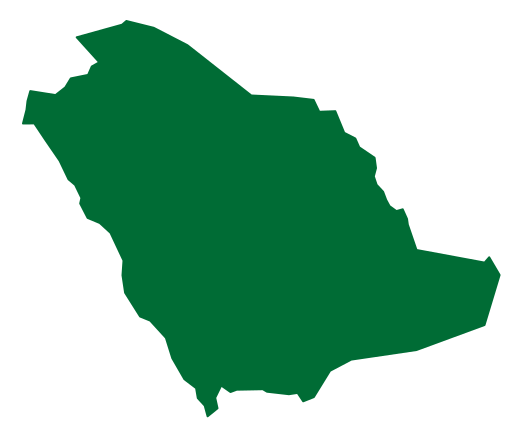
The Battle of Turabah was a confrontation that took place around the town of Turabah in the southwest of the Kingdom of Saudi Arabia. The town belongs to the Makkah Region and lies about 150 kilometres southeast of Taif, among the highlands of Najd.[1]
The confrontation came at a stage when relations between Najd and Hejaz were marked by tension between King Abdulaziz bin Abdulrahman Al Saud and Sharif Hussein bin Ali, and a British mission was sent to reconcile the two in 1338 AH/1920.[7]
Location of Turabah and Its Valley
Wadi Turabah, one of the largest and most extensive valleys of the region, rises in the Sarawat Mountains and runs eastward until it meets Wadi Kara 12 kilometres north of the town of Turabah. At the lower end of the valley, alongside the town, lie agricultural remains, most notably ordinary wells and some inscriptions.[4]
Turabah's geographical position gave it commercial and strategic importance, for the town has stood on the trade caravan routes and, later, the pilgrimage routes since before Islam and after it, and it became known for the crop trade, foremost among them dates, along with its markets and agricultural settlements.[1] Palm growing is the main crop along the sides of the valley, sustained by abundant water and fertile soil; the palms number more than two million, and more than ten centres and Turabah General Hospital are attached to the town.[1]
Natural and Archaeological Landmarks of Turabah
The area around Turabah brings together a varied natural and archaeological heritage. Wadi Turabah Al-Buqum is among the most prominent natural and historical landmarks of the governorate, Harrat Al-Buqum, one of the most striking geological phenomena in the region, lies at its centre, and the valley holds rock inscriptions, archaeological sites and old forts.[2]
Among its best-known landmarks is Jabal Hadhn, a towering black mountain range from which the valleys of Al-Ray', Al-Sahubiyah and Al-Ayinah descend. South of the governorate lies Harrat Al-Buqum, formerly known as Harrat Nawasib, and among its best-known valleys is Wadi Kara.[3]
The Old Grand Palace is an archaeological site on the summit of a hill north of Turabah, built by Hamad bin Abdullah bin Muhi Al-Buqami in 1212 AH. It consists of 43 rooms and contains a mosque and a large courtyard with a horse stable and provision stores, and it is surrounded by a high wall with an eastern gate.[4]
Political Context of the Battle
On the eve of the First World War, Sharif Hussein in Hejaz was subject to the Ottoman State, which doubted his loyalty to it, while the Emirate of Hail in Jabal Shammar was bound by loyalty to the Ottomans.[8]
Under the Treaty of Al-Uqair, concluded during the First World War, Britain recognised Abdulaziz as Emir of Najd and Al-Ahsa and undertook to provide him with financial and military assistance, on condition that he not contact any other state or conclude treaties without its consent.[6]
The documents of the Saudi State held in the India Office in London preserve a large part of the events of 1902–1931, while the correspondence and reports of the British consulate in Jeddah record information on the relationship between Najd and Hejaz and Al Rashid, the Turks and Britain.[10]
Outcomes of the Battle and the Path of Unification
After the confrontation, differences between King Abdulaziz and Sharif Hussein deepened as a result of the restrictions the Sharif placed on the arrival of Najdi pilgrims for the Hajj, so a British mission came to Najd and Hejaz in an attempt to ease the tension between them, and talks were held between the two sides in Riyadh and then in Makkah on a journey in 1338 AH/1920.[7]
In 1343 AH the port of Al-Qunfudhah was restored to calm and stability after its liberation from the control of the garrison of Sharif Hussein bin Ali, by the Saudi army led by Abdulwahab bin Mohammed Abu Malha together with Omar Al-Askar.[9] Sharif Khalid bin Lu'ay, a Saudi commander from Taif, led the reinforcements that set out from Taif, and his son Saad took over the command after him; the force performed well at the Battle of Al-Madaya in 1350 AH.[9]
Documentary works record the injury to the left eye of King Abdulaziz and his long course of treatment during the battles of the recovery of the state within the path of unification of the Kingdom of Saudi Arabia.[5] The condition of the Treaty of Al-Uqair was cancelled in the Treaty of Jeddah of 1927, in which Britain recognised Abdulaziz as King of Hejaz and Najd and his right to conclude treaties with other states.[6]
Related people
Frequently Asked Questions
Q: Where did the Battle of Turabah take place? A: Around the town of Turabah in the southwest of the Kingdom of Saudi Arabia, which belongs to the Makkah Region, lies about 150 kilometres southeast of Taif, and is among the highlands of Najd.
Q: What gave Turabah its strategic importance? A: Its position on the trade and pilgrimage caravan routes since before Islam and after it, and its renown for the crop trade, foremost among them dates, along with its markets and agricultural settlements.
Q: What are the most prominent natural and archaeological landmarks of Turabah? A: Wadi Turabah Al-Buqum, Harrat Al-Buqum, Jabal Hadhn and Wadi Kara, the rock inscriptions and old forts, and the Old Grand Palace, which was built in 1212 AH.
Q: How were relations between Najd and Hejaz at this stage? A: They were marked by tension between King Abdulaziz and Sharif Hussein, on account of which a British mission of reconciliation was sent in 1338 AH/1920; then the port of Al-Qunfudhah was restored to stability in 1343 AH, and the condition of the Treaty of Al-Uqair was cancelled by the Treaty of Jeddah in 1927.
Q: What accompanied the phase of unification after the confrontation? A: The liberation of the port of Al-Qunfudhah from the garrison of Sharif Hussein in 1343 AH, and Britain's recognition of Abdulaziz as King of Hejaz and Najd by the Treaty of Jeddah in 1927.
Tourism and nature
Related topics
- EventUnification of Saudi ArabiaKing Abdulaziz's path from the recovery of Riyadh in 1902 to the proclamation of the Kingdom of Saudi Arabia on 23 September 1932, now National Day.
- EventTreaty of Al-UqairThe Treaty of Al-Uqair is a treaty signed on 18 Safar 1334 AH, corresponding to 26 December 1915, between King Abdulaziz bin Abdulrahman Al Saud and the British Government represented by Sir Percy Cox, at Al-Uqair Port in Al-Ahsa Governorate. In it Britain recognized Abdulaziz as Emir of Najd and Al-Ahsa, and it was later annulled under the Treaty of Jeddah of 1927.
- EventTreaty of Jeddah (1927)The Treaty of Jeddah is an agreement signed in 1927 between King Abdulaziz bin Abdulrahman Al Saud and Britain. In it Britain recognized Abdulaziz as King of the Hijaz and Najd, affirmed his right to conclude treaties with other states, and brought the Treaty of Darin to an end.
- RegionMakkah RegionA western Saudi region administered from Makkah, encompassing Jeddah, Taif and other governorates, where pilgrimage, maritime trade, coastal landscapes and uplands meet.
- RegionHail RegionA north-central Saudi region administered from Hail, associated with the Aja and Salma mountains, the Nafud desert, historical caravan routes and varied regional activities.
Sources & references
- Saudi Press Agency (SPA) — Turabah Governorate: location, climate, palms and centres
- Saudi Press Agency (SPA) — Wadi Turabah Al-Buqum and Harrat Al-Buqum
- Saudi Press Agency (SPA) — Jabal Hadhn, Harrat Al-Buqum and Wadi Kara
- Saudi Press Agency (SPA) — Wadi Turabah and the Old Grand Palace
- Saudi Press Agency (SPA) — documentary on the left eye of King Abdulaziz
- King Abdulaziz Foundation — Al-Darah Journal (Treaty of Al-Uqair 1915 and Treaty of Jeddah 1927)
- King Abdulaziz Foundation — Al-Darah Journal (British mission of reconciliation between Najd and Hejaz 1338 AH/1920)
- King Abdulaziz Foundation — Al-Darah Journal (subjection of Sharif Hussein and the Emirate of Hail to the Ottomans on the eve of the First World War)
- King Abdulaziz Foundation — Al-Darah Journal (Sharif Khalid bin Lu'ay and the liberation of Al-Qunfudhah 1343 AH)
- King Abdulaziz Foundation — Al-Darah Journal (documents of the Saudi State in the India Office and the Public Record Office)