
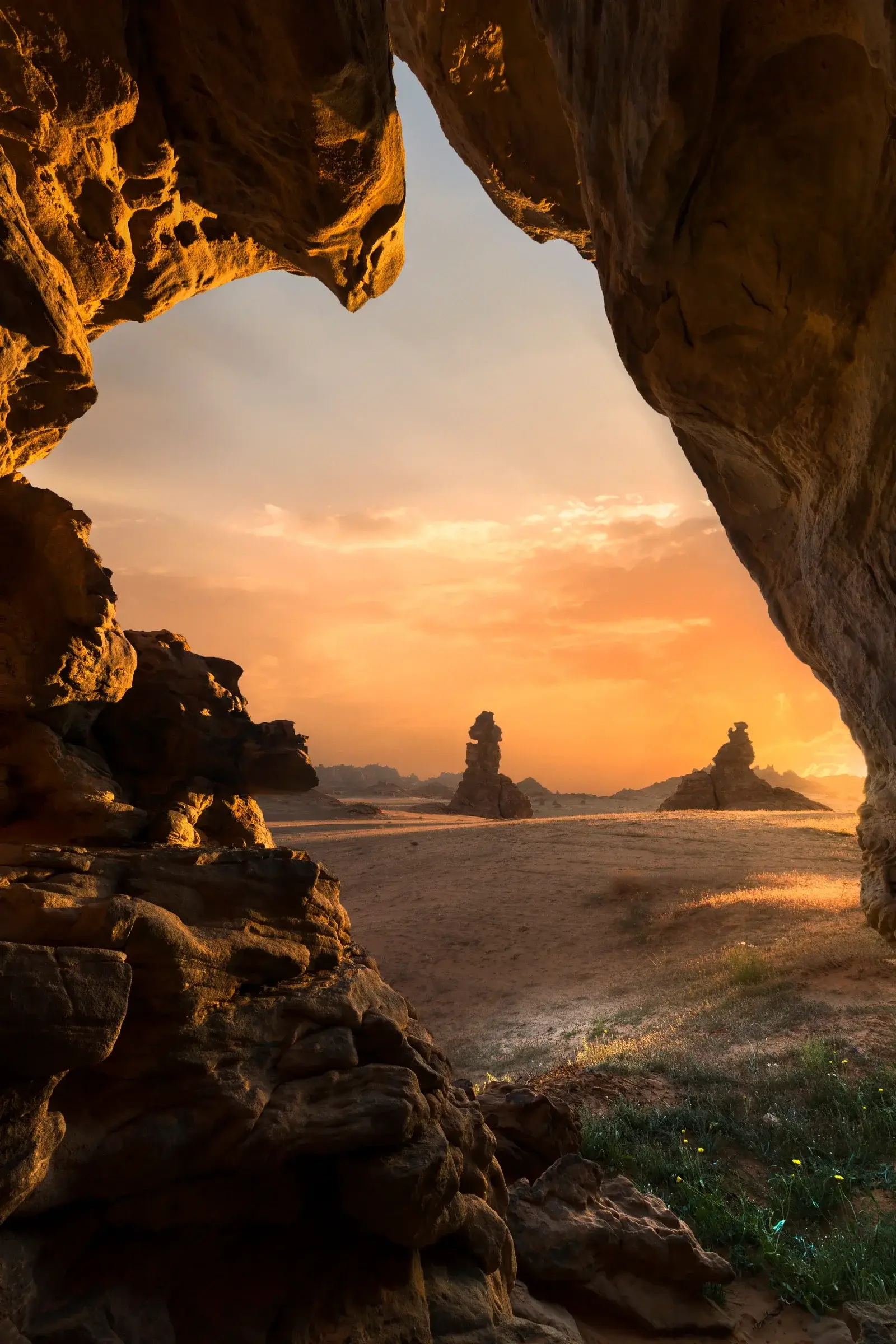

Overview
Hail lies in the centre of the Kingdom's northern half, surrounded by Al-Jawf, the Northern Borders, Tabuk, Madinah and Al-Qassim. It is the seventh largest region, about 120,000 km², and shares its name with its capital. [1]
Administration
The region has eight governorates besides the city of Hail and 109 centres. The governorates are Baqaa, Al-Hait, Al-Ghazalah, Ash-Shinan, As-Sulaimi, Samira, Ash-Shamli and Mawqaq. [1]
Geography and climate
The land divides between the Nafud desert in the north and the Shammar mountains in the centre, which branch into the Aja and Salma ranges; Hail city sits on the eastern flanks of Aja. The climate is continental, hot by day in summer and cold in winter, and spring is the best season to visit. [1]
History
The area's history runs from the Stone Age to the Islamic era. It was a station on the Kufa pilgrimage road and trade routes and is associated with Hatim al-Tai, famed for his generosity, whose palace remains lie in the Aja mountains. [1]
World Heritage sites
In 1436 AH/2015 CE the rock-art sites of Jubbah and of Rata and Al-Manjur were inscribed on the UNESCO World Heritage List, following the French traveller Charles Huber's publication of inscriptions from the area in 1884. [1]
Events and services
Since 1427 AH/2006 CE the region has hosted the Hail International Rally, the 'Great Nafud Challenge'. It is home to the University of Hail, founded in 1426 AH/2005 CE, and Hail International Airport. [1]
Tourism and nature
- NatureDahna DesertThe Kingdom's third-largest desert, an arc of red sand about 1,200 km long linking the Great Nafud to the Rub al Khali across five regions.
- NatureWadi Al-RumahThe Kingdom's longest seasonal watercourse, about 510 km, rising in the Khaybar lava field and crossing seven governorates of Hail and Al-Qassim to the Thuwayrat sands.
Related topics
- HistoricDarb ZubaydahThe Kufa pilgrimage road linking Iraq to Makkah through five Saudi regions, used since before Islam and named after the spring dug by Zubaydah bint Ja'far.
- EventUnification of Saudi ArabiaKing Abdulaziz's path from the recovery of Riyadh in 1902 to the proclamation of the Kingdom of Saudi Arabia on 23 September 1932, now National Day.
- HistoricRock Art of HailThe Rock Art of Hail is a World Heritage property in the Hail Region of Saudi Arabia, inscribed on the UNESCO list in 2015, comprising the largest rock art complexes in the Arabian Peninsula with engravings spanning about 10,000 years.
- HistoricThe Great Nafud DesertThe Great Nafud Desert is a vast sand sea in the north of the Kingdom of Saudi Arabia, covering about 65,000 km², or nearly 3.2% of the Kingdom's land area, with wide parts lying within the Imam Turki bin Abdullah Royal Reserve. It contains a diversity of dune forms and notable landmarks such as Jabal Al-Ulaym and Nafud Al-Ashyakh.
- HistoricKing Salman bin Abdulaziz Royal Nature ReserveKing Salman bin Abdulaziz Royal Nature Reserve is a royal nature reserve in the northwest of the Kingdom of Saudi Arabia and the largest reserve in the Middle East, with a total area of 130,700 square kilometres extending across four administrative regions. It contains broad biodiversity and rock art sites inscribed on the UNESCO World Heritage List.
- EventThe Capture of RiyadhThe Capture of Riyadh was King Abdulaziz bin Abdulrahman Al Saud's recovery of the city of Riyadh and his entry into it with his men on 5 Shawwal 1319 AH, corresponding to 16 January 1902, together with his pledge of allegiance as Emir there. It was followed by the unification of Najd, the capture of Al-Ahsa, and his official recognition as ruler of Najd, Qassim, and Al-Ahsa.
- HistoricHarrat Al-Harrah ReserveHarrat Al-Harrah Reserve is a high-conservation natural area in northwestern Saudi Arabia, extending across the Northern Borders and Al-Jawf regions within the boundaries of the King Salman bin Abdulaziz Royal Reserve. It features a volcanic plateau and plant and wildlife diversity, and is the first reserve established by the Saudi Wildlife Authority.
- EventBattle of Rawdat MuhannaThe Battle of Rawdat Muhanna was fought at Rawdat Muhanna in the Qassim region between the forces of King Abdulaziz bin Abdulrahman Al Saud and the forces of the Emirate of Al Rashid. It was followed by King Abdulaziz's consolidation of his authority over Qassim, the official Ottoman recognition of him as King over Najd, Qassim and Al-Ahsa, and the subsequent unification of the Kingdom of Saudi Arabia.
- EventBattle of TurabahThe Battle of Turabah was a confrontation that took place around the town of Turabah in the southwest of the Kingdom of Saudi Arabia, a town belonging to the Makkah Region and holding a strategic position on the trade and pilgrimage caravan routes between Najd and Hejaz. The battle came at a stage in which relations between Najd and Hejaz were marked by tension between King Abdulaziz bin Abdulrahman Al Saud and Sharif Hussein bin Ali.
- EventBattle of KanzanThe Battle of Kanzan was an engagement fought in the vicinity of Al-Ahsa in the Eastern Province during the unification of the Kingdom of Saudi Arabia, part of King Abdulaziz bin Abdulrahman Al Saud's response to the tribes that attacked trade and pilgrim caravans in eastern Arabia. It came after the capture of Riyadh in 1902 and the annexation of Al-Ahsa to the Saudi State in 1913, and was followed by his confrontation of the rumours spread about his death after his meeting with the Ajman warriors.
- HistoricAja and Salma MountainsThe Aja and Salma mountains are two mountain ranges in the Hail Region and among its most famous natural and heritage landmarks, forming a destination for environmental and mountain tourism and for archaeological sites that include the palace of Hatim al-Ta'i and Darb Zubaydah [1].
- EventBattle of SarifThe Battle of Sarif was the first attempt by King Abdulaziz bin Abdulrahman Al Saud to recover Riyadh in 1318 AH / 1901 CE, and men of Al Saud and the people of Riyadh took part in it. It followed the departure of the Al Saud family from Riyadh with Imam Abdulrahman bin Faisal in 1308 AH / 1890 CE and the taking of Kuwait as a base of departure, and it was followed by the successful attempt in 1319 AH / 1901–1902 CE that led to the recovery of Riyadh.
- EventBattle of Al-BukayriyahThe Battle of Al-Bukayriyah was fought in 1904 between the forces of King Abdulaziz bin Abdulrahman Al Saud on one side and the Ottoman Empire (the Turks) and Al Rashid on the other, within the course of the unification of the Kingdom of Saudi Arabia. The records of the Saudi state are preserved in the India Office in London, covering the events of the period from 1902 to 1931.
- EventBattle of JarrabThe Battle of Jarrab is among the events of the confrontation between Najd and Hail at the outset of World War I, and it was connected with developments in the region, including the military plan of the Ottoman authorities in 1914 and Britain's efforts to make contact with King Abdulaziz; the events of the unification of the Kingdom of Saudi Arabia then continued until the proclamation of the Kingdom in 1351 AH / 1932.
- HistoricSamriSamri is one of the folk arts of the Kingdom of Saudi Arabia, performed to the beating of drums with distinctive dances, and its name goes back to 'Samar'. It is among the most prominent traditional performing arts in the Najd region and its north, and it has a presence in Al-Jawf and Hail and at national festivals and social occasions.
- EventEmirate of Jabal ShammarThe Emirate of Jabal Shammar is an emirate that arose in the Hail region, and it came to govern the region after the Emirate of Al Ali that preceded it. In its last years it was linked to its position towards the Ottoman State during the First World War, and then its era ended with the annexation of Hail to the Saudi State in the reign of King Abdulaziz in 1340 AH.
- HistoricNajdi ArchitectureNajdi Architecture is a Saudi architectural style that expresses the urban identity of the Najd region, and it draws on local construction materials in a design adapted to the desert climate. Its applications continue in modern urban projects, competitions and cultural events inside the Kingdom and abroad.
- RegionHail CityHail City is a Saudi city in Hail region, known as the land of rock art inscribed on the World Heritage List; it contains historical palaces, museums and historical markets, and the Aja mountains.
- HistoricSaudi HoneySaudi honey is the product of apiaries spread across the regions of the Kingdom of Saudi Arabia, and its yield varies between grazing ranges depending on the abundance of blossoms and their flowering periods. It receives official attention in licensing, training, marketing, and the organisation of production seasons and festivals.
- HistoricGhada TreeThe Ghada tree is a desert plant and one of the most famous plants of the deserts of the Kingdom of Saudi Arabia; it reaches a height of 4 metres and its roots extend for tens of metres until they reach water. It spreads from the Rub' al Khali desert in the south to the northern edge of the An-Nafud desert, it stabilises sand dunes, and Al-Ghada Park in Unaizah Governorate holds the largest botanical garden in the world of Ghada trees.