
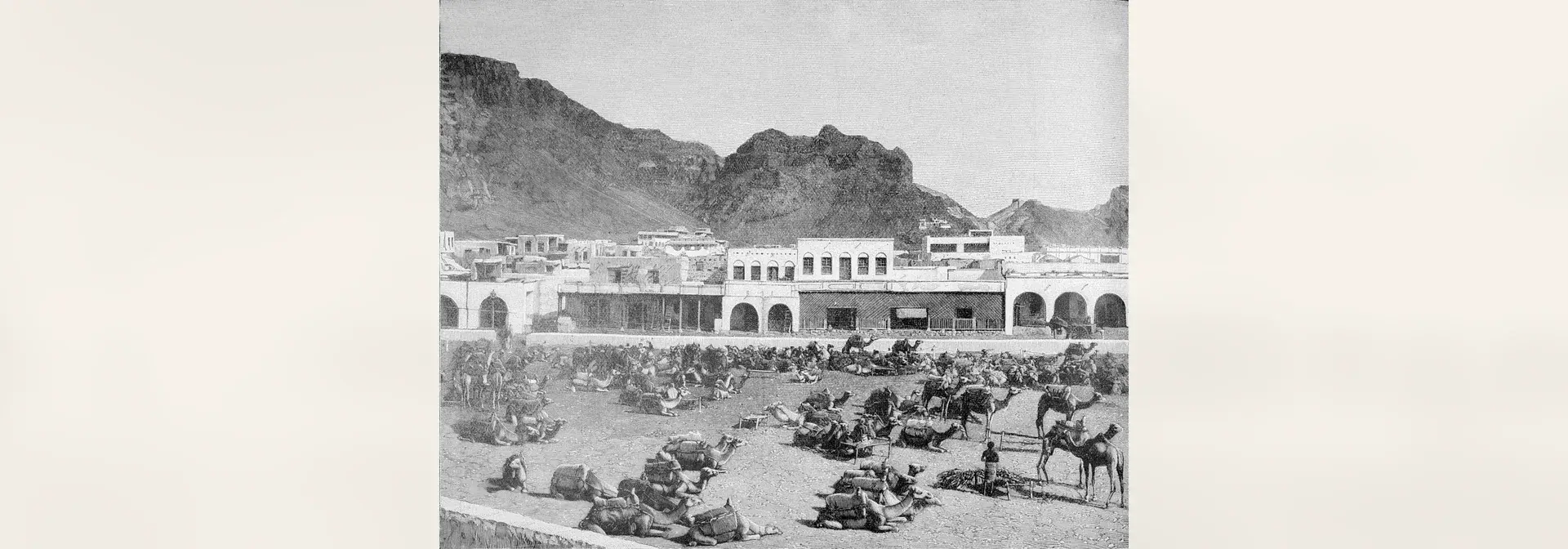
Overview
The history of Jeddah is the history of a city on the eastern shore of the Red Sea, which from the seventh century CE became a major port on Indian Ocean trade routes, carrying goods through it to Makkah.[1]
Historic Jeddah holds more than 650 heritage buildings, five historic main markets, historic mosques and one historic school, and was inscribed on the UNESCO World Heritage List in 2014.[2][1]
Location and Commercial Role of Historic Jeddah
Jeddah's historic area stretches across 2.5 square kilometres on the eastern shore of the Red Sea in Makkah Region, and is considered the oldest part of Jeddah.[2]
Its geographical position makes it a meeting point for world trade routes between Asia and Africa and a centre of cultural and economic exchange, and from the seventh century CE it became a major port for pilgrims coming to Makkah.[2]
The Official Port of Makkah
Architectural Style of Historic Jeddah
Tall tower houses decorated with large wooden roshans define the architectural style of Historic Jeddah, among the examples of Hejazi architecture on the Red Sea coast, built by leading merchants in the late nineteenth century CE.[1]
Some of the area's buildings, which are owned by Jeddah families, contain archaeological features more than 500 years old.[3]
Inscription on the World Heritage List
Historic Jeddah was inscribed on the UNESCO World Heritage List in 2014 under criteria (ii)(iv)(vi), with a property area of 17.92 hectares and a buffer zone of 113.58 hectares.[1]
In 2024 the Historic Jeddah Program of the Ministry of Culture marked ten years since the inscription, within its efforts to revive the area, preserve its cultural and urban legacy and turn it into a world heritage destination in line with Saudi Vision 2030.[2]
The Revival of Historic Jeddah Project
In 2021, His Royal Highness the Crown Prince and Prime Minister, Prince Mohammed bin Salman bin Abdulaziz, announced the launch of the "Revival of Historic Jeddah" project, which aims to develop the living environment of the area so that it becomes an attractive centre for business and cultural projects and a leading destination for entrepreneurs.[3]
Supporting and Rescuing Heritage Buildings
On 18 Ramadan 1445 AH, corresponding to 28 March 2024, the Ministry of Culture, represented by the Historic Jeddah Program, announced the completion of work in a project to support and rescue 56 buildings threatened with collapse in Historic Jeddah, which carry rich architectural and heritage elements.[3]
The project drew support of SAR 50 million from the private expenditure of His Royal Highness the Crown Prince.[3]
Archaeological Studies at the Uthman ibn Affan Mosque
Archaeological studies at the Uthman ibn Affan Mosque in Historic Jeddah uncovered hundreds of remains of archaeological material, some of which date back about 1,200 years.[4]
The mihrab of the mosque and its floor area have remained as they are for more than a thousand years, and the building in its present form was established in the fourteenth century AH, that is, the late twentieth century CE, with successive restoration work belonging to the traditional architectural style.[4]
The Red Sea Museum
The Old Waterfront
Jeddah's old waterfront served as a main route for pilgrims, and it will be rebuilt to tell visitors to the area the story of the Hajj since the dawn of Islam.[3]
Extension of the Historic Jeddah Project Program
At its session held in Jeddah on 14 April 2026, the Council of Ministers approved a two-year extension of the term of the Historic Jeddah project program.[6]
Frequently Asked Questions
Q: Where is Historic Jeddah located? A: On the eastern shore of the Red Sea, stretching across 2.5 square kilometres.[1][2]
Q: When did Jeddah become a port for Makkah? A: In the seventh century CE, when Caliph Uthman ibn Affan made it the official port of Makkah.[1]
Q: When was Historic Jeddah inscribed on the World Heritage List? A: In 2014, under criteria (ii)(iv)(vi).[1]
Q: What are the most prominent features of the architectural style in Historic Jeddah? A: Tall tower houses decorated with large wooden roshans, built by leading merchants in the late nineteenth century CE.[1]
Q: What is the Revival of Historic Jeddah project? A: A project launched in 2021 to develop the living environment of the area and make it an attractive centre for business and cultural projects.[3]
Conclusion
Related topics
- HistoricHistoric JeddahHistoric Jeddah, or Al-Balad, is an urban core on the Red Sea shaped by maritime trade and pilgrimage, with houses distinguished by projecting wooden windows.
- RegionJeddah CityJeddah City is a Saudi city that is a gateway to the Two Holy Mosques and a station through which cultures have passed. Its history spans more than 1,400 years, and it is home to Historic Jeddah, inscribed on the World Heritage List in 2014, alongside modern development projects, most notably the Jeddah Central Project.
- EventHistory of MakkahThe history of Makkah is a continuous record from the age of Ibrahim, peace be upon him, and the building of the Holy Kaaba to the Saudi era, embracing antiquities, landmarks, scholars, endowments and services for pilgrims. Its events are spread across the Mamluk era and the Ottoman period, then the educational and regulatory renaissance in the Kingdom of Saudi Arabia.
- HistoricHejazi ArchitectureHejazi architecture is a Saudi architectural style associated with the coastal areas on the Red Sea, known for its wooden rawasheen and historic houses. It is included in the Saudi Architecture Map, which comprises 19 architectural styles, and efforts to protect and develop it continue.
- National visions and programmesSaudi Vision 2030: A Framework for TransformationAn introduction to Saudi Vision 2030, its social, economic and institutional themes, and the relationship between implementation programmes, long-term targets and measured results.
- RegionMakkah RegionA western Saudi region administered from Makkah, encompassing Jeddah, Taif and other governorates, where pilgrimage, maritime trade, coastal landscapes and uplands meet.
Sources & references
- UNESCO — World Heritage List, "Historic Jeddah, the Gate to Makkah" (site 1361)
- Umm Al-Qura Official Gazette — "Historic Jeddah Celebrates a Decade Since Its UNESCO Inscription" (SPA), 22 July 2024
- Umm Al-Qura Official Gazette — "Completion of the Support and Rescue Works for 56 Buildings in Historic Jeddah" (SPA), 28 March 2024
- Umm Al-Qura Official Gazette — "Discovery of Architectural Patterns at the Uthman ibn Affan Mosque in Jeddah" (SPA), 3 March 2024
- Umm Al-Qura Official Gazette — "Opening of the Red Sea Museum and Inauguration of the Prince Mohammed bin Salman Global Center for Arabic Calligraphy" (SPA), 26 July 2026
- Umm Al-Qura Official Gazette — "Council of Ministers session held in Jeddah" (SPA), 14 April 2026